
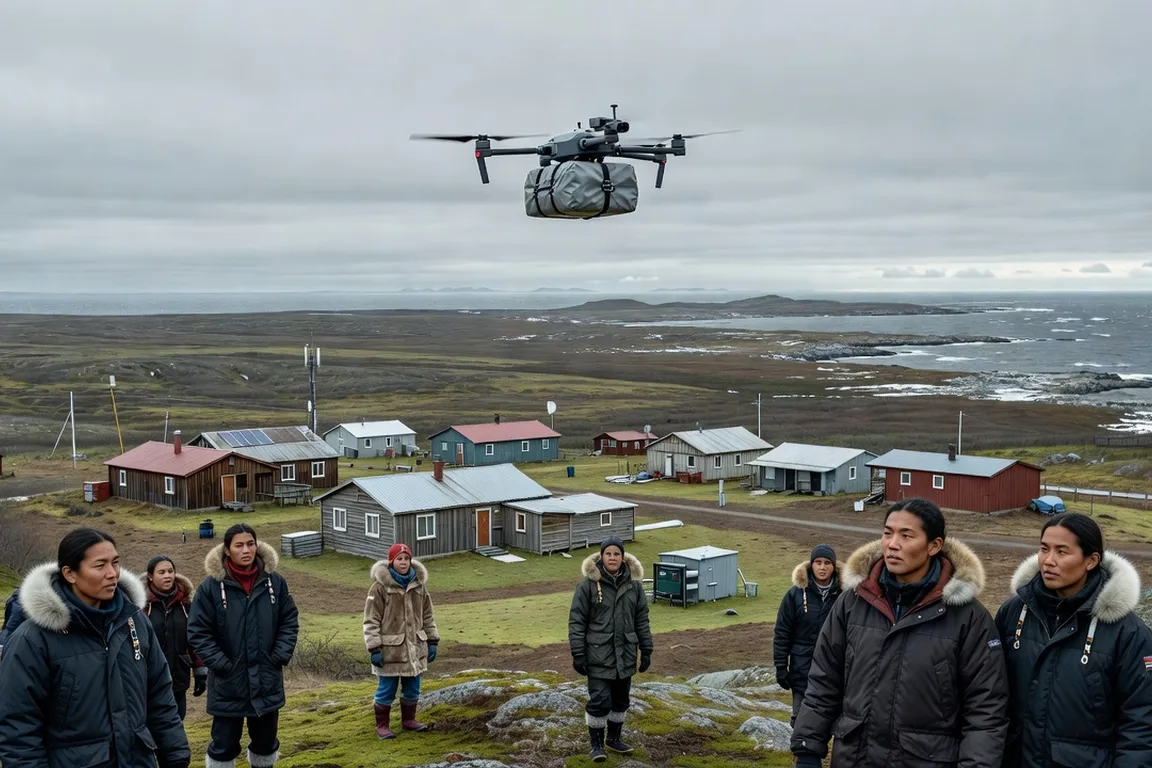
Logistics for Nunavik’s 14 communities has always relied on two modes of transport: air, expensive and weather-dependent, and sea, seasonal and limited to a few months a year. Between these two extremes, a third option is quietly emerging in 2026: the cargo drone, capable of delivering small critical loads without needing a runway or a full crew.
This feature examines where this technology actually stands in the Quebec Arctic context — beyond the hype often surrounding pilot project announcements — and what it can reasonably offer isolated communities in the coming years. For the broader regional logistics challenges, see our feature on Nunavik’s most isolated villages, as well as our overview of Kuujjuaq, Nunavik’s administrative capital, home to several of the region’s most advanced logistics pilot projects.
The logistics question in Northern Quebec goes well beyond the mere transport of everyday goods. It touches directly on communities’ ability to keep essential infrastructure running, ensure continuity of health care, and reduce dependence on long, costly supply chains. It is in this context that cargo drone technology is drawing growing interest, despite its current immaturity.
Interest in drone logistics has also grown alongside the broader digitization of northern infrastructure management, where IT companies and municipal planners increasingly coordinate on projects that combine connectivity, energy resilience, and transport innovation as parts of a single strategic conversation rather than separate silos.
The historic logistics challenge of isolated Nunavik communities
None of Nunavik’s 14 villages are connected by road to southern Quebec’s road network. Freight transport relies on two distinct logistical windows: the navigation season, from July to mid-October, during which the Nunavik and the Mitiq ship the bulk of annual freight (construction materials, vehicles, heavy equipment), and air transport, available year-round but at a much higher cost than sea freight, reserved for urgent or perishable goods.
This structure demands rigorous logistical planning: whatever isn’t ordered in time for the summer ship must either wait until the following year or be flown in at a cost often disproportionate to the value of the goods themselves. For medication, critical spare parts and health equipment, this constraint can have direct consequences on the quality of services offered to the population.
Limits of traditional air transport in bad weather
Arctic weather conditions — snowstorms, freezing fog, violent winds — regularly interrupt scheduled air links, sometimes for several consecutive days. Air Inuit, the main carrier serving the region, maintains a remarkably reliable service given the conditions, but remains subject to the same physical constraints as any crewed aircraft: a cleared runway, minimum visibility, and wind conditions compatible with a safe landing.
Key takeaway: a multi-day interruption of scheduled air service is not an exceptional event in Nunavik — it’s a normal seasonal occurrence that can critically delay an urgent medical delivery if no alternative exists.
These interruptions have cascading effects that go beyond a simple delivery delay. An order for equipment to repair a failed electrical generator can be delayed several more days if a storm grounds flights, extending an already critical situation for the affected community. It is precisely in this type of scenario that the potential of cargo drones, able to fly in weather conditions slightly more forgiving than some larger aircraft, is drawing the attention of regional logistics planners. Connected weather stations improving delivery safety are increasingly used to anticipate favorable flight windows for these cargo drones before a storm fully sets in.
Cargo drone pilot projects underway in Canada and elsewhere in the Arctic
Several initiatives, still at the pilot stage in 2026, are exploring the potential of cargo drones in Arctic or subarctic environments comparable to Nunavik. These projects, run in partnership between specialized companies, regional health organizations and research institutions, are mainly testing:
- Delivery of medical supplies between a main health center and secondary service points a few dozen kilometers away.
- Transport of critical spare parts for essential infrastructure (electrical generators, water treatment systems).
- Demonstration flights in extreme winter conditions to validate the resilience of propulsion and navigation systems in the cold.
Comparable experiments conducted in Greenland, Alaska and the Canadian North are building a growing body of real-world data on the reliability of this technology in Arctic environments, beyond laboratory testing.
Range, payload and extreme cold resistance
Extreme cold is the main technical constraint for cargo drones intended for the Arctic. Lithium-ion batteries, the most common propulsion technology for commercial drones, lose a significant share of their effective capacity below -20°C, reducing actual flight range compared to specifications quoted for temperate conditions.
| Parameter | Temperate conditions | Arctic conditions (below -20°C) |
|---|---|---|
| Flight range (fixed-wing drone) | 300-400 km | 100-250 km |
| Typical payload | 5-25 kg | 3-18 kg (reduced to offset battery weight) |
| Ground preparation time | 10-15 min | 25-45 min (de-icing, battery preheating) |
| GPS navigation reliability | Standard | Standard, but sensitive to Arctic ionospheric interference |
The most promising models for Arctic use often combine hybrid gas-electric propulsion, which extends range beyond what batteries alone allow, at the cost of increased mechanical complexity and maintenance.
Transport Canada’s regulatory framework for long-range drones
The main obstacle to large-scale drone logistics deployment in the Arctic is not technical but regulatory. Transport Canada regulates Beyond Visual Line of Sight (BVLOS) operations under a demanding authorization regime that requires:
- A detailed risk assessment for each proposed flight corridor.
- A detect-and-avoid system for other aircraft, particularly important in areas where crewed regular flights also operate.
- Authorizations often granted on a case-by-case basis rather than as reusable general permits.
- Specific training and certification requirements for operators.
This still actively evolving framework legitimately aims to guarantee the safety of shared airspace, but it considerably slows the transition from pilot projects to routine commercial operation.
Tip: organizations considering integrating logistics drones into medium-term planning should closely follow the evolution of Transport Canada’s BVLOS regulatory framework rather than relying solely on technical capabilities announced by manufacturers, which are often ahead of what regulations currently allow.
Priority use cases: medication, spare parts, mail
Use cases identified as priorities by Nunavik’s health organizations and municipalities share a common feature: high value relative to weight, combined with sensitivity to delivery delay.
- Urgent medication and medical supplies: insulin, cold-chain vaccines, diagnostic kits, emergency medication out of local stock.
- Critical spare parts: components for electrical generators, drinking water treatment systems, telecommunications equipment whose failure immediately affects an entire community.
- Priority mail and documents: urgent administrative documents, medical samples to be sent for analysis to a southern laboratory.
Bulk freight, everyday consumer goods and construction materials will remain, for the foreseeable future, in the domain of traditional air or seasonal sea transport, as current drones’ carrying capacity is structurally incompatible with these volumes.
Compared costs: drone vs chartered flight vs snowmobile
| Transport mode | Approximate cost (urgent, short-distance delivery) | Typical delay | Weather sensitivity |
|---|---|---|---|
| Dedicated chartered flight | $3,000 - $15,000 | A few hours if weather permits | High |
| Cargo drone (future use) | $200 - $800 (estimated operating cost) | 30 min - 2h depending on distance | Moderate (better tolerance of some conditions) |
| Snowmobile / all-terrain vehicle | $100 - $500 | Several hours depending on distance and terrain | High in winter, variable |
| Regular Air Inuit flight (if slot available) | Included in regular service | Per schedule, sometimes several days’ wait | High |
This table remains indicative: drone operating costs are not yet stabilized at commercial scale in Nunavik in 2026, absent large-scale deployment that would allow ground infrastructure costs to be amortized over a sufficient volume of deliveries.
Technical obstacles still unresolved
Beyond regulation, several technical challenges still limit large-scale deployment:
- Navigation in bad weather remains a challenge: current drones tolerate violent winds and icing less well than larger crewed aircraft.
- Ground infrastructure (charging stations, heated hangars, trained technical staff) must be replicated in each community served, representing a significant investment for a still-modest delivery volume.
- Cold-weather maintenance requires rare specialized expertise, echoing the same technical-labor scarcity problem seen in other northern IT sectors.
- Limited range confines practical flight corridors to relatively short distances between neighboring communities, currently excluding long-distance links to southern Quebec.
The role of local IT companies in deployment
Any eventual deployment of a logistics drone fleet in Nunavik will require local technical skills for first-line maintenance, management of navigation and communication systems, and integration with the existing IT infrastructure of health centers and municipalities. This convergence between logistics and digital infrastructure connects to the broader connectivity and local technical capacity issues documented in our northern IT deployment story.
IT companies already present in the region, accustomed to the logistical and climate constraints specific to Nunavik, are naturally positioned to support this transition if it materializes at greater scale in the coming years. For additional resources on logistics and travel in Canada’s northern regions, Voyage Canada regularly publishes analysis on travel challenges in remote territory.
Training the next generation of northern drone technicians
A recurring theme across every pilot project reviewed for this feature is the shortage of technicians qualified to maintain and operate cargo drones in extreme cold. Unlike consumer drones, cargo models intended for Arctic logistics require technicians trained in cold-weather battery management, airframe de-icing procedures, and troubleshooting avionics that behave differently at -30°C than in a manufacturer’s temperate test facility.
Building this workforce locally, rather than flying in specialists from the south for every maintenance cycle, would meaningfully improve both the cost structure and the resilience of any future drone logistics network. Northern IT companies already active in server deployment and network maintenance are natural candidates to expand into this adjacent skill set, provided training programs and certification pathways become available within the region rather than requiring lengthy stays in southern Canada.
Outlook for the next decade of northern logistics
The most likely evolution over the next decade is not a replacement of traditional air and sea transport by drones, but targeted complementarity: drones handling urgent, low-volume deliveries between nearby communities, while regular flights and seasonal marine transport continue to carry the bulk of logistics volume.
The evolution of Transport Canada’s regulatory framework, the maturation of cold-resistant battery technologies, and the gradual decline in cargo drone acquisition costs will be the three determining factors in the actual speed of adoption of this technology in the Quebec Arctic.
Comparable experiences elsewhere in the circumpolar Arctic
Nunavik is not the only Arctic region exploring the potential of cargo drones. In Greenland, several pilot projects have tested delivering medical supplies between small coastal communities separated by fjords difficult to reach overland, in a climatic and geographic context bearing notable similarities to Nunavik. In Alaska, trials conducted in partnership with American universities have focused on the resilience of batteries and electronic systems to extreme temperatures comparable to those of Northern Quebec.
These comparable experiences offer valuable lessons, notably on failure rates observed under real-world conditions (significantly higher than in temperate environments during the first years of deployment), on preventive maintenance protocols that reduce these failure rates, and on hybrid funding models combining public investment with private-sector partnerships. Canada, through federal research programs and university collaborations, participates in this circumpolar knowledge exchange, which accelerates collective learning without every region having to repeat the same initial mistakes.
What communities actually expect from this technology
Consultations with several Nunavik municipalities and cooperatives reveal measured expectations rather than unbridled enthusiasm for cargo drones. Local stakeholders interviewed as part of pilot projects generally express three priorities: reliability over speed, ease of use for local staff without aviation-specific training, and integration that does not displace existing jobs in the regional air transport sector, an important employer for several communities.
This last concern deserves to be taken seriously in the design of any large-scale deployment project. Air Inuit and other regional carriers employ a significant number of Nunavik residents, and poorly designed automation of air logistics could have economic and social consequences that go beyond the purely technical delivery challenge.
Environmental considerations of drone logistics
Proponents of drone cargo logistics frequently cite environmental benefits compared to chartered flights, given the smaller fuel footprint of an electric or hybrid drone relative to a full-size aircraft. This argument holds for genuinely small, urgent payloads that would otherwise require a dedicated charter flight, but it weakens considerably once the comparison shifts to regularly scheduled flights that already combine multiple deliveries and passengers into a single trip. A realistic environmental assessment of drone logistics in Nunavik would need to account for the full lifecycle cost of battery production and disposal in a region without local recycling infrastructure, a factor rarely mentioned in vendor marketing materials but relevant to any honest accounting of the technology’s net impact.
Insurance, liability and risk management
Commercial deployment of cargo drones in Arctic airspace also raises insurance and liability questions that remain imperfectly resolved. An incident involving a cargo drone — a crash in an inhabited area, a collision with a crewed aircraft, damage to ground infrastructure — triggers a chain of liability potentially involving the drone operator, the manufacturer, the organization that ordered the delivery, and in some cases the authority that granted the flight permit.
Insurers specializing in aviation are beginning to develop products adapted to this type of operation, but premiums remain high in the absence of a sufficient claims history to establish reliable actuarial pricing. This insurance uncertainty represents an additional obstacle, often underestimated in discussions focused solely on technical and regulatory aspects, to large-scale commercial deployment of this technology in the Quebec Arctic.
Conclusion
Delivery drones represent a promising but still immature technology for widespread deployment in Nunavik in 2026. Their real potential lies in complementing existing transport modes rather than replacing them, primarily for urgent medical deliveries and critical spare parts that cannot wait for the next scheduled flight or the next shipping season.
To go further into comparative logistics costs in the region, see our feature on Nunavik internet costs, which illustrates similar economic dynamics applied to another infrastructure sector.
Frequently asked questions
Are drone pilot projects already active in Nunavik in 2026?
Yes, several limited pilot projects are underway in the Canadian Arctic, mainly focused on delivering medication and lightweight medical supplies between a main health center and secondary service points. These initiatives remain small-scale in 2026, often carried out in partnership between specialized cargo drone companies, regional health organizations and university research programs, but they demonstrate growing technical feasibility in extreme climate conditions.
What is the realistic flight range of a cargo drone in extreme cold?
Fixed-wing cargo drones designed for Arctic conditions show a realistic range of 100 to 250 kilometers in extreme cold (below -20°C), compared to 300 to 400 kilometers in temperate conditions for the same models. Extreme cold significantly reduces lithium battery capacity, which is why the most promising Arctic models often combine hybrid gas-electric propulsion to extend range beyond what batteries alone allow.
What Transport Canada regulations govern long-distance drones?
Transport Canada regulates Beyond Visual Line of Sight (BVLOS) drone operations under a specific authorization regime that requires a detailed risk assessment, a detect-and-avoid system for other aircraft, and often case-by-case authorization for each flight corridor. This regulatory framework, still evolving, is currently one of the main limiting factors for large-scale drone logistics deployment in the Canadian Arctic, more so than purely technical constraints.
Can drones replace Air Inuit flights for light freight?
Not in the near future for the bulk of freight, but drones can usefully complement Air Inuit flights for one-off, urgent, low-volume deliveries — medication, critical spare parts, medical samples — particularly when weather temporarily prevents a scheduled flight or when the wait for the next scheduled flight is incompatible with the urgency of the need. The volume and weight a drone can carry remain far below the capacity of a crewed aircraft.
What does an Arctic-adapted delivery drone cost?
A medium-sized cargo drone adapted to Arctic conditions (extreme cold resistance, de-icing, extended range) generally costs between $80,000 and $300,000 CAD to acquire depending on payload and range, plus ground infrastructure costs (charging or refueling stations, heated hangars) and operating costs including certified pilot training and specialized cold-weather maintenance.
What types of packages are priority for drone delivery?
Priorities identified by health organizations and municipalities center first on urgent medication and medical supplies, critical spare parts for essential equipment (generators, water treatment systems, telecommunications infrastructure), and priority mail or urgent administrative documents. Bulk freight and everyday consumer goods will remain in the domain of traditional air transport or seasonal marine transport for the foreseeable future.