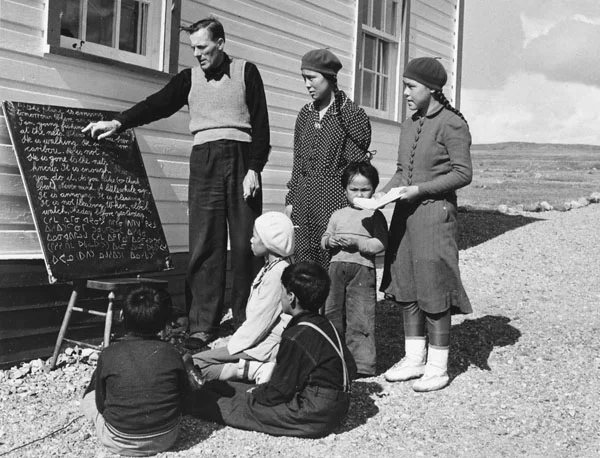
Inuktitut syllabics in Nunavik originate from an adaptation of Cree syllabics made by Anglican missionaries in 1855. Their spread, however, relied on their active adoption by Inuit, who taught, copied and used them to communicate and develop literacy. Today, this writing system coexists with the Latin alphabet and remains present in education, signage, publications and digital tools in Nunavik.
Inuktitut, a living language of Nunavik
In Nunavik, the Inuit language is Inuktitut. It has been spoken for millennia and belongs to a broad family of Arctic languages that also includes Inuvialuktun and Inuinnaqtun. The territory includes regional varieties, notably those of Ungava and Hudson Bay. These varieties form part of a language that remains at the heart of Nunavik’s cultural, educational and community life.
The term Inuktut is an umbrella term that includes Inuktitut, Inuvialuktun and Inuinnaqtun. In the Nunavimmiut context, Inuktitut refers to the language used by Inuit of Nunavik. Its oral and written use is evident in schools, community publications, signage, social media and the visual identity of institutions in the territory.
The vitality of Inuktitut is also apparent in recent data. In 2021, approximately 98% of Inuit in Nunavik reported being able to speak Inuktitut. Between 2016 and 2021, the number of speakers increased by approximately 715 people, representing an increase of 6.1%. In Quebec, approximately 12,770 people had Inuktitut as their mother tongue in 2021, with the great majority living in Nunavik.
- Inuktitut is the Inuit language spoken in Nunavik.
- Regional varieties include, notably, those of Ungava and Hudson Bay.
- The term Inuktut encompasses Inuktitut, Inuvialuktun and Inuinnaqtun.
- Syllabics and the Latin alphabet are both used to write Inuktitut.
The origins of the syllabic model
The history of the syllabics used for Inuktitut in Nunavik begins with a writing system created for other Indigenous languages. During the 1840s, James Evans, a Methodist missionary based at Norway House, Manitoba, developed a syllabic writing system. He designed it first for Ojibwe, then adapted it for Cree between 1840 and 1845.
The syllabic principle makes it possible to represent syllables through distinct signs. This writing system became the basis for later adaptations. It was therefore not originally created for Inuktitut, but its structure was adopted and modified to better correspond to the sounds of that language.
This stage is important for understanding what followed: Nunavik Inuktitut syllabics emerged through a process of linguistic adaptation. Their form developed from a system already used for Cree, then adjusted to reflect the sound systems of Inuktitut and James Bay Cree.
The adaptation to Inuktitut in 1855
In 1855, Anglican missionaries John Horden, Bishop of Moose Factory, and Edwin Arthur Watkins adapted Cree syllabics to Inuktitut. Watkins introduced this writing system among Inuit of Fort George and Petite rivière de la Baleine. This adaptation marks the documented beginning of the use of syllabics for Inuktitut in the regions concerned.
The same period saw the publication of the first book printed in Inuktitut. At Moose Factory, John Horden printed a small collection of passages from the Gospels in the Petite rivière de la Baleine dialect in 1855 and 1856. Printing this collection gave a material form to the adapted writing system and enabled texts to circulate in an Inuit language.
In November 1865, Horden and Watkins met in London under the direction of Henry Venn. They then modified the system to better represent the sounds of Inuktitut and James Bay Cree. The syllabics used in Nunavik are therefore part of careful work of adjustment connected to the linguistic characteristics of the communities where they are used.
| Period | Event | Significance for written Inuktitut |
|---|---|---|
| Années 1840 à 1845 | James Evans develops a syllabic writing system for Ojibwe, then for Cree. | Cree syllabics become the model from which Inuktitut writing is adapted. |
| 1855 à 1856 | John Horden and Edwin Arthur Watkins adapt syllabics to Inuktitut; Horden prints a collection of passages from the Gospels. | The first book printed in Inuktitut appears in the Petite rivière de la Baleine dialect. |
| Novembre 1865 | Horden and Watkins modify the system with Henry Venn. | The signs are adjusted to better represent the sounds of Inuktitut and James Bay Cree. |
| À partir de 1876 | Edmund James Peck translates and prints several works in Inuktitut. | The texts contribute to the circulation and learning of syllabics. |
| 1976 | The language commission of the Inuit Cultural Institute adopts syllabics and the Latin alphabet as co-official writing systems. | The two writing systems are recognized within the framework of the titirausiq nutaaq reform. |
Edmund James Peck and the rise of printed texts
In 1876, Edmund James Peck, recruited by John Horden, arrived on the east coast of Hudson Bay. He reached the Petite rivière de la Baleine post on 24 October 1876. Known in Inuktitut as Uqammaq, meaning “the one who speaks well,” Peck took part in an important period of translating and printing texts in Inuktitut.
His printed works included excerpts from the New Testament in 1878, the Book of Common Prayer in 1881 and the four Gospels in 1897. The complete New Testament was published in 1912, followed by the Psalms in 1917. These publications increased the availability of written texts in a language used in Nunavik.
Printed books alone do not tell the full history of syllabics. Their spread became possible because Inuit used them and circulated them. The texts provided a medium, while learning and transmission took place within families and communities.
- Syllabics are adapted to Inuktitut from the Cree system.
- Printed texts are produced in the Petite rivière de la Baleine dialect and in other forms of Inuktitut used in the regions concerned.
- Inuit learn, teach and use the writing system through their own networks of transmission.
- Syllabics become a tool for communication and literacy.
Inuit adoption of syllabics
The spread of syllabics in Nunavik relied on their practical adoption by Inuit. The system is easy to learn and became widely used. In the 1920s, most Inuit in the regions concerned knew how to read and write it. This spread reflects a collective ability to make writing a lasting tool in community life.
Mothers taught syllabics to children. Inuit catechists copied and carried texts. These practices gave writing a continuity that did not depend solely on printing or on the arrival of new works. They show the central role of Inuit in the daily transmission of reading and writing.
Syllabics thus became a means of communication and literacy. Their history in Nunavik is not limited to their creation or initial adaptation: it also includes the acts of learning, copying, carrying and teaching that ensured their presence among many families and communities.
This adoption explains why syllabics still hold a visible place in Nunavik’s linguistic landscape. They are associated with a living written practice, carried by Inuit and integrated into several areas of public and community life.
Two recognized writing systems and a Nunavimmiut adaptation
In 1976, the language commission of the Inuit Cultural Institute adopted syllabics and the Latin alphabet as co-official writing systems for Inuit languages. This decision was part of the reform called titirausiq nutaaq. It recognizes the coexistence of two ways of writing Inuit languages.
In Nunavik, Makivik restored the ai-pai-tai column of the syllabary. This decision represents an adaptation specific to Nunavik. It illustrates the ability of Inuit institutions to support writing choices connected to practices in the territory.
The Latin alphabet is also used in the form of qaliujaaqpait. The coexistence of syllabics and the Latin alphabet does not lessen the importance of either one: it offers two writing systems present in contemporary linguistic practices. The visual identity of Kativik Ilisarniliriniq also combines syllabics and Latin letters.
- Syllabics have been recognized alongside the Latin alphabet since 1976.
- The reform is called titirausiq nutaaq.
- Makivik restored the ai-pai-tai column in Nunavik.
- The Latin alphabet is also used under the name qaliujaaqpait.
Inuktitut in schools and frameworks of recognition
Inuktitut holds a foundational place in education in Nunavik. Kativik Ilisarniliriniq, Nunavik’s school board, teaches in Inuktitut as a first language. French and English are taught as second languages in the 14 communities. Clause 17.0.59 of the James Bay and Northern Quebec Agreement establishes that the language of instruction is Inuktitut.
Inuktitut is not an official language of Quebec, where French is the official language. It is nevertheless recognized and protected in certain frameworks, including the James Bay and Northern Quebec Agreement and the Charter of the French Language for education. Its status differs from the one it holds in Nunavut, where Inuktitut has official status; this status does not apply in Nunavik.
In this context, education in Inuktitut ensures continuity between the family language, school-based transmission and written use. Syllabics and the Latin alphabet can therefore support learning of the first language while coexisting with the learning of French and English as second languages.
Syllabics in digital and public life
Syllabics remain visible in Nunavik schools, signage and community publications. They are also part of the visual identity of Kativik Ilisarniliriniq, where they appear alongside the Latin alphabet. Their presence confirms that this writing system belongs both to the history and to the current uses of Inuktitut.
Syllabics are encoded in Unicode in the Unified Canadian Aboriginal Syllabics block, from U+1400 to 167F. This encoding enables their use in digital environments. Keyboards and digital tools are available, notably through Nunavik-IcE resources and Kativik Ilisarniliriniq.
Thanks to these tools, syllabics can be used in digital communications and on social media. Their history thus connects the adaptation made in the 19th century, the community learning developed by Inuit, the recognition of two writing systems and current digital uses. In Nunavik, syllabics remain a visible expression of Inuktitut and Inuit linguistic continuity.
Frequently asked questions
Who created the syllabics used for Inuktitut?
James Evans, a Methodist missionary, devised the syllabic system in the 1840s for Ojibwe and then Cree. Anglican missionaries John Horden and Edwin Arthur Watkins adapted it to Inuktitut in 1855, and Edmund James Peck spread it from 1876 onward.
Why were the syllabics introduced?
Missionaries wanted to translate religious texts into Inuktitut. The system, simple to learn, spread through the active adoption of Inuit: mothers taught it to their children, and Inuit catechists copied and carried the texts.
Are syllabics still used in Nunavik?
Yes. They appear in schools, signage and community publications, in the visual identity of Kativik Ilisarniliriniq and in digital tools through Unicode encoding. Since the 1976 reform, they coexist with the Latin alphabet.
How many people speak Inuktitut in Nunavik?
In 2021, about 98% of Nunavik Inuit reported being able to speak Inuktitut, and the number of speakers grew by about 6.1% between 2016 and 2021.
Is Inuktitut an official language in Quebec?
No. Inuktitut is not an official language of Quebec, where French holds that status, but it is recognized and protected in certain frameworks, notably the James Bay and Northern Quebec Agreement, which makes it the language of instruction in Nunavik schools.
To go further
- Glossary: 30 essential terms of Nunavik and Eeyou Istchee
- Digital sovereignty in Nunavik and Eeyou Istchee