Kuujjuaq is now the largest community in Nunavik and its administrative capital. Its history brings together the long-standing presence of the Kuujjuamiut, the establishment of a trading post called Fort Chimo, the shift of the centre of life to the west bank of the Koksoak River during the military period, and then the incorporation of the northern village municipality under the name Kuujjuaq. Its name, ᑰᑦᔪᐊᖅ, means “the great river.”
The Kuujjuamiut and the great river
The ancestors of the Kuujjuamiut, the Inuit of Kuujjuaq, have travelled through the region for a very long time. The territory is shaped by the Koksoak, the river to which the name Kuujjuaq directly refers. Kuujjuaq means “the great river” and designates the section of the Caniapiscau downstream from its confluence with the rivière aux Feuilles. The syllabic form of the name is ᑰᑦᔪᐊᖅ.
The Koksoak River and Ungava Bay are among the geographic landmarks associated with Kuujjuaq. They also feature in the history of the trading post, the shift of the centre of life and the activities that characterize the community today. The Koksoak remains an important place for tourism, as do Ungava Bay and the migration of the George River caribou, observed from August to September.
- Kuujjuaq means “the great river.”
- The name refers to the Koksoak River.
- The syllabic form is ᑰᑦᔪᐊᖅ.
- The Koksoak River, Ungava Bay and the George River caribou are connected to local tourism.
Encounters on the east bank of the Koksoak
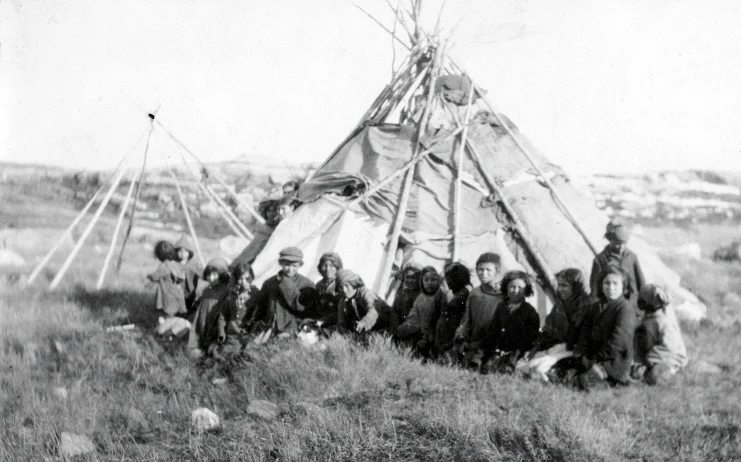
On 25 August 1811, Moravian missionaries Benjamin Gottlieb Kohlmeister and George Kmoch met Inuit on the east bank of the Koksoak. They were then seeking a mission site. This effort, however, did not lead to the establishment of a permanent Moravian mission in the region.
The east bank of the Koksoak later played a role in the beginnings of the trading post. It was home to the first Hudson’s Bay Company establishment in the Ungava Bay region. The site is locally known as Kuujjuatuqaq. These historical reference points help situate the first colonial installations mentioned in the history of Kuujjuaq, on a territory already travelled through for a very long time by the ancestors of the Kuujjuamiut.
Local history is therefore not limited to an administrative settlement or transportation infrastructure. It is part of a territorial continuity in which the Koksoak, its banks and Ungava Bay shape relationships among people, activities and places.
Fort Good Hope becomes Fort Chimo
In 1830, the Hudson’s Bay Company established a first trading post in the Ungava Bay region, on the east bank of the Koksoak. The post was first called Fort Good Hope. As early as 1831, it was renamed Fort Chimo to avoid confusion with another Fort Good Hope.
The name “Chimo” is an anglicization of saimuuq, an Inuktitut greeting generally rendered as “let us shake hands.” This origin recalls the presence of Inuktitut in the place-name history of the area, even when the post is identified by an English name.
The post’s trade did not remain profitable. Fort Chimo closed in 1843, before reopening in 1866. These openings, closures and resumptions are part of the history of an establishment founded near the Koksoak, in a territory where the Kuujjuamiut have a long-standing and enduring presence.
| Reference point | Event | Significance in the history of Kuujjuaq |
|---|---|---|
| 1811 | Benjamin Gottlieb Kohlmeister and George Kmoch meet Inuit on the east bank of the Koksoak. | No permanent Moravian mission is established. |
| 1830 | The Hudson’s Bay Company establishes Fort Good Hope. | First trading post mentioned in the Ungava Bay region. |
| 1831 | Fort Good Hope becomes Fort Chimo. | The new name avoids confusion with another Fort Good Hope. |
| 1843 and 1866 | Closure of the post, followed by reopening. | Trade is initially unprofitable, then the post resumes its activities. |
| 1941 to 1945 | Construction and operation of American installations on the west bank. | The centre of life shifts to the west bank, and the infrastructure later serves as the core of the modern village. |
| 1979 | Fort-Chimo officially becomes Kuujjuaq. | The northern village municipality is incorporated under the name Kuujjuaq. |
The airfield and the shift to the west bank
On 12 July 1941, a United States Army team, the USAAF, led by Captain Elliott Roosevelt, surveyed the site of a future airfield at Fort Chimo. On 10 October 1941, the American weather and communications station Crystal I was installed on the west bank of the Koksoak. Crystal I should not be confused with Crystal II, which refers to Frobisher Bay, now Iqaluit.
The runway was built in the summer of 1942. On 1 October 1942, the 8th Weather Squadron established a detachment there. These installations changed the organization of the place: the military presence accelerated the shift of the centre of life to the west bank of the Koksoak. After the war, the infrastructure left on site served as the core of the modern village.
Between 1944 and 1945, the installations were turned over to the Canadian government. In 1948, the site became Naval Radio Station Chimo. This station closed in 1952 and its personnel were transferred to Frobisher Bay. The site then became Kuujjuaq Airport, equipped with a Nav Canada control tower.
- The site of the future airfield is surveyed at Fort Chimo.
- Crystal I is installed on the west bank of the Koksoak.
- The runway is built and the 8th Weather Squadron maintains a detachment there.
- The installations are turned over to the Canadian government.
- After the closure of Naval Radio Station Chimo, the site becomes Kuujjuaq Airport.
An airport at the heart of regional connections
Kuujjuaq Airport is Nunavik’s main air hub. This function is part of the continuity of the infrastructure established on the west bank of the Koksoak during the military period and which became, after the war, one of the foundations of the modern village.
Kuujjuaq has no permanent road connection with the South. Access is by air. In this context, the airport plays a central role in travel and in connections between Kuujjuaq and other places in Nunavik. The presence of a Nav Canada control tower is part of its infrastructure.
The airport’s role as a regional hub complements Kuujjuaq’s administrative position. The community brings together regional institutions, a hospital and the headquarters of the Kativik Regional Police Force. Its importance therefore does not rest on a single service: it is reflected in the concentration of organizations that support regional life.
From Fort-Chimo to Kuujjuaq
On 26 February 1979, the name Fort-Chimo was officially replaced by Kuujjuaq upon the incorporation of the northern village municipality. The municipality was incorporated on 29 December 1979. The name change confirms the use of Kuujjuaq, an Inuktitut name directly linked to the Koksoak and its importance in the territory.
The transition from Fort-Chimo to Kuujjuaq also makes it possible to distinguish the history of the trading post from that of the contemporary municipality. Fort Chimo refers to an establishment whose name comes from the anglicization of saimuuq. Kuujjuaq, for its part, refers to the great river that shapes the place. These two names belong to different periods in local history, while recalling the enduring importance of the Koksoak.
The northern village municipality now bears a name that expresses a major geographic landmark of the territory. This place-name recognition is part of a history in which the Inuit of Kuujjuaq, the Kuujjuamiut, are at the heart of the region’s human continuity.
Administrative capital of Nunavik
Kuujjuaq is the largest community in Nunavik and its administrative capital. In 2021, its population was 2,668 inhabitants, compared with 2,754 in 2016, representing a decrease of 3.1%. Its regional role is notably linked to the presence of organizations and services that have their head office, headquarters or operations there.
- The Kativik Regional Government, or KRG, has its head office there.
- Makivik has its head office there.
- Kativik Ilisarniliriniq, the school board, has its head office there.
- The headquarters of the Kativik Regional Police Force has been located there since 1996.
- Ungava Tulattavik Hospital is located in Kuujjuaq.
- Kuujjuaq Airport serves as a regional hub.
This institutional concentration highlights the regional leadership exercised in Kuujjuaq. The community hosts organizations involved in administration, education, health services, regional security and air communications in Nunavik. It therefore holds an important position in the contemporary organization of the territory.
A community connected to notable journeys
Kuujjuaq is connected to several individuals whose paths reflect significant engagement in public life. Charlie Watt is the founder and first president of Makivik, as well as a senator. Sheila Watt-Cloutier is an environmental activist. Mary Simon is the 30e Governor General of Canada.
These paths are associated with a community that is at once an Inuit living place, an administrative centre and a regional air hub. They are part of a history that extends from the long-standing presence of the Kuujjuamiut to the institutions established in Kuujjuaq today.
From the east bank, where the trading post and the site called Kuujjuatuqaq were located, to the west bank, where military infrastructure helped form the core of the modern village, Kuujjuaq has undergone important transformations. Its current name, its administrative role, its airport and its institutions express the central place it holds in Nunavik.
Notable Facts and People
Since September 20, 2023, Kuujjuaq has been home to the new Isuarsivik Regional Recovery Centre, inaugurated after years of community planning. With 22 beds — more than double the previous facility — it is the only regional recovery centre of its kind in Nunavik, serving all 14 of the region’s communities. Its approach combines clinical care, Inuit traditions and land-based healing, including a healing cabin at Navvaataaq Lake acquired in 2023.
The Nunavik capital is also a major cultural hub. Held in Kuujjuaq since 1996, Aqpik Jam is the region’s largest music festival: four days of concerts, including an aqpik berry-picking contest. The local music scene has deep roots: William Tagoona, who settled in Kuujjuaq in the early 1970s, was a member of The Harpoons, one of the first Inuit rock bands. Contemporary creators associated with the community include spoken word artist and curator Taqralik Partridge, stage artist Sylvia Cloutier and circus performer Charlie Gordon.
Local Services and Institutions
Municipal office. The village is administered by the Northern Village municipality of Kuujjuaq. Its municipal office, at P.O. Box 210 (Kuujjuaq, QC, J0M 1C0), can be reached at 819 964-2943. The current mayor is Mary Johannes.
Daycare. Childcare is provided by CPE Iqitauvik, together with the Tumiapiit facility.
School. Education is provided by Kativik Ilisarniliriniq: Pitakallak School (kindergarten to grade 3) and Jaanimmarik School (grade 4 to Secondary V). Instruction is delivered in Inuktitut as the first language, with French and English taught as second languages.
Cooperative. The local economy relies in part on the Kuujjuaq Co-op, a member of the Fédération des coopératives du Nouveau-Québec (FCNQ), which brings together 14 cooperatives in 14 Nunavik communities.
Health. Kuujjuaq is served by the Ungava Tulattavik Health Centre, one of Nunavik’s two regional hospitals (with Puvirnituq’s Inuulitsivik Health Centre).
The Airport
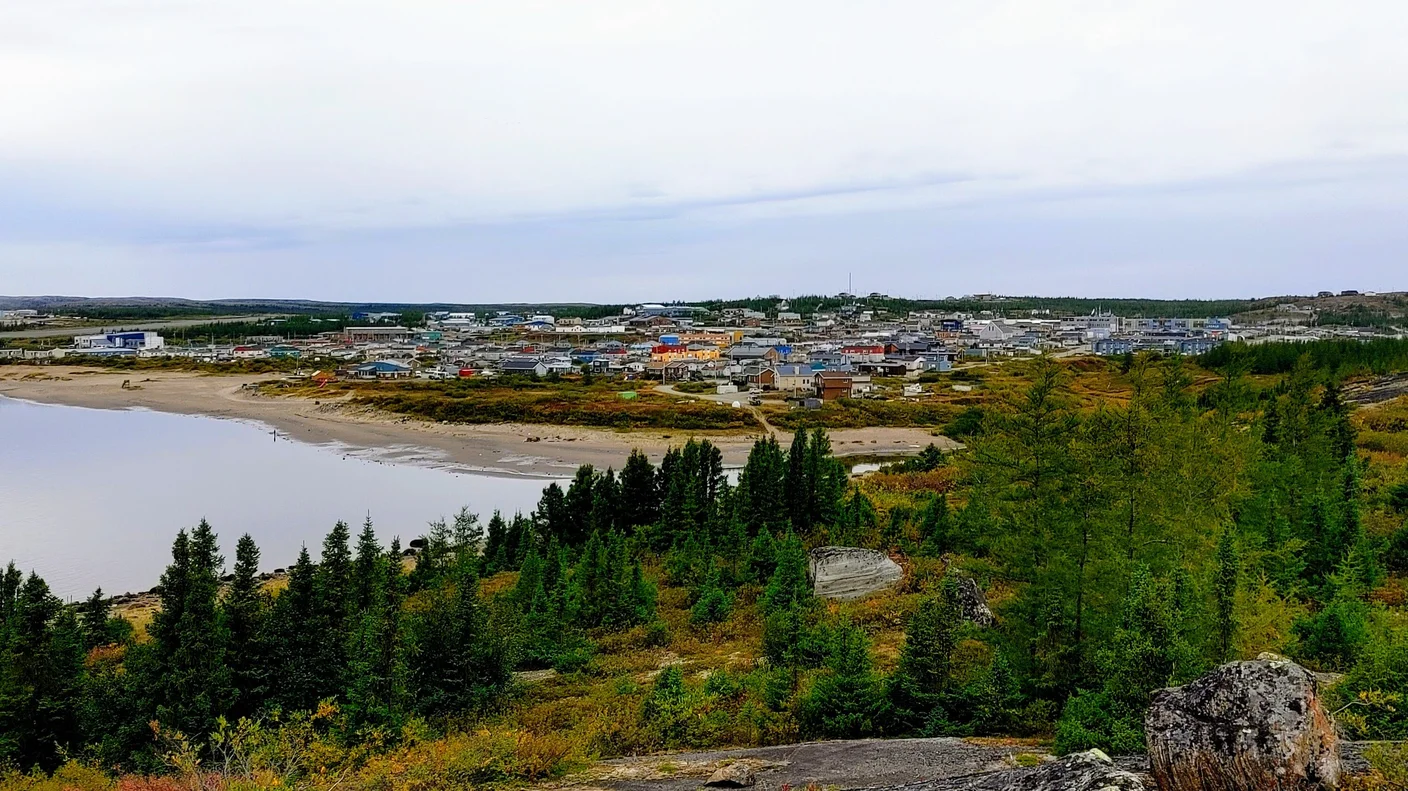
Kuujjuaq Airport bears the codes YVP (IATA) and CYVP (ICAO) (coordinates: 58,0950, −68,4222). It has two runways: 07/25 asphalt (6,000 ft / 1,829 m) and 13/31 gravel (5,001 ft / 1,524 m). It is Air Inuit’s hub: the airline links Kuujjuaq to Montreal, the coastal network and Ungava Bay, while Canadian North serves Iqaluit and Ottawa among other destinations.
Tourism and Attractions
The village and its territory offer several attractions:
- Atlantic salmon and Arctic char fishing, and caribou hunting opportunities
- the passage of the George River caribou herd, observable in August and September
- Old Chimo, the site of the original settlement, a few kilometres downstream on the opposite shore
To go further
- Kuujjuaq today: services, travel and accommodation
- Air transport in Nunavik: Air Inuit and Canadian North
In the same series : Nunavik History
- Kuujjuaraapik and Whapmagoostui
- The Inuit language and syllabics
- Religion in Nunavik
- The James Bay agreements
Frequently asked questions
Why is Fort Chimo now called Kuujjuaq?
The name Fort-Chimo was officially replaced by Kuujjuaq on February 26, 1979, when the community was constituted as a northern village municipality. Kuujjuaq means "the great river" and refers to the Koksoak River.
What does the name "Chimo" mean?
Chimo is an anglicization of saimuuq, an Inuktitut greeting generally rendered as "let's shake hands." The trading post was first named Fort Good Hope in 1830 and renamed Fort Chimo in 1831.
Why did the American military set up at Fort Chimo?
In 1941 the United States established a weather and communications station, Crystal I, on the west bank of the Koksoak, and built an airfield in 1942. The facilities, handed over to Canada in 1944-1945, became today's Kuujjuaq Airport.
What is the population of Kuujjuaq?
The 2021 census counted 2,668 residents in Kuujjuaq, making it the largest community in Nunavik.
Why is Kuujjuaq the administrative capital of Nunavik?
Kuujjuaq is home to the head offices of the Kativik Regional Government (KRG), Makivik Corporation and Kativik Ilisarniliriniq, the Kativik Regional Police Force headquarters, the Ungava Tulattavik hospital and the region's main airport.
Where are the municipal office and the daycare in Kuujjuaq?
The Northern Village municipal office of Kuujjuaq can be reached at 819 964-2943 (P.O. Box 210, J0M 1C0); the village daycare is CPE Iqitauvik.
What are the school, the cooperative and the health centre of Kuujjuaq?
Kuujjuaq is home to Pitakallak School (kindergarten to grade 3) and Jaanimmarik School (grade 4 to Secondary V) (Kativik Ilisarniliriniq), the Kuujjuaq Co-op, a member of the FCNQ, and the Ungava Tulattavik Health Centre (regional hospital).