Religion in Nunavik is part of a history of continuities, encounters and change. Traditional Inuit spirituality recognized spirits in people, animals, objects and the forces of nature. Beginning in the 19th century, Christian missions became established in the region. Today, different Churches coexist alongside an Inuit identity in which the values of sharing, respect for animals and responsibility toward the community remain important.
A spirituality connected to the living world
In traditional Inuit spirituality, people, animals, objects and the forces of nature possessed spirits. This worldview established an attentive relationship between human beings and the world around them. Hunting, the seasons, the sea, travel and health were not solely practical activities: they were also connected to rules of respect and spiritual relationships.
Seda, also called Sedna, held an important place in this spiritual universe. She was the spirit or goddess who governed the sea and controlled seals, whales and other marine animals. Accounts about her varied from one region to another. Names associated with these variations include Takannaaluk and Sassuma Arnaa. These accounts expressed the importance of the sea and marine animals in Inuit life.
Stories did not serve only to explain the world. They also passed on the group’s history and taught essential qualities, including patience, calm and generosity. In this way, they helped preserve shared knowledge and values from one generation to the next.
- People, animals, objects and the forces of nature had spirits.
- Seda governed the sea and marine animals.
- Stories passed on the group’s history and taught patience, calm and generosity.
- Spiritual practices were connected to relationships among people, animals and the environment.
Rules of respect toward animals and the sea
Inuit spirituality included taboos and rules of respect. These rules concerned, in particular, hunting, the preparation of hides, meals and the treatment of captured animals. They reminded people that animal resources required care and responsibility.
It was forbidden, in particular, to sew caribou hides on the sea ice during the dark months. Nor was one to eat the meat of land animals and that of marine animals at the same meal. A whale knife could be tied with seal skin. When a seal was killed, it could be offered water.
An annual ceremony for the return of seal bladders is also mentioned in Alaska. These practices illustrate the importance given to relationships with marine animals and to the actions that guided hunting. They reflect a culture in which respect, restraint and awareness of the consequences of one’s actions were part of collective life.
The angakok and spiritual responsibility
The angakok, or angakkuq, was a man or woman endowed with special spiritual powers. These powers were acquired through solitude and fasting. The angakok advised the community and intervened when it sought to understand difficult situations.
Bad weather, illness or difficult hunting could be interpreted in relation to the breaking of taboos. In this context, the angakok held a role of advice and interpretation. Their knowledge was part of an understanding of the world in which human actions, rules of respect and living conditions were closely connected.
Name and soul also formed part of this continuity. The name of a deceased relative could be given to a newborn, and the spirit could continue to live. This practice expressed a lasting connection between generations and particular attention to the memory of loved ones.
- Solitude and fasting could make it possible to acquire particular spiritual powers.
- The angakok advised the community in the face of bad weather, illness and difficult hunting.
- Difficulties could be associated with the breaking of taboos.
- The name of a deceased relative could be passed on to a newborn.
The first missionary visits to Nunavik
The first missionary contacts mentioned in this history did not all immediately lead to permanent establishments. On 25 August 1811, the Moravian missionaries Kohlmeister and Kmoch passed through the Koksoak. This visit, however, did not result in a permanent mission.
In 1884, Edmund Peck passed through Fort Chimo. The organized Anglican mission in the region then began in 1899, within the Diocese of the Arctic of the Anglican Church of Canada. At the beginning of the XXe century, an Anglican mission station was established at Fort Chimo, now Kuujjuaq.
Christian presence thus developed in stages, through visits, mission stations and institutional establishments. It introduced new gathering places, new forms of education and religious practices that shaped the history of several Nunavik communities.
| Period | Religious event in Nunavik |
|---|---|
| 25 August 1811 | Visit by the Moravian missionaries Kohlmeister and Kmoch to the Koksoak, without a permanent mission. |
| 1884 | Visit by Edmund Peck to Fort Chimo. |
| 1899 | Beginning of the organized Anglican mission in the region. |
| 1936 | Catholic mission in Kangiqsujuaq. |
| 1938 | Catholic mission in Ivujivik. |
| 1948 | Notre-Dame-de-Fatima Catholic mission in Kuujjuaq. |
| 1957 | Construction of the first Anglican church building in Fort Chimo/Kuujjuaq. |
| 1963 | Anglican church in Kangiqsujuaq. |
Anglican and Catholic missions in the communities
In Fort Chimo/Kuujjuaq, the Anglican mission station of the beginning of the XXe century preceded the construction of the first Anglican church building in 1957. Kuujjuaq’s religious history also includes the Notre-Dame-de-Fatima Catholic mission, established in 1948 in the Diocese of Amos. This mission was followed by an infirmary, a school and a weather station.
In Kangiqsujuaq, a Catholic mission was established in 1936, after the closure of the Révillon Frères post, with an Oblate presence. An Anglican church was built there in 1963. The village thus experienced the coexistence of Catholic and Anglican traditions.
In Ivujivik, a Catholic mission was established in 1938. It closed in the 1960s, when the State took over services. These histories show that Churches were present in different local contexts and that their activities were linked to services such as education, care and supplies.
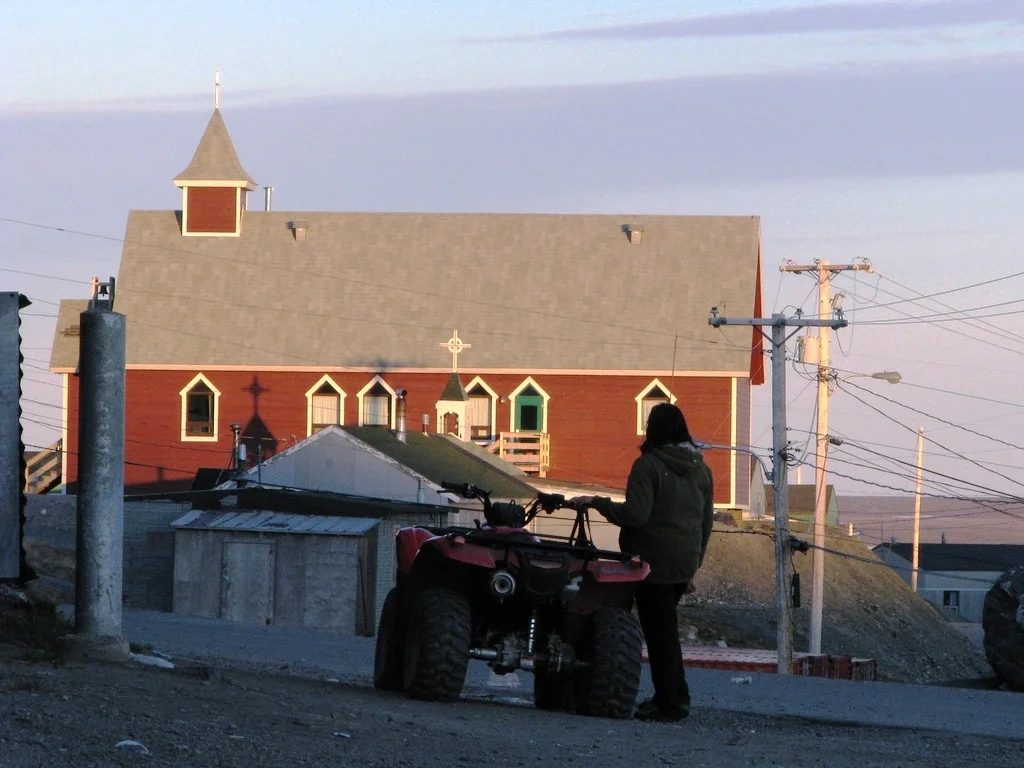
Historically, Churches contributed to teaching reading and writing, to primary health care through infirmaries, to social assistance and to supplies. They also served as gathering places. Beginning in the postwar period, the federal and then provincial State gradually took over schools and dispensaries.
Kuujjuaq, a crossroads of Christian traditions
The presence of several churches in Kuujjuaq can be explained by the community’s role as a crossroads. The Koksoak and Ungava Bay were connected to trade, missions and administration. Missionary visits, religious establishments and their associated services thus converged in this important place of travel and circulation.
Distinct institutional networks became established in succession: the Moravians in 1811, the Anglicans at the end of the 19th century and the Catholics in 1948. These networks included clergy, places of worship as well as associated schools or services. The village’s growth after 1945, linked to a military base and public services, also encouraged denominational diversity.
More recently, Pentecostal and evangelical Churches have been added to the religious landscape. They emphasize personal conversion, prayer and singing, with active community participation. This diversification reflects the ability of communities to sustain different expressions of faith within their own settings.
- Kuujjuaq is a crossroads connected to the Koksoak, Ungava Bay, trade, missions and administration.
- Moravian, Anglican and Catholic establishments belonged to distinct institutional networks.
- The village’s growth after 1945 contributed to denominational diversity.
- Pentecostal and evangelical Churches have more recently contributed to this diversity.
A Christian faith lived alongside Inuit identity
Today, Christian faith and Inuit identity are combined in Nunavik. This reality cannot be reduced to an opposition between a shamanic past and a Christian present. The two traditions have interacted and continue to evolve. This approach makes it possible to recognize the complexity of religious history while respecting the ability of Inuit to define and live their identities and affiliations.
Values connected to hunting, sharing and respect for animals remain present within this continuity. They recall that Inuit identity includes lasting ties to the land, family relationships and community life, including in a context where Christian practices hold an important place.
Missions historically condemned certain practices, including the angakkuq, drumming and throat singing. Today, Inuit artists, Elders and institutions are reassessing these traditions as heritage. This reassessment highlights knowledge, cultural expressions and a memory that fully belong to Inuit communities.
Inuit leadership in today’s Churches
The religious history of Nunavik also includes strong Inuit leadership within the Churches. Annie Ittoshat, born in Kuujjuaraapik, became an Anglican bishop. Her path illustrates the presence and contribution of Inuit leaders in religious institutions that are part of the contemporary history of northern Quebec.
Today’s churches should therefore be understood as places where prayer, singing, community engagement and personal journeys of faith come together. They are part of a broader history, in which Inuit spiritual traditions, Christian missions, community services and the reclaiming of heritage have shaped diverse realities.
This history calls for recognition both of Inuit spiritual practices passed down through stories, rules of respect and ties between generations, and of the actions of Inuit who have transformed Christian institutions within their communities. In Nunavik, beliefs and religious practices thus remain connected to memory, sharing and collective life.
Frequently asked questions
Which Churches are present in Nunavik?
The three most visible currents are Anglicanism, established since the late 19th century; Roman Catholicism, developed mostly in the 20th century; and Pentecostal and evangelical Churches, present more recently.
Why does Kuujjuaq have churches of several denominations?
Kuujjuaq is an old crossroads of the Koksoak and Ungava Bay where distinct missionary networks followed one another: a Moravian passage in 1811, an Anglican presence from the late 19th century, a Catholic mission in 1948, and growing denominational diversity after 1945.
What is traditional Inuit spirituality?
It holds that people, animals, objects and the forces of nature possess spirits. Seda governs the sea and its animals, rules and taboos frame hunting and social life, and the angakkuq advises the community.
What role did the Churches play historically?
They contributed to teaching reading and writing, to first-line health care through their infirmaries, and to social aid and supplies. After the war, the state gradually took over the schools and nursing stations.
How do Christian faith and Inuit identity coexist?
They combine: values of sharing, respect for animals and responsibility toward the community remain important, and Inuit leaders hold responsibilities within the Churches, such as Anglican bishop Annie Ittoshat, born in Kuujjuaraapik.
To go further
- Community tourism in Eeyou Istchee: Cree villages and etiquette
- Glossary: 30 essential terms of Nunavik and Eeyou Istchee