
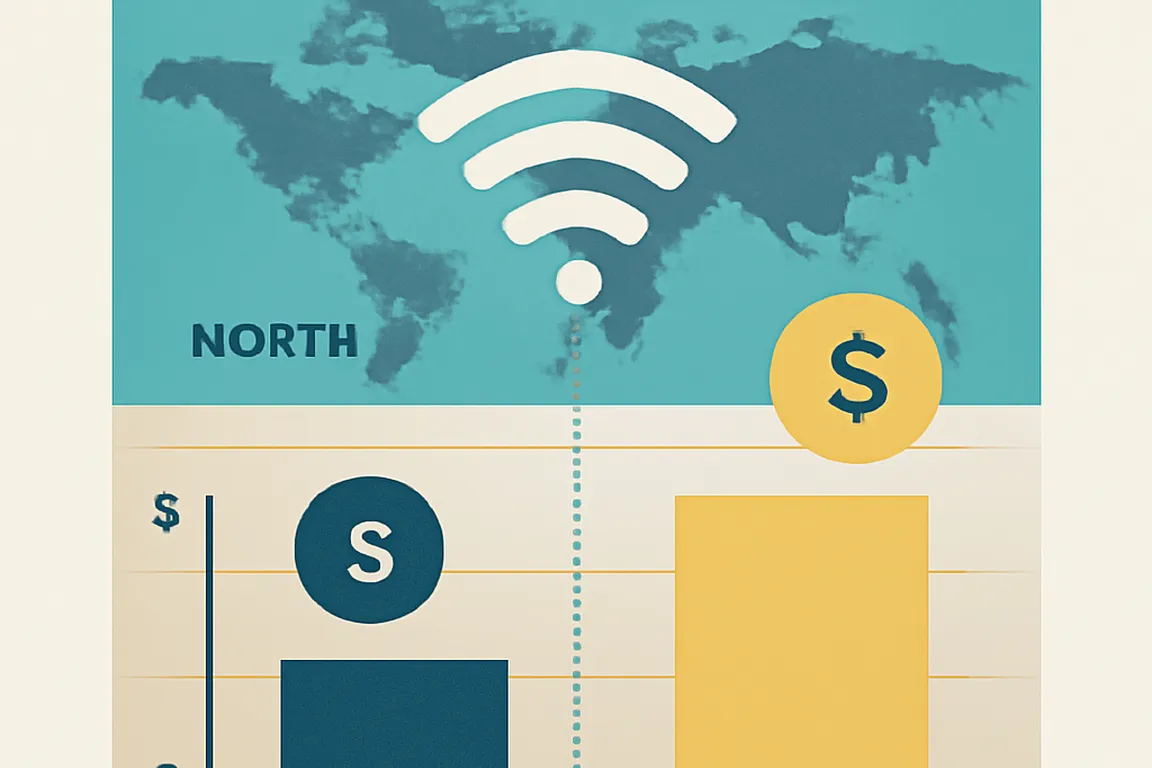
The digital divide between northern and southern Quebec is real, documented and persistent. In 2026, a household in Puvirnituq pays $100 to $180/month for 10 to 30 Mbps internet access. A Montreal household pays $60 to $80/month for 1 Gbps. The gap is staggering — and it is narrowing only slowly.
This guide aims to give an honest picture of real costs in Nunavik in 2026. All figures are estimates drawn from public sources and documented field experience — rates evolve regularly and vary by plan and local negotiations. This same cost gap extends to groceries: our interview on food security and the cost of living in Nunavik breaks down the same dynamics applied to the grocery basket.
The north-south cost gap: real numbers
| Indicator | Typical Nunavik | Montreal / Urban Quebec |
|---|---|---|
| Residential 25 Mbps subscription | $100-180/month | $60-80/month (for 1 Gbps) |
| Cost per Mbps available | ~$5-8/Mbps/month | ~$0.08/Mbps/month |
| Equipment (installation) | $0-650 depending on provider | $0-100 |
| Estimated reliability (uptime) | 85-95% | 99%+ |
| Typical latency | 30-600 ms | 5-20 ms |
| Fibre optic coverage | Limited (Kuujjuaq partial) | Near-universal |
Tamaani Internet rates in 2026
Tamaani Internet, operated by Makivik Society, is Nunavik’s community reference operator. Its network covers the 14 coastal villages via geostationary satellite links and local distribution infrastructure (community Wi-Fi, internal building cabling).
Estimated residential plans (ranges, non-contractual):
- Standard access (5-10 Mbps): $80-120/month
- Enhanced access (15-25 Mbps): $130-180/month
- Institutional access (guaranteed speed): from $200/month
Factors that influence Tamaani rates: village (Kuujjuaq generally lower rates; small isolated villages like Aupaluk or Ivujivik pay more); data volume (some plans include monthly limits with speed throttling beyond); subscription type (residential, business, institutional — businesses and institutions sometimes have negotiated conditions with KRG support).
Tamaani’s limitation: geostationary satellite latency (600 ms) constrains delay-sensitive uses — intensive video conferencing, online gaming, some reactive cloud tools. For these uses, Starlink or partial fibre like Kuujjuaq is needed.
Starlink in Nunavik — equipment cost, subscription and 3-year total cost of ownership
Starlink (SpaceX) has been available across Nunavik since 2023. Its LEO constellation offers latency reduced to 30-50 ms and speeds between 50 and 200 Mbps — a spectacular improvement over geostationary satellite.
Starlink cost structure (2026 estimates):
- Residential terminal: approximately $650 (standard kit, dish + router)
- Monthly subscription: $140 to $170/month (residential plan)
- Business plan: $200 to $280/month (bandwidth priority, enhanced SLA)
3-year total cost of ownership:
- Residential Starlink: $650 + ($155/month × 36 months) = ~$6,230
- Tamaani residential over 3 years:
$130/month × 36 = **$4,680**
Over 3 years, Starlink costs approximately $1,500 more than Tamaani — but with incomparably better speeds and latency. For a remote professional or small business, the productivity difference generally justifies the gap.
Starlink limitations in Nunavik: $650 upfront equipment cost is a real access barrier for many northern households; sensitivity to extreme weather; no universal residential household subsidy (unlike institutions).
Xplore — offerings in served villages
Xplore (formerly Xplorenet) operates in several Nunavik communities via long-range wireless and satellite links. Estimated rates comparable to Tamaani ($100-200/month). Confirmed presence in Puvirnituq, Inukjuak, Kangiqsujuaq (partial).
Bell and Télébec — options in Kuujjuaq and accessible areas
Bell and Télébec maintain a presence in Nunavik’s most accessible areas, primarily Kuujjuaq and Kuujjuaraapik-Whapmagoostui. Estimated institutional/business rates: dedicated 25-50 Mbps connection $300-600/month; dedicated 100 Mbps with SLA $500-1,000/month. Bell does not offer standard residential plans in Nunavik villages like Tamaani does.
Available subsidy programmes in 2026
Branché Québec / Québec Connecté (MESI)
Quebec’s Ministry of Economy and Innovation funds infrastructure projects to bring broadband to underserved areas. This programme primarily targets infrastructure projects (operators, municipalities) rather than individual households, but has an indirect impact on available service quality.
CRTC Broadband Fund
The CRTC administers a federal fund of approximately $750 million over 5 years to improve broadband access in rural and northern regions. Several Nunavik projects have benefited from this funding since 2021.
Connecting Families / Brancher pour innover 3.0 (ISED federal)
This federal programme funds projects connecting households and institutions in rural and remote areas. Nunavik communities have received funding in previous cycles.
Inuit Community Development Fund (FCDI)
Makivik Society and partner organizations have community funds to finance digital projects, including institutional connectivity.
Makivik Corporation and Kativik Regional Government programmes
The KRG has a support programme for businesses and households wishing to access available subsidies. Contact the KRG in Kuujjuaq for personalized guidance.
North-south comparison table — real residential subscription
| Use | Puvirnituq | Inukjuak | Kuujjuaq | Montreal | Sherbrooke |
|---|---|---|---|---|---|
| Available speed | 10-150 Mbps | 15-200 Mbps | 25-200+ Mbps | 1 Gbps | 1 Gbps |
| Monthly residential cost | $100-180 | $100-180 | $80-160 | $60-80 | $60-75 |
| Cost per Mbps | ~$5-10 | ~$4-8 | ~$2-5 | ~$0.07 | ~$0.08 |
| Typical latency | 30-600 ms | 30-600 ms | 30-100 ms | 5-20 ms | 5-20 ms |
Despite these higher costs and bandwidth constraints compared to the south, e-commerce and digital payments in Nunavik are growing, particularly for lightweight, high-value purchases that suit constrained connections better than typical southern Quebec online shopping. Residents making the most of these constraints often rely on a guide to digital apps and tools suited to Northern Quebec to manage offline-first workflows that reduce dependence on costly, unreliable bandwidth.
Hidden costs: equipment, installation and northern maintenance
The advertised monthly cost doesn’t reflect the total cost of connectivity ownership in Nunavik. Several additional items apply: Starlink equipment depreciation and potential replacement (Arctic conditions generally reduce equipment lifespan below manufacturer claims); installation by a qualified Nunavik technician ($200-600 in labour costs); maintenance (replacing a failed component may require a technician from outside, whose air travel costs can exceed $1,000); power supply costs in villages using diesel generators.
What public institutions pay
Schools, CLSCs, KRG offices and municipal administrations generally benefit from improved conditions: dedicated connections at negotiated rates subsidized by provincial and federal governments, guaranteed SLAs for critical uses (CLSC telemedicine, emergency transmissions), and Branché Québec funding for school and health infrastructure projects. The real cost for institutions can be 30 to 60% lower than the equivalent residential rate thanks to public subsidies.
For long-term cost and infrastructure evolution perspectives, our interview with northern telecom policy expert Marc-Antoine Desjardins offers an in-depth strategic view.
For village-by-village comparisons, see our connectivity guide by village.
Soleica supports Nunavik institutions, SMEs and communities in IT infrastructure optimization. See our services for an analysis of your specific situation.
For economic and social news on Indigenous communities in Quebec, Le Peuple Actu regularly publishes analysis on economic issues facing Indigenous communities in Quebec.
Frequently asked questions
How much does Tamaani Internet cost in Puvirnituq per month?
Residential Tamaani plans in Puvirnituq typically range from $100 to $180/month in 2026, depending on the subscribed speed and plan type (standard residential or enhanced access). These rates are higher than in Kuujjuaq due to distance and upstream satellite link capacity. For businesses and institutions, dedicated plans exist at negotiated rates, often with partial government subsidies.
Are there government assistance programmes for internet costs in Nunavik?
Yes, several programmes exist. Quebec's Branché Québec programme (MESI) subsidizes infrastructure in underserved areas. The CRTC Broadband Fund finances connectivity projects in remote communities. The federal Connecting Families program (ISED) has funded several Nunavik projects since 2020. Makivik Society and the Kativik Regional Government also have community funds to reduce residential costs in certain villages. Households can inquire about these programmes at their municipal office or the KRG.
Is Starlink cheaper than Tamaani in Nunavik?
Starlink isn't necessarily cheaper than Tamaani on a monthly basis — both services fall in similar ranges ($140-200/month). The main difference is Starlink's upfront equipment cost (~$650 for the terminal), which represents a significant barrier to entry. Over three years, the total cost of ownership of Starlink and Tamaani is relatively comparable, but Starlink offers significantly better speeds and latency. For intensive professional uses, the Starlink investment is generally recouped quickly.
What is the price of a professional internet subscription in Kuujjuaq?
A professional plan in Kuujjuaq varies considerably by need. For a small business or office, a dedicated Tamaani connection can cost $200-400/month. Bell offers institutional connections with guaranteed SLAs from $300-800/month. A combined Tamaani + Starlink setup for a business represents approximately $350-500/month in recurring operational costs. These rates are far above equivalent offers in Montreal ($80-200/month for guaranteed 1 Gbps).
Do Nunavik businesses benefit from special internet rates?
Nunavik cooperatives (Fédération des coopératives du Nouveau-Québec) have been able to negotiate group rates with Tamaani for their members, reducing the per-unit cost for retail points and affiliated businesses. Federal assistance programmes targeting rural SMEs can also cover a portion of connectivity costs. The Kativik Regional Government has a support programme for businesses seeking to access these subsidies.