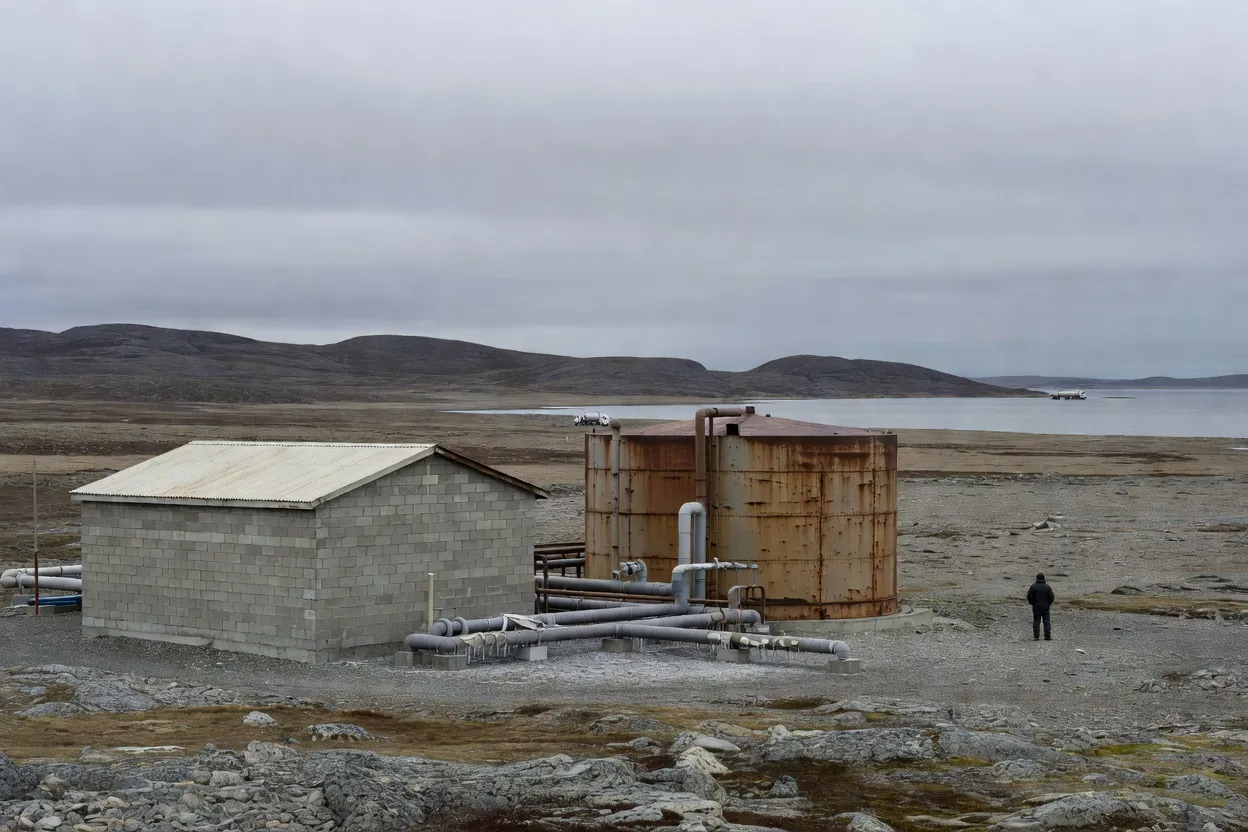
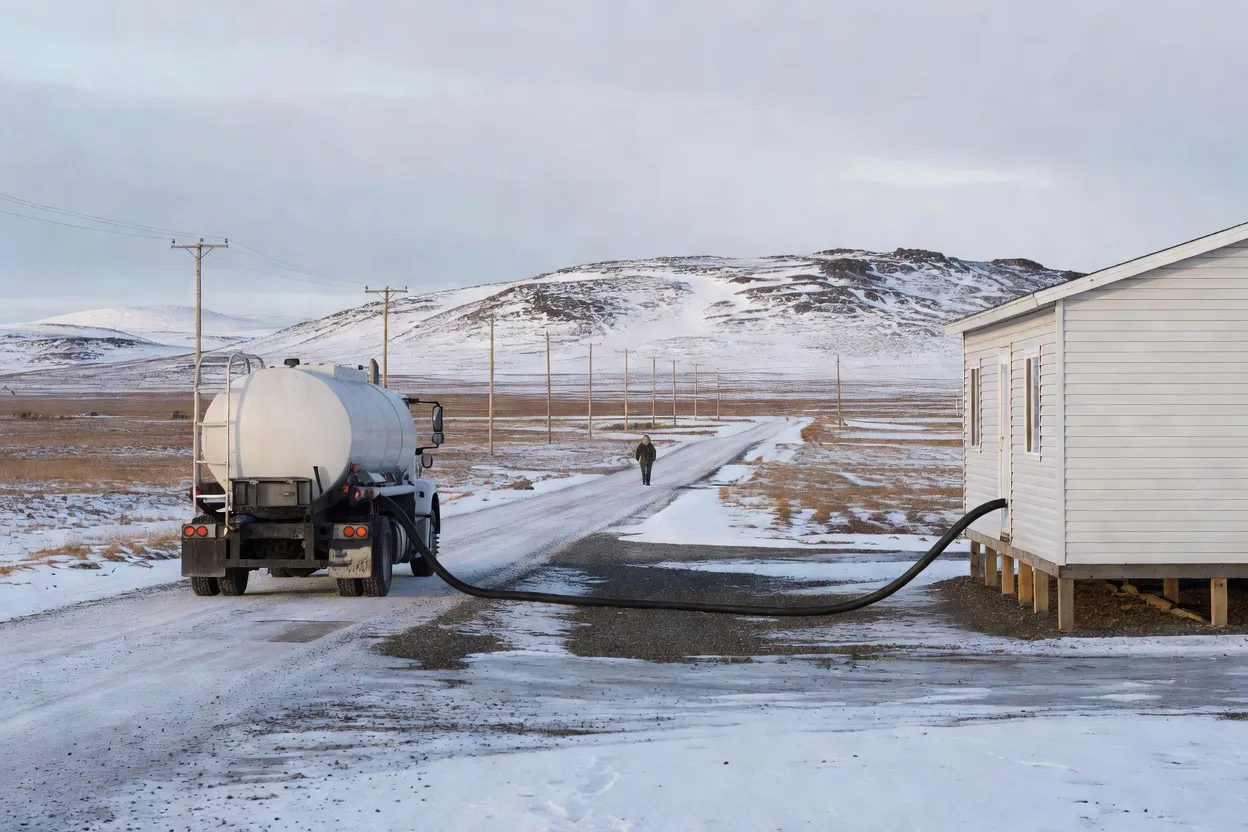
In most Nunavik villages, drinking water does not flow through pipes to the homes. It is treated at a local plant, then delivered by tanker truck. This public service is part of daily life in Inuit communities, as much as government services in the villages. This article presents how delivery works, how responsibilities are shared and two episodes documented by the northern press and the regional government.
A network of trucks rather than pipes
According to Inuit Tapiriit Kanatami (ITK), 41 of the 51 Inuit communities in Inuit Nunangat rely solely on tanker-truck delivery. Water is delivered to each home’s tank. Only five communities are served exclusively by piped systems: Inuvik, Kuujjuarapik, Resolute Bay, Nain and Hopedale. Kuujjuarapik is therefore the only Nunavik community in that situation.
The truck is thus not an emergency measure but the normal way water is distributed. When a truck breaks down or a road is blocked, delivery slows even if the treatment plant is operating.
Who does what: Northern Villages and the KRG
Municipal services, including water distribution, are provided by the Northern Villages. The Kativik Regional Government (KRG) offers technical assistance and, according to the Inukjuak mayor, funds water and sewer trucks, but not enough, without running the services itself: its chair Hilda Snowball sums it up by saying that the Northern Villages are the ones that deliver them.
In May 2024, Nunatsiaq News reported difficulties in several villages: broken water and sewer trucks, a treatment plant out of service, long waits for parts and a shortage of mechanics in Inukjuak, which has three water trucks. In that report, schools must close when water or sewer service is interrupted for more than two hours, and health facilities see their cleaning and staff retention affected.
Aupaluk: nine months under a boil-water advisory
In December 2024, the village of Aupaluk, with about 230 residents, had been under a boil-water advisory continuously for nine months, according to CBC. In summer and fall the village pumps water from the nearby river into a reservoir, but the river freezes in winter. Once the stored water is used up, water comes from a lake about five kilometres from the village.
The KRG considered it a water quantity problem rather than a quality problem. According to CBC, in December 2024 it was investing $2.9 million in a new prefabricated reservoir, within a $15 million budget planned through 2026 for water infrastructure upgrades. According to Nunatsiaq News, in August 2025 the installation of that reservoir was still listed as ongoing in the May public works report. According to the KRG municipal public works activity report of November 2025, the reservoir erection was completed and the insulation work was to be completed the following summer. Mayor Maggie Akpahatak said the old tank was too small, with water shortages every winter.
Puvirnituq: the frozen line of 2025
In March 2025, the line of about five kilometres linking the river pump to Puvirnituq’s treatment plant froze. A boil-water advisory was issued on March 20 and was still in force in mid-May, according to Nunatsiaq News.
With the line out of service, trucks had to collect water at the river. Only three of the municipality’s five water trucks were running for more than 2,000 residents, some homes went up to three weeks without delivery, and the hospital and school were served first. The KRG helped clear snow, source truck parts and test water. A temporary replacement pipe and other supplies arrived, while the permanent pipe was to be delivered by ship from England (situation as of mid-May 2025). The municipal council declared a state of emergency after the water shortage hampered firefighters at a house fire, and on May 16 the Inuulitsivik Health Centre relocated patients and elders to Montreal hospitals. According to the KRG municipal public works activity report of November 2025, the temporary raw water pipeline was later dismantled, and the damaged section of the raw water pipeline was repaired and recommissioned on October 15.
In mid-May 2025, six other Nunavik communities were under boil-water advisories, three of them as a precaution because of technical problems. A KRG official said at the time that there was no trace of drinking-water contamination in any of the villages.
| Aupaluk | Puvirnituq | |
|---|---|---|
| Period | Boil-water advisory in place for nine months as of December 2024 | Advisory issued March 20, 2025, still in force in mid-May |
| Population | About 230 residents | More than 2,000 residents |
| Cause | River frozen in winter, reserve exhausted | Pipeline of about 5 km frozen between the pump and the plant |
| Response | New $2.9-million tank funded by the KRG | Temporary pipe in May 2025; damaged section repaired and recommissioned on October 15, 2025 |
Permafrost and freezing
The freezing of the Puvirnituq line shows that the Arctic winter can interrupt water production itself. Permafrost is another factor. According to Ouranos, its thaw can cause ground instability and settling, increase the risk of landslides, weaken building foundations and warp or crack roads and airstrips. In 1998, 20 houses had to be relocated in Salluit after a landslide.

Water, housing, health and remote monitoring
Access to water intersects with several issues. Constraints of buildings and terrain overlap with housing and infrastructure, and water quality bears directly on health and health services. Technical trades are also passed on through practice: our feature on vocational and post-secondary training describes the framework.
For equipment whose monitoring depends on a data link, remote IT assistance for Nunavik and northern Quebec is one possible source of support.
Key takeaways
- In Nunavik, drinking water is delivered by tanker truck in most villages; Kuujjuarapik is the only Nunavik community served solely by pipes.
- The Northern Villages provide municipal services; the KRG provides technical assistance and, according to the Inukjuak mayor, funds the trucks, though not enough.
- Aupaluk went nine months under a boil-water advisory in 2024, and Puvirnituq suffered a frozen-line failure in spring 2025: both cases show the scale of the constraints that the villages and the KRG manage in a system that depends on trucks, seasonal sources and winter.
Sources
- Inuit Tapiriit Kanatami, Access to Drinking Water in Inuit Nunangat
- CBC News, Aupaluk: nine months of boil-water advisory and a new reservoir
- Nunatsiaq News, Puvirnituq water supply woes stretch on
- Nunatsiaq News, Puvirnituq mayor sees reason for hope
- Nunatsiaq News, Nunavik villages lack reliable access to water
- Ouranos, Permafrost impacts
Frequently asked questions
How does drinking water reach homes in Nunavik villages?
According to Inuit Tapiriit Kanatami, 41 of the 51 Inuit communities in Inuit Nunangat rely solely on tanker-truck delivery, which fills each home's water tank. In Nunavik, Kuujjuarapik is one of five Inuit communities served exclusively by piped systems.
Who provides water services in northern villages?
Municipal services are provided by the Northern Villages. The Kativik Regional Government (KRG) offers technical assistance and, according to the Inukjuak mayor, funds water and sewer trucks but not enough; in the words of KRG chair Hilda Snowball, it is the Northern Villages that deliver municipal services.
What is a prolonged boil-water advisory for households?
A boil-water advisory recommends boiling water before drinking it when it has not been tested. In Aupaluk, the advisory had been in force for nine months in December 2024. The KRG saw a water quantity problem rather than a quality problem and was investing $2.9 million in a new reservoir.
What happened in Puvirnituq in 2025?
In March 2025, the five-kilometre line linking the river pump to the treatment plant froze. A boil-water advisory was issued on March 20, trucks had to collect water at the river, and only three of the village's five water trucks were running for more than 2,000 residents.
Why does permafrost cause problems for northern infrastructure?
According to Ouranos, permafrost thaw can cause ground instability and settling, weaken building foundations and warp roads and airstrips. In 1998, 20 houses in Salluit had to be relocated after a landslide.