
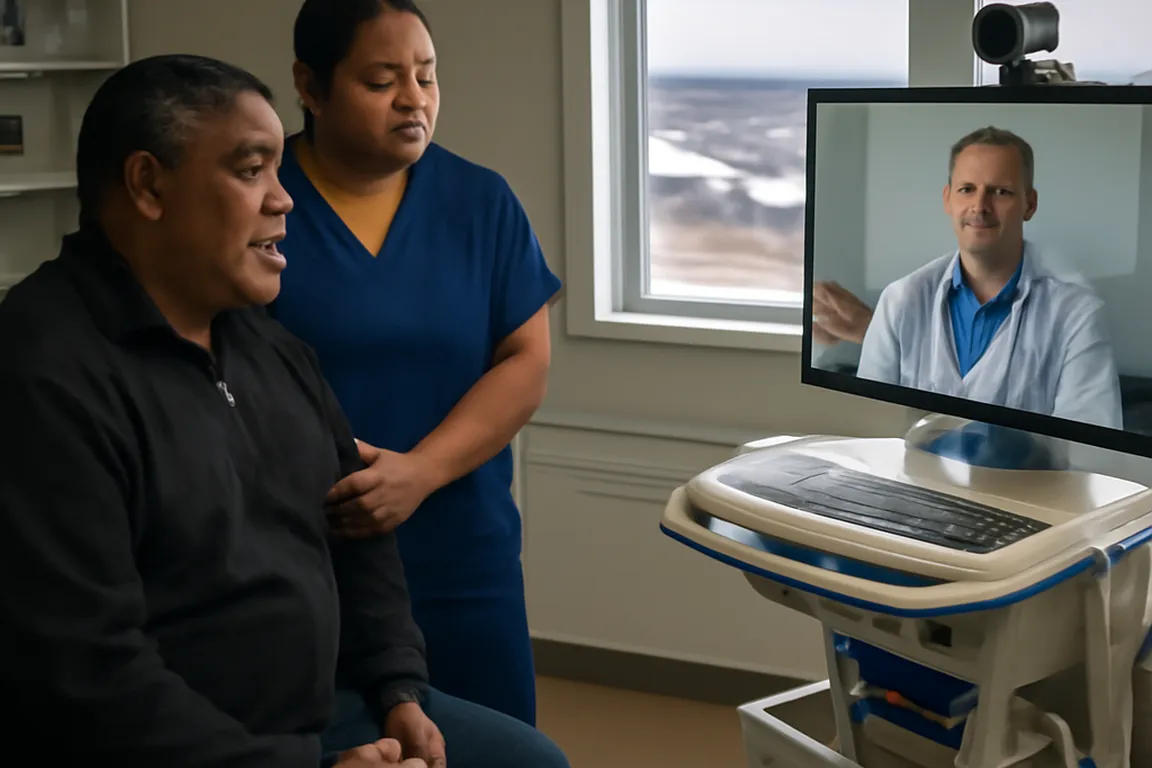
In a territory where the nearest hospital can be more than 1,500 kilometers away and where the only available mode of transport is by air, telemedicine is not a mere technological convenience: it has become a structural pillar of access to care in Nunavik and Eeyou Istchee. But this technological promise remains entirely dependent on network infrastructure that the territory is still struggling to bring up to a level of reliability comparable to southern Quebec.
This feature examines the state of e-health in Northern Quebec in 2026: the technologies actually deployed, the bandwidth constraints that limit their reach, and the investments needed for telemedicine to fully deliver on its promise. For the broader regional connectivity context, see our feature on internet providers in Nunavik. For social and economic news on Quebec’s Indigenous communities, Le Peuple Actu regularly publishes analysis that sheds light on the broader context of this digital health transformation.
Access to healthcare remains one of the most sensitive indicators of territorial inequality in Quebec. In Nunavik and Eeyou Istchee communities, this access long meant near-total dependence on air evacuations for anything beyond primary care. The rise of telemedicine over the past two decades has gradually changed that reality, without eliminating it entirely.
Geographic remoteness and access to care in Nunavik
Nunavik has 14 coastal villages, none connected by road to southern Quebec’s road network. Each village has a primary health center, but access to specialized care — cardiology, oncology, psychiatry, specialized pediatrics — has historically required travel to Montreal, Quebec City or, for certain cases, to the Kuujjuaq hospital center when it has the required capacity.
A chartered medical flight from an isolated village like Aupaluk or Ivujivik to Montreal represents a cost of several thousand to tens of thousands of dollars depending on weather conditions and urgency, not counting the physical and psychological stress imposed on the patient and family, often separated from their community support network for the duration of treatment.
Telemedicine has gradually established itself since the 2000s as a tool to reduce these avoidable trips, with a notable acceleration since the COVID-19 pandemic, which broadened cultural and clinical acceptance of remote consultation.
The role of the Nunavik Regional Board of Health and Social Services
The Nunavik Regional Board of Health and Social Services (NRBHSS) coordinates all health services in the region, including the deployment and management of the telemedicine program. The organization partners with major university hospital centers in the south — notably the CHUM and the Montreal Children’s Hospital — to organize structured access to remote specialist consultations.
This regional governance enables coherent coordination among the 14 local health centers, rather than a proliferation of isolated, mutually incompatible initiatives. The NRBHSS also negotiates the clinical protocols that determine which types of consultations can legitimately be done remotely and which always require a physical presence.
Key takeaway: telemedicine in Nunavik is not a technological improvisation in the face of isolation, but a structured program spanning more than two decades, with established clinical protocols and dedicated regional governance.
This institutional maturity sets Nunavik apart from many other remote regions where telemedicine remains a one-off initiative, dependent on temporary project funding rather than durably embedded in routine care delivery. The NRBHSS has made telemedicine a permanent component of its service offering, with a recurring dedicated budget rather than funding through a one-time grant renewed year after year.
Telemedicine technologies currently deployed
The technical setup relies on several complementary building blocks:
- Dedicated clinical videoconferencing: medical-grade equipment (not simple consumer software) installed in health centers, providing a video stream stable and secure enough for clinical use.
- Remote examination peripherals: digital stethoscopes, otoscopes and dermatoscopes that transmit diagnostic-quality physical exam data to the remote specialist.
- Shared patient record platforms allowing the specialist in the south to consult medical history before and during the teleconsultation.
- Priority links: some health centers have bandwidth dedicated to medical uses, separate from and prioritized over the village’s residential network, to guarantee service quality during teleconsultation slots.
Bandwidth and network reliability: the critical bottleneck
The entire promise of telemedicine collapses if the connection degrades mid-consultation. This is the number one structural constraint of the system in Nunavik.
| Consultation type | Minimum recommended bandwidth | Tolerable latency | Sensitivity to outages |
|---|---|---|---|
| Chronic follow-up (simple video) | 3-5 Mbps | Up to 300 ms | Moderate |
| Specialist opinion with assisted exam | 8-10 Mbps | Under 200 ms | High |
| Tele-ultrasound / transmitted imaging | 10-15 Mbps | Under 150 ms | Very high |
| Pre-evacuation triage | 3-5 Mbps | Up to 400 ms | Moderate |
Villages with low-earth-orbit satellite service (Starlink, Telesat Lightspeed) now offer service quality compatible with most clinical uses. Villages still dependent on classic geostationary satellite experience latency that complicates fine clinical exchanges, particularly for consultations requiring quick verbal interaction between the patient, the on-site nurse and the remote specialist.
Common mistake: underestimating the impact of residential peak hours on the quality of a clinical teleconsultation scheduled in the late afternoon, when dozens of households in the village are simultaneously using the same shared satellite cell. Telemedicine slots scheduled in the morning generally benefit from better reliability.
Digital patient records and privacy challenges
Digitization of patient records in Nunavik follows the same regulatory requirements as everywhere in Quebec, with additional considerations specific to the northern context. Medical data is hosted in Canadian data centers compliant with security standards applicable to the health network, with systematic encryption of data in transit and at rest.
Limited connectivity requires specific architectural choices: rather than continuous real-time synchronization, which would saturate available bandwidth, systems favor delayed synchronization for non-urgent record updates, reserving real-time network capacity for active consultations and emergencies.
This same authentication and privacy challenge extends to digital access to government services in Nunavik, where the same connectivity constraints complicate real-time identity verification for other administrative processes beyond health records.
The question of data sovereignty over Inuit and Cree community health data connects to the broader debate on northern digital sovereignty, addressed in our feature on Nunavik connectivity and digital infrastructure.
The role of local nurse practitioners and CLSCs
No telemedicine consultation works without competent local clinical presence. Nurse practitioners and CLSC staff form the indispensable link in the setup: they welcome the patient, perform basic physical exams, operate remote examination peripherals, and interpret the clinical nuances that the camera alone cannot convey to the remote specialist.
This reality deserves emphasis in the face of a sometimes simplistic narrative that presents telemedicine as a substitute for local medical staff. It’s the opposite: telemedicine multiplies the expertise available to this staff, it never replaces them.
Current limits: when teleconsultation isn’t enough
Certain clinical situations structurally escape telemedicine, regardless of connection quality:
- Surgical and trauma emergencies requiring immediate physical intervention.
- High-risk deliveries, which require obstetric presence and on-site surgical capacity.
- Examinations requiring fine physical manipulation impossible to replicate remotely, even with advanced connected peripherals.
- Situations where the patient has communication difficulties that make remote interaction less effective than a physical presence.
In these cases, telemedicine retains a useful coordination role: it allows the remote specialist to prepare for the patient’s arrival before transfer, reducing delays once the patient arrives at the hospital.
Comparison with southern Quebec health networks
Local health hubs and multidisciplinary health centers in southern Quebec are also experimenting with telemedicine, but in a fundamentally different context: abundant bandwidth, relative proximity to hospitals should teleconsultation fail, and denser medical staffing.
| Criterion | Nunavik / Eeyou Istchee | Southern Quebec (local health hubs, health centers) |
|---|---|---|
| Typical bandwidth | 5-150 Mbps depending on village | 100 Mbps - 1 Gbps |
| Distance to reference hospital | 300-1,700 km, air only | 20-150 km, road |
| Role of telemedicine | Structural, often essential | Complementary, often optional |
| Local clinical staffing | Nurse practitioners, rotating physicians | Family physicians on permanent staff |
This comparison illustrates why the reliability of network infrastructure carries disproportionate weight in Nunavik: where a telemedicine outage in the south simply postpones a routine consultation, the same outage in Nunavik can delay a clinical opinion decisive to whether or not to evacuate a patient.
Planned infrastructure investments
Several investment priorities shape the roadmap for northern e-health in the coming years:
- Modernizing clinical videoconferencing equipment in the oldest health centers.
- Extending priority links dedicated to health, separate from the residential network, to guarantee service quality regardless of public network load.
- Progressively deploying a unified electronic patient record between institutions in Nunavik, Eeyou Istchee and southern hospitals.
- Ongoing training of nursing staff in the use of the latest remote examination peripherals.
These investments remain conditional on provincial and federal budget cycles, which explains the pace sometimes seen as slow relative to needs identified in the field.
2026-2030 outlook for northern digital health
Continued improvement in low-earth-orbit satellite connectivity, documented in our feature on Nunavik internet providers, should progressively reduce the technical limitations that still affect some villages. Wider availability of more stable links opens the door to more advanced uses: real-time tele-ultrasound, enriched telepsychiatry, and remote monitoring of physiological parameters via wearable connected devices.
Coordination with Eeyou Istchee organizations, including the Niskamoon Corporation, which supports several community health initiatives, illustrates a deeper trend: growing integration of the specific perspectives and needs of communities into the very design of digital health tools, rather than a simple transposition of solutions designed for southern Quebec. This inter-organizational coordination between Nunavik and Eeyou Istchee, two territories with distinct cultural realities but comparable infrastructure challenges, is gaining importance as regional digital projects multiply.
Funding for northern e-health: sources and sustainability
Funding for telemedicine programs in Nunavik and Eeyou Istchee comes from several combined sources, which has direct implications for project sustainability and the long-term planning capacity of clinical teams.
Base funding comes from the recurring budget of Quebec’s Ministry of Health and Social Services, allocated to the NRBHSS under a formula that accounts for the geographic dispersion of the population served. This funding covers routine operating costs: equipment maintenance, coordination staff salaries, and subscriptions to clinical videoconferencing platforms.
Federal programs, notably those administered by Indigenous Services Canada, supplement this base funding for one-off infrastructure projects: renewal of aging equipment, deployment of new remote examination peripheral technologies, or expansion of dedicated medical bandwidth at health centers that still lack it.
Finally, partnerships with foundations and university research programs occasionally fund more experimental pilot projects, such as integrating new connected sensors or studying the clinical impact of telemedicine on specific patient cohorts.
Important: while the multiplicity of funding sources allows some flexibility, it also complicates long-term planning. A project funded by a one-time grant that isn’t renewed can find itself interrupted, leaving clinical teams and patients without continuity of service. The organizations that succeed best are those that manage to migrate promising pilot projects into recurring base-budget funding.
Cultural acceptability of telemedicine
Beyond technical considerations, the adoption of telemedicine in Inuit and Cree communities also depends on its cultural acceptability. Elders, in particular, sometimes express a preference for care delivered in physical presence, rooted in community traditions of closeness. The clinical teams that succeed best in deploying telemedicine take the time to explain how the technology works, systematically pair a trusted local staff member with the remote consultation, and never impose teleconsultation as the only option available when an alternative with physical presence remains possible within a reasonable timeframe.
The language question also remains present: while most consultations take place in French or English with the support of an Inuktitut or Cree interpreter when needed, the availability of remote medical interpretation services remains uneven from one health center to another. Strengthening this interpretation capacity is among the priorities identified by several stakeholders in the regional network. The mental health component illustrates these human and technical support challenges particularly well, a topic explored further in our interview on mental health and digital social services in Nunavik.
The role of continuous training for nursing staff
The quality of a teleconsultation does not depend solely on available bandwidth or the sophistication of remote examination peripherals: it depends just as much on the competence of local nursing staff in using these tools effectively and correctly interpreting instructions relayed by the remote specialist. The NRBHSS, in collaboration with several Quebec nursing education institutions, has developed continuing education modules specifically designed for nurse practitioners working in a northern context.
These modules cover both technical aspects (handling digital stethoscopes, calibrating connected dermatoscopes, troubleshooting common connection issues) and the clinical and relational aspects specific to telemedicine — how to structure a three-way consultation (patient, nurse, specialist), how to manage silences and transmission delays without losing the clinical thread, and how to adapt medical vocabulary for smooth interpretation when an Inuktitut or Cree interpreter is involved.
Retaining qualified nursing staff remains a structural challenge in several Nunavik villages, which complicates building cumulative expertise in telemedicine. Nurses who stay in their positions for several years develop a comfort with telemedicine tools that measurably improves consultation quality — a factor often underestimated in strictly technical evaluations of the system.
Conclusion
Telemedicine is today an indispensable, but not sufficient, pillar of access to care in Northern Quebec. Its effectiveness depends directly on the quality of network infrastructure that remains uneven from one village to the next, and its optimal deployment requires preserving the central role of local clinical staff rather than treating it as a simple technical relay.
To go further into the infrastructure issues underlying this transformation, see our feature on Kuujjuaq, Nunavik’s capital, home to several of the region’s most important health institutions.
Frequently asked questions
What minimum bandwidth is needed for reliable telemedicine consultations?
A video teleconsultation of acceptable quality requires a stable rate of at least 3 to 5 Mbps simultaneously (upload and download), ideally with latency under 150 ms. For more demanding uses such as tele-ultrasound or transmission of high-resolution medical images, a rate of 10 Mbps or more is recommended. Over a classic geostationary satellite link with 600 ms latency, consultations remain possible but with noticeable response delays that complicate fine clinical exchanges.
What types of consultations can actually be done remotely in Nunavik?
Follow-up consultations for chronic conditions (diabetes, hypertension, mental health), specialist opinions in dermatology, psychiatry and pediatrics, and initial triage before a possible evacuation, all lend themselves well to telemedicine. On the other hand, surgical emergencies, complicated deliveries and most interventions requiring a thorough physical exam still require transport to a southern hospital, with telemedicine then serving to prepare and coordinate that transfer.
How are digital patient records secured in a limited-connectivity context?
Digital patient records used in Nunavik rely on systems hosted in Canadian data centers, with encryption of data in transit and at rest. Limited connectivity requires an architecture that favors delayed synchronization for non-urgent updates, reserving real-time bandwidth for active consultations. Access remains subject to the same confidentiality requirements as everywhere in Quebec, reinforced by the specific protocols of the Nunavik Regional Board of Health and Social Services.
What role do local nurses and CLSCs play in the telemedicine setup?
Nurse practitioners and CLSC staff form the indispensable link in northern telemedicine: they welcome the patient, perform basic physical exams (vital signs, palpation, assisted ultrasound), and serve as technical and clinical intermediaries with the specialist consulted remotely. Telemedicine does not replace this on-site staff — it multiplies their reach by giving them access to specialized expertise otherwise unavailable locally.
Does telemedicine replace medical air evacuations?
No, telemedicine reduces the number of avoidable medical evacuations by enabling a rapid specialist opinion that sometimes confirms transport isn't necessary, but it does not replace evacuations for cases requiring urgent physical intervention. Available data suggest a significant reduction in non-essential evacuations since teleconsultation became widespread, representing substantial savings given the high cost of a chartered medical flight from Nunavik to Montreal or Quebec City.
What health infrastructure investments are planned by 2030?
Announced investments focus mainly on modernizing teleconsultation equipment in existing health centers, improving bandwidth dedicated to priority medical links (separate from the residential network), and progressively deploying unified electronic patient records between Nunavik, Eeyou Istchee and southern hospitals. The pace of these investments remains conditional on provincial and federal budgets allocated to northern infrastructure.