
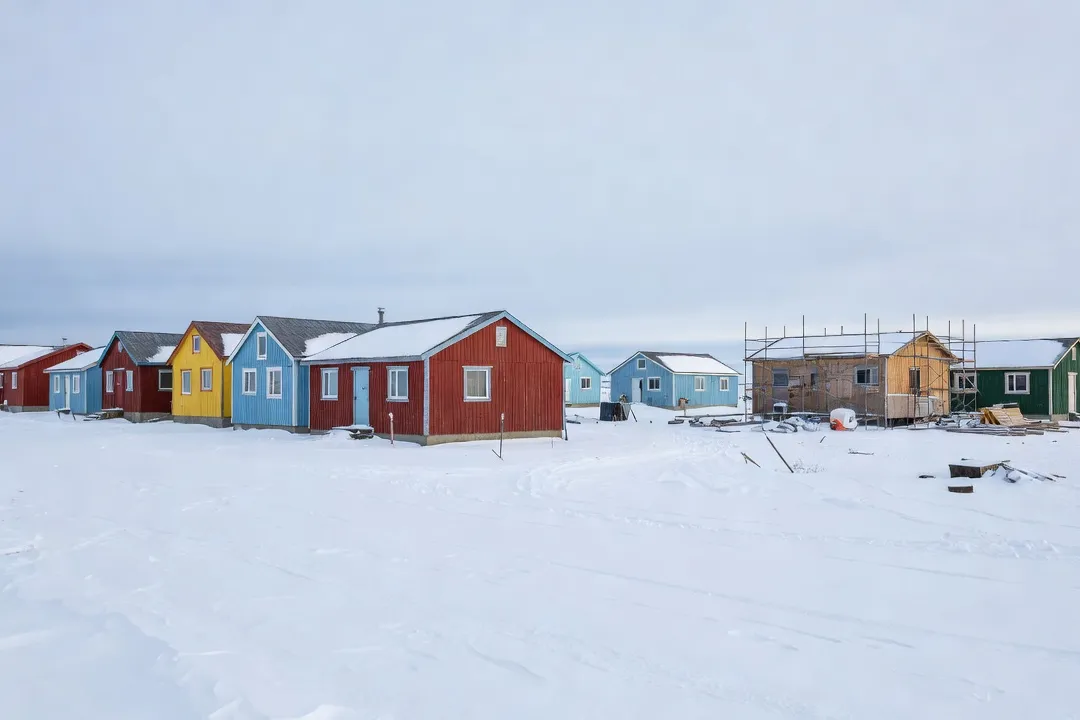
Nunavik is currently short about 1,039 housing units, a shortfall up 16% since 2021. Nearly one household in two lives in an overcrowded situation. And building a house in one of the region’s 14 villages still costs, in 2026, more than double the price of an equivalent house in Quebec City. This is not a recent problem: it is an infrastructure debt that has been accumulating for decades, worsened by population growth that the current pace of construction cannot keep up with.
This feature does not claim to solve the issue — that would be far beyond the scope of a blog post. It instead tries to gather, sourced and dated, the data needed to understand the real scale of the problem, why it is so hard to fix in a territory with no road network, and which approaches are actually being tested rather than simply announced.
The scale of the shortfall, in numbers
The most recent available data (2025) put the shortfall at 1,039 housing units across all of Nunavik, up from 893 in 2021 — a 16% increase in four years that shows current construction doesn’t even offset population growth, let alone close the accumulated gap.
| Indicator | Value | Source / year |
|---|---|---|
| Housing shortfall | 1,039 units | 2025 study, +16% vs. 2021 |
| Social housing stock | ~4,071 to 4,200 units | Kativik Municipal Housing Bureau |
| Overcrowded households | 47% | Radio-Canada |
| Core housing need rate | 34% (vs. 6% for all of Quebec) | Nunivaat, 2021 |
| Annual construction pace | ~100 units/year | Radio-Canada, multiple sources |
| Households on the waiting list | 500 to 600 people | Regional housing office |
The core housing need rate — the statistical measure combining overcrowding, poor housing condition and financial inability to afford decent housing — is nearly six times higher than the rest of Quebec. That’s the most telling gap: this isn’t a matter of degree, but a structurally different situation from the rest of the province.
Why population growth makes things worse every year
Nunavik has one of the highest population growth rates in Quebec, driven by a birth rate well above the provincial average. A housing stock that merely stagnated would already produce a growing shortfall; a stock that grows by barely 100 units a year against this demographic backdrop mechanically widens the gap year after year, regardless of any short-term factor.
That’s what explains the shortfall growing 16% in four years despite real public investment. Closing the current gap would require building well beyond the current pace for several consecutive years, while simultaneously absorbing population growth — a target that neither logistics capacity nor available labour currently allow to reach at the same time.
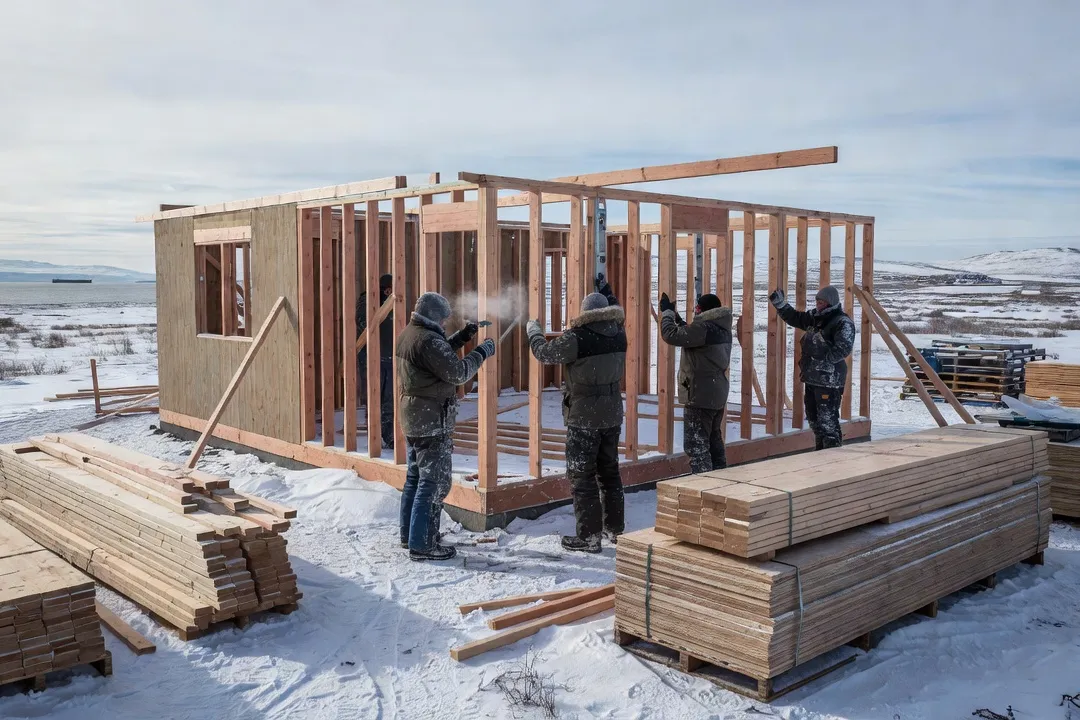
Why building in Nunavik costs two to three times more than in the south
None of Nunavik’s 14 communities is connected by road. Everything that goes into a construction site — lumber, steel, cement, windows, plumbing and electrical equipment — must be shipped either by boat during a limited summer resupply window (generally late June to early October), or by plane outside that window, at a significantly higher cost.
This logistical constraint is not a marginal line item in a project’s cost structure:
- The Quebec government estimates that handling and transport alone account for roughly 20% of total construction cost, before even the price of materials themselves.
- Port unloading capacity and the number of ship rotations possible before autumn freeze-up physically limit how much material can arrive in a given season — a weather delay or a port strike can push back an entire project by several months, or even a full year.
- Permafrost requires specific foundation methods and complicates the very choice of buildable land near existing villages.
- Skilled labour often has to be brought in from the south, with the accommodation and travel costs that involves.
The concrete result: the Société d’habitation du Québec already estimated the cost of a 98 m² house in Kuujjuaq at nearly $345,000, more than double an equivalent house built in Quebec City. There is no structural reason for this gap to close as long as the supply model remains unchanged.
What the SHQ and the Kativik Municipal Housing Bureau are doing
The Société d’habitation du Québec (SHQ) remains the main provincial funder for housing programs in northern Quebec. On the ground, the Kativik Municipal Housing Bureau manages most of the social housing stock across the 14 villages and administers the waiting lists, estimated at several hundred households based on available data.
These programs fall within a broader framework stemming from the James Bay and Northern Quebec Agreement, which recognizes specific obligations toward Nunavik’s Inuit communities on housing and infrastructure. One-off federal-provincial funding agreements are regularly announced to accelerate certain projects, but their cumulative effect remains, year after year, below the pace needed to reverse the trend.
Solutions being tested rather than isolated announcements
Several approaches are currently being tried or proposed to break this pattern of accumulating shortfall:
- Partial modular prefabrication in the south — building part of the components (walls, pre-assembled plumbing elements) in southern Quebec factories before shipping them by boat reduces actual on-site construction time, where labour and the usable season are the scarcest resources.
- Local housing cooperatives — the co-op model, already present in Kuujjuaq, allows pooling some construction and maintenance costs while giving residents direct control over managing their housing, rather than depending solely on a remotely managed social housing stock.
- Multi-year supply planning — rather than ordering materials project by project, grouping orders over several years makes better use of each available ship rotation and reduces the risk that a single weather delay derails an entire project.
- Local construction workforce training — professional training programs in construction offered locally (see our feature on professional and postsecondary training in Nunavik) aim to reduce dependence on labour brought in from the south, which eases part of the temporary accommodation costs on construction sites.
None of these approaches alone is enough to close a shortfall of over 1,000 units. Their value is cumulative: each removes one constraint from the system (labour cost, logistics window, financing, local governance) without claiming to solve the crisis on its own.
The cooperative model deserves a closer look, because it illustrates well this logic of a constraint partly lifted rather than a miracle solution. A housing cooperative brings together a group of households who become joint owners of the building, pool routine maintenance costs, and take turns managing the property. This model reduces dependence on a single housing office for every minor maintenance decision, which speeds up routine repairs — but it also requires a sufficient contributor base and a collective management culture that takes time to establish, which explains why its rollout remains limited to a few communities rather than generalized across all of Nunavik.
Different situations depending on the village
The regional figure of 47% of overcrowded households masks significant differences from one village to another. The most isolated communities on Hudson Bay — Ivujivik, Akulivik, Puvirnituq — generally combine the hardest access to materials (fewer ship rotations than on the Ungava Bay route) with some of the strongest demographic pressure in the region. Kuujjuaq, as the administrative capital, has a particular status: served by a larger airport and more diversified economic activity, it also attracts a disproportionate share of newcomers coming to work for regional institutions, which feeds its own housing pressure despite relatively more sustained investment.
This local variation explains why the solutions to prioritize aren’t uniform: a housing cooperative that works well in Kuujjuaq, where the village’s size allows for simpler close-proximity management, doesn’t necessarily transfer as-is to a village of fewer than 500 residents where the pool of potential contributors is too small to fund long-term stock maintenance.

What the waiting lists reveal about lived reality
The 500 to 600 people on the waiting list recorded by the regional housing office represent only a partial snapshot of the problem: a good share of households in real overcrowding situations never appear on an official waiting list, either because they cohabit with family by choice as much as by necessity, or because the administrative process to register discourages some of the people who would need it. Social workers in the region regularly report that the real wait time for a family without a particular priority status (elder, person with reduced mobility, domestic violence situation) can stretch over several years, a duration with documented repercussions on children’s schooling, respiratory health, and the residential stability of young households. A house originally designed for four or five people can end up housing twice that number for several consecutive years, without this situation ever appearing in official wait-time statistics.
The link with connectivity and digital services
The housing crisis is not a topic isolated from the rest of the region’s digital development. A modern construction site itself depends on reliable connectivity — shared plans online, logistics coordination with southern suppliers, tracking shipments by boat. Our feature on Nunavik internet costs documents a very similar cost dynamic: the same geographic constraint that drives up construction costs also drives up the cost of network access, with the same two-to-five-times gap compared to southern Quebec on otherwise essential goods and services.
Similarly, managing waiting lists, housing requests and maintenance of the existing stock increasingly relies on municipal digital tools — a topic we cover in our feature on digital municipal governance in northern villages.
The bottom line
Nunavik’s housing shortfall is not a one-time problem that a single wave of investment will resolve. It is a structural consequence of three cumulative factors: high population growth, construction costs two to three times higher than southern Quebec due to the absence of a road network, and a construction pace that, at around 100 units a year, only slows the worsening of the problem without ever reversing it.
The approaches currently being tested — prefabrication, cooperatives, multi-year planning, local training — each tackle one link in this chain of constraints. Their real effect will only be measurable over several years, as the accumulated shortfall is compared, year after year, to the actual construction pace across the 14 villages.
Main sources consulted for this feature: Radio-Canada (Espaces autochtones and ICI Radio-Canada), Nunatsiaq News, Nunivaat, Société d’habitation du Québec (habitation.gouv.qc.ca), Kativik Regional Government, Le Soleil (2026-05-02, Kuujjuaq cooperatives), FRAPRU. Figures consulted in August 2026; social housing data evolves with these organizations’ successive publications.
Frequently asked questions
How many housing units is Nunavik short of in 2026?
A 2025 study puts the shortfall at 1,039 units, up 16% from the 893 missing units recorded in 2021. The current social housing stock is around 4,071 to 4,200 units for the entire region, managed mostly by the Kativik Municipal Housing Bureau. Some broader estimates, which also factor in renovation and replacement needs for the aging stock, point to a shortfall close to 800 additional units just to absorb demographic growth over the coming years.
Why is housing overcrowding so common in Nunavik?
Radio-Canada reports that 47% of Nunavik households are overcrowded, and Nunivaat estimates the core housing need rate in the region at 34%, compared to 6% for Quebec as a whole. This situation stems from the combination of an insufficient housing stock, population growth well above the Quebec average, and a construction pace that has not kept up with that growth for several decades. Several generations of the same family then end up sharing the same home for lack of an available unit.
Why is it so expensive to build a house in Nunavik?
None of Nunavik's 14 villages is connected to any road network: every construction material must arrive either by ship during a limited summer resupply window (roughly late June to early October), or by plane outside that window at significantly higher cost. The Quebec government estimates that handling and transport alone account for around 20% of total construction cost. On top of that comes the near-total import of materials (lumber, steel, cement), permafrost constraints on site selection, and housing costs for workers brought in from the south. The SHQ already estimated the cost of a 98 m² house in Kuujjuaq at nearly $345,000, more than double an equivalent house in Quebec City.
How many new housing units are built each year in Nunavik?
The construction pace sits around 100 housing units per year for the whole region, a figure regularly cited as insufficient given both the accumulated shortfall and ongoing population growth. Exceeding this threshold is difficult in practice: port unloading capacity, the number of ship rotations possible before freeze-up, and the availability of skilled labour physically limit how many construction sites can run in parallel each season.
Which organizations manage social housing in Nunavik?
The Kativik Municipal Housing Bureau manages most of the social housing stock across the 14 communities, with a waiting list estimated at several hundred households according to available data. The Société d'habitation du Québec (SHQ) remains the main provincial funder for housing programs in northern Quebec, alongside federal programs specifically targeting Nunavik Inuit under agreements stemming from the James Bay and Northern Quebec Agreement.