

The digitization of public services, businesses, and cultural activities in Nunavik and Eeyou Istchee generates growing volumes of data every year. These data concern health, territory, languages, community finances, natural resources, and oral heritage. For Indigenous organizations and local administrations, the question is no longer only how to store this information, but who controls it. Digital sovereignty and data governance have become strategic issues on par with electricity, transportation, and connectivity.
This article is intended for managers of organizations, municipalities, clinics, and cooperatives across northern Quebec. It offers a practical framework for understanding what data governance means in a northern context, which actors carry it, which obstacles slow its implementation, and which steps allow an organization to begin without waiting for unlimited resources. The technical protection of these data is directly linked to the cybersecurity practices we documented in our cybersecurity guide for organizations in Nunavik and Eeyou Istchee.
What digital sovereignty means in the Quebec Far North
Digital sovereignty refers to a community’s ability to master the infrastructure, platforms, and data that concern it. For Indigenous peoples in Quebec, this concept builds on the broader principle of Indigenous data sovereignty, supported by the federal government in recent strategic documents Rapport sur les résultats ministériels de 2024-2025. The Canada School of Public Service notes that Indigenous peoples must be able to decide how information about them is collected, used, and shared La souveraineté des données autochtones.
In Nunavik and Eeyou Istchee, this sovereignty takes concrete form. It means being able to host patient records on servers whose access the communities control, deciding which language data may be shared with outside researchers, keeping territorial maps in systems that do not depend on a foreign vendor, and ensuring that demographic statistics primarily serve local priorities. Geography is not merely a logistical obstacle: it transforms digital sovereignty into a resilience issue, because a satellite or fibre outage can isolate a village for hours or days.
This reality distinguishes northern Quebec from urban contexts. In a southern city, digital sovereignty is often discussed in terms of vendor choice, data location, or regulatory compliance. In Nunavik, it first means maintaining an essential service without an outside connection, training local administrators, and ensuring that decisions about data remain made on the territory.
The stakeholders in Inuit and Cree data governance
Data governance in Nunavik and Eeyou Istchee involves several levels of actors, each with different mandates and capacities. Coordination among these actors remains central, because no single body holds all the levers.
The Kativik Regional Government (KRG) plays a structuring regional role in Nunavik. It intervenes in infrastructure development, technical support for northern villages, and representation with the provincial and federal governments. Through Tamaani Internet, the KRG launched Nunavik’s first regional Internet service provider in 2004, a key milestone in Inuit digital sovereignty Tamaani Internet Timeline. Tamaani remains a central connectivity actor today.
The Cree Nation Government of Eeyou Istchee holds governance responsibilities at the scale of the Cree Nation. It leads territorial mapping and resource management projects, including a regional geospatial strategy developed with geographic information system tools Cree Nation Government: Mapping for Shared Understanding. These territorial data constitute a strategic asset whose control has political and economic dimensions.
Northern villages and local Cree administrations are the first responders for citizens. They collect permit applications, manage housing waitlists, deliver social services, and maintain administrative registers. Their ability to govern their own data determines the quality of services delivered. To understand how these administrations integrate digital tools into their processes, see our feature on digital municipal governance in northern villages.
Community organizations, cooperatives, clinics, and schools complete the picture. They often hold highly sensitive and culturally specific data, such as language recordings, oral histories, patient records, and information on subsistence practices. Finally, researchers, provincial and federal governments, and private companies regularly interact with these data as outside users, raising the question of sharing conditions.
Structural challenges of northern data governance
The challenges of data governance in Nunavik and Eeyou Istchee cannot be reduced to a lack of political will. They result from material, human, and institutional constraints that reinforce each other.
The first challenge is connectivity. Despite major investments, such as the 124 million dollars announced by the Quebec government in 2022 to improve Internet in the Nord-du-Québec region Investments to improve Internet in Nord-du-Québec, bandwidth remains limited, expensive, and vulnerable to weather. This complicates backup synchronization to outside data centres, the use of standard cloud services, and the deployment of real-time governance tools.
The second challenge is the shortage of specialized labour. Skills in database administration, IT security, information system architecture, and data analysis are rare in northern villages. Existing training is not always adapted to local realities, and career paths in the south often attract trained talent. This scarcity leaves organizations dependent on outside consultants, which weakens digital sovereignty.
The third challenge is data fragmentation. Information about the same issue is often scattered across the health ministry, the education ministry, regional bodies, municipalities, cooperatives, and independent researchers. Each actor uses its own formats, tools, and access rules. The result is duplication, contradiction, and data loss during system transitions.
The fourth challenge is legal. Quebec and Canadian privacy frameworks apply in the North, but they do not always address the specifics of Indigenous data. Sharing agreements, informed consent, access rights, and secondary-use conditions must be negotiated case by case, requiring legal and technical expertise that small organizations do not always possess.

Reference frameworks: OCAP, DMP, and local hosting
Several reference frameworks exist to structure data governance. The best known in Canada is OCAP, developed by the First Nations Information Governance Centre. OCAP stands for Ownership, Control, Access, and Possession The First Nations Principles of OCAP. These principles assert that First Nations hold collective rights over their data, control how they are collected and used, decide who can access them, and should be able to possess them physically or logically.
Although OCAP was originally designed for First Nations, it increasingly informs data governance discussions in Nunavik and Eeyou Istchee. Its strength lies in its simplicity and its ability to frame relationships with outside partners. A researcher studying health in a northern village, a company collecting geological data on Cree territory, or a government centralizing statistics must be able to demonstrate how it respects these four pillars.
A Data Management Plan (DMP) is another operational tool. It is a document that specifies, for a project or an organization, what data are collected, by whom, for what purpose, for how long, with what access rights, and under what sharing conditions. In a northern context, a good DMP includes clauses on server location, documentation language, community consent protocols, and mechanisms for returning data to communities.
Local hosting represents the third building block of governance. It does not mean systematically rejecting cloud services, but consciously choosing where the most sensitive data reside. For a health centre, a local server can host active patient records while an encrypted backup is sent to a Canadian data centre when bandwidth allows. For a language archive, a community server can preserve original recordings before any copy is shared with research partners. This hybrid approach combines sovereignty and resilience. It also connects to the connectivity issues covered in our feature on digital infrastructure in Nunavik.
Comparative table of data governance approaches
The choice of a governance strategy depends on the type of data involved. The following table compares traditional approaches, often inherited from central administrations, with sovereign approaches favoured by organizations across northern Quebec.
| Data type | Traditional approach | Sovereign approach | Main issue |
|---|---|---|---|
| Health data | Centralized in a single provincial system | Local server controlled by the health centre, encrypted backup in Canada | Continuity of care during network outages |
| Language and oral data | Archived at the research institution | Community custody, sharing under contract | Protection of heritage and elders |
| Territorial and mapping data | Files held by ministries or companies | Regional GIS managed by the Nation or Regional Government | Control of land use and resources |
| Municipal administrative data | Software hosted outside the territory | Tools hosted in Quebec with local administration | Decision-making autonomy and responsiveness |
| Financial and banking data | Foreign platforms with no data location clause | Canadian services with known data location | Compliance and reduced legal risk |
This table does not present a systematic opposition between external and internal solutions. It aims to show that each data type deserves a deliberate decision based on risk, cost, and community benefit. The question is not always whether to bring everything back to the territory, but who retains final control and what guarantees exist in case of dispute, vendor failure, or political change.
Concrete applications in public services
Data governance has direct applications in several public service sectors in Nunavik and Eeyou Istchee. Health is one of the most sensitive domains. Local health centres manage patient records, prescriptions, telemedicine appointments, and exchanges with hospitals in Montreal or Quebec City. The ability to host these records locally, control access, and guarantee availability during a satellite outage directly affects quality of care.
Education is another application area. Northern schools collect data on academic results, attendance, special needs, and language pathways. Governing these data makes it possible to track the effectiveness of Inuktitut and Cree revitalization programs, adapt educational resources, and protect student information.
Natural resource and land management represents a third domain. Data on wildlife, vegetation, waterways, ice, archaeological sites, and hunting zones carry major economic and cultural importance. Their governance shapes the ability of communities to negotiate with mining promoters, commercial hunters, or government agencies. This heritage dimension connects to the cultural preservation issues discussed in our interview on digital archiving of Inuit and Cree heritage.
Social services and employment complete the picture. Housing waitlists, social assistance records, training programs, and employment statistics provide valuable information for regional planning. Without clear governance, these data risk being used for purposes that do not match community priorities.
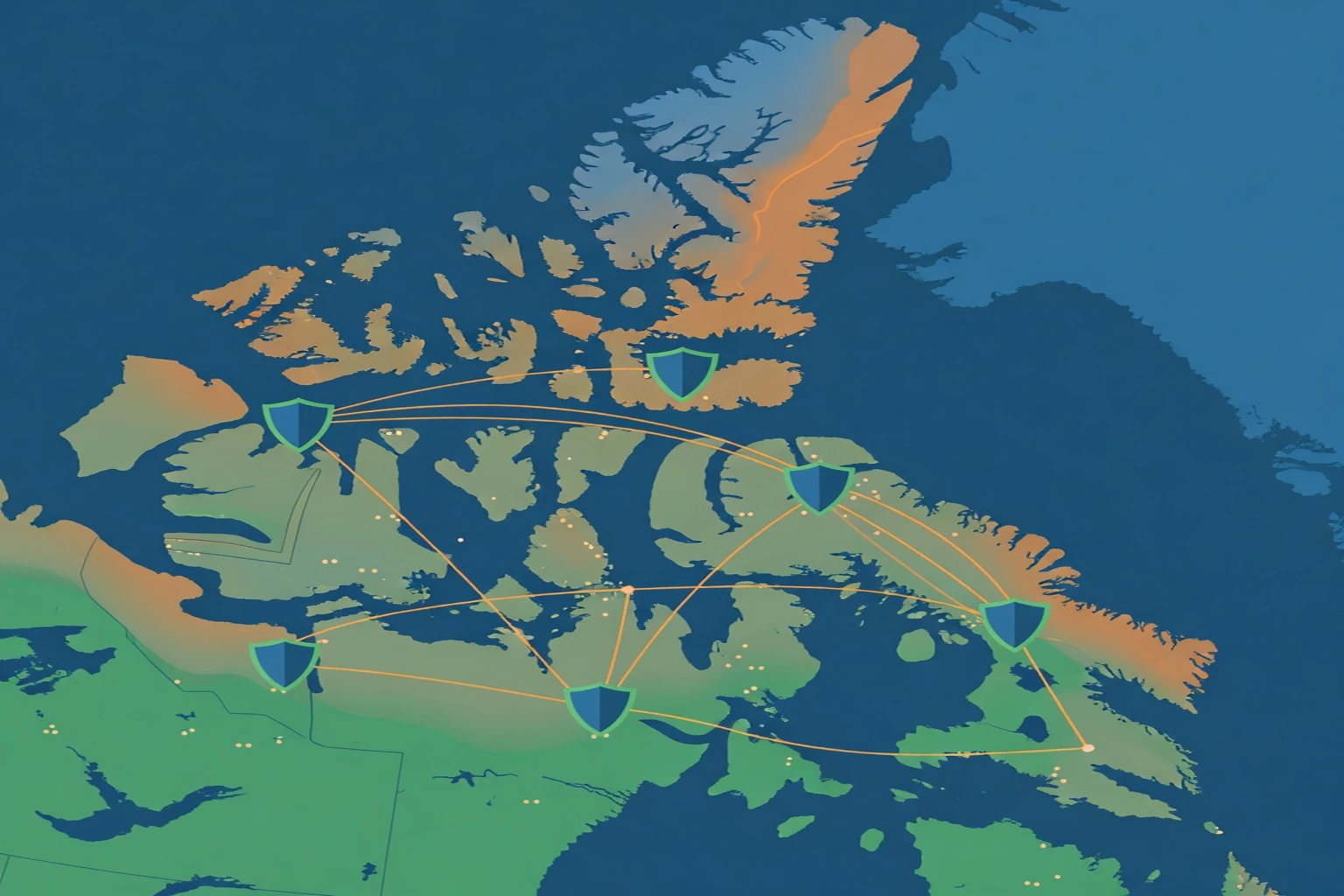
The link between digital sovereignty and community resilience
Digital sovereignty is not an end in itself. It serves broader objectives of community resilience, decision-making autonomy, and cultural preservation. A community that masters its data can respond more effectively to health emergencies, plan its infrastructure, defend its territorial rights, and transmit its languages.
Operational resilience first depends on the ability to function without an external link. A village that keeps local copies of essential data can maintain basic services during a satellite outage, a storm that grounds flights, or a cyberattack. This technical autonomy limits vulnerability to outside disruptions.
Political resilience concerns the ability to negotiate with outside partners. A community that owns its own demographic, economic, and environmental data has solid arguments in discussions with governments and companies. It can challenge statistics, propose its own indicators, and demand that decisions be based on shared data rather than outside approximations.
Cultural resilience, finally, depends on control over linguistic, oral, and artistic data. Digitization offers powerful tools for preserving and sharing languages, but it also creates the risk of outside appropriation if communities do not control sharing conditions. Data governance over cultural information is a mechanism against such appropriation.
Roadmap for organizations in Nunavik and Eeyou Istchee
Implementing data governance does not require an immediate radical transformation. Organizations can progress step by step, starting with the actions that have the greatest impact given limited resources.
-
Inventory sensitive data. The first step is to list the data held by the organization: type, location, responsible person, tool used, sensitivity level, and planned retention period. Even a partial inventory helps identify priority risks.
-
Write a simple internal policy. There is no need to produce a fifty-page legal document. A two- or three-page policy can already clarify who accesses which data, how outside access requests are handled, which tools are authorized, and how backups are managed.
-
Train local administrators. Digital sovereignty depends on internal skills. The goal is to have at least two people able to administer common systems, manage access, restore a backup, and talk with vendors. Training resources in web development and system administration are available through initiatives such as Code Your Web, which offers learning paths adapted to Quebec’s digital realities.
-
Favour Canadian-hosted tools. For the most sensitive data, prefer vendors that guarantee data location in Canada and comply with Quebec and Canadian laws. This limits legal risks related to access requests by foreign authorities.
-
Negotiate ownership and data return clauses. Any contract with a researcher, consultant, or vendor must clarify who owns the collected data, under what conditions it may be reused, and how it is returned to the community at the end of the contract. OCAP principles can serve as a basis for these negotiations.
-
Set up redundant backups. Backup is an essential dimension of governance. A local copy, a copy at another site on the territory, and a copy in a Canadian data centre form a reasonable architecture for most northern organizations.
-
Review and adjust annually. Data governance is not a one-time project. Tools evolve, threats change, and community needs become clearer. An annual review keeps the policy current and integrates lessons learned.
Digital sovereignty in Nunavik and Eeyou Istchee will not be built by adopting solutions imported from the south. It will emerge from deliberate choices, local skills, and governance frameworks adapted to Indigenous realities. Organizations that begin today to inventory their data, train their teams, and negotiate sovereignty clauses in their contracts lay the foundations for durable digital autonomy.
Frequently asked questions
What is digital sovereignty for Indigenous peoples of the North?
It is a community or nation's ability to decide how its data are collected, stored, shared, and used. In Nunavik and Eeyou Istchee, this includes linguistic, territorial, administrative, health, and heritage data. It depends on local infrastructure, internal skills, and governance frameworks adapted to Indigenous realities.
What are the main obstacles to data governance in Nunavik?
The main obstacles are limited and costly connectivity, a shortage of local technical skills, dependence on outside providers, fragmented responsibilities between regional and community bodies, and the absence of legal frameworks specific to the Inuit territory.
How do OCAP principles apply to Cree and Inuit data?
OCAP stands for Ownership, Control, Access, and Possession. It asserts that Indigenous communities own their collective data, control how it is collected and used, decide who can access it, and should be able to hold it physically or logically. These principles serve as a reference when negotiating any data sharing with researchers or governments.
What role does local hosting play in digital sovereignty?
Local hosting allows critical data to remain on the territory, reduces dependence on foreign clouds, cuts access times despite limited bandwidth, and guarantees continuous access even when external links fail.
What concrete steps can a small organization take to govern its data better?
It can inventory its sensitive data, write a simple internal policy, train two local people in system administration, favour Canadian-hosted tools, negotiate ownership clauses with vendors, and plan redundant backups on the territory.