
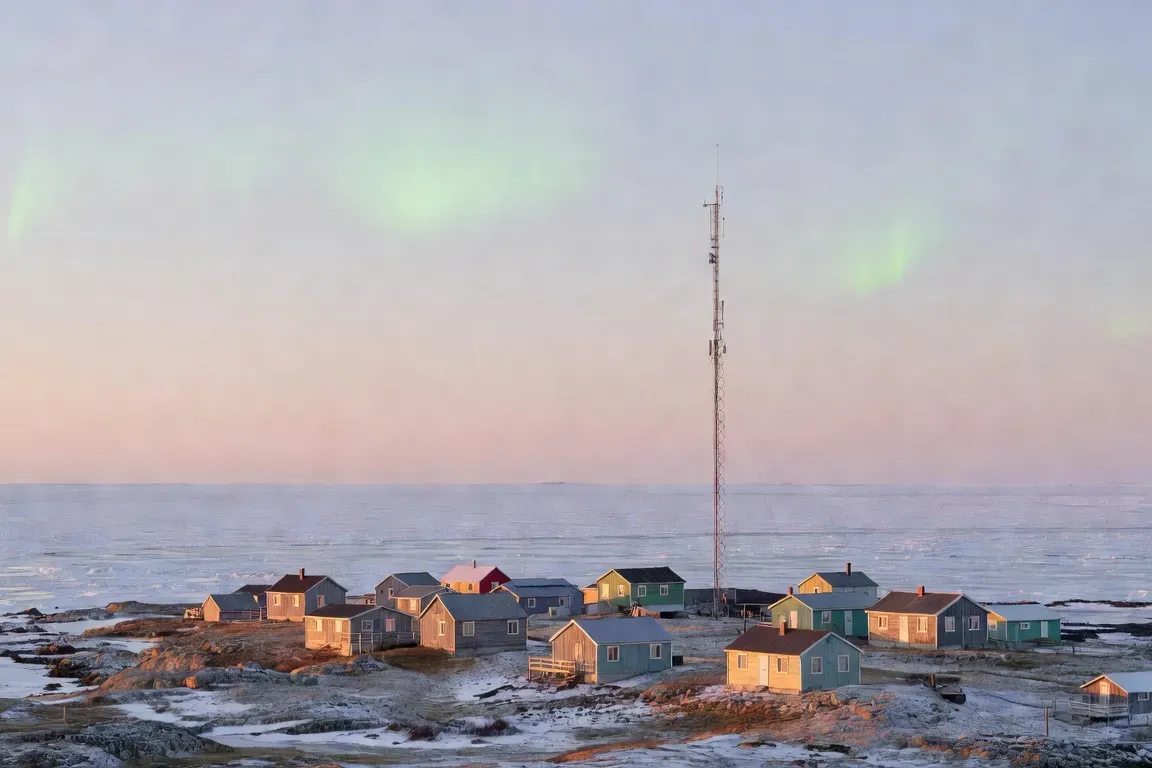
Nunavik occupies the northern third of Quebec — about 500,000 square kilometres, an area larger than mainland France. Fourteen villages dot the coast of Hudson Bay, Hudson Strait and Ungava Bay. None is connected to the south by road. None is connected to another village by land. Everything arrives by ship during three months of summer, or by plane the rest of the year.
In this context, talking about “digital infrastructure” does not have the same meaning as in a southern Quebec city. Every kilowatt of electricity, every metre of cable, every hour of technical intervention has a specific cost and logistics. And yet, in 2026, residents’ expectations — and those of the State that provides them with services — do not differ fundamentally from those in Sherbrooke or Trois-Rivières. Caring for a patient remotely requires stable bandwidth. Following a CEGEP course requires minimum bandwidth. Running a food cooperative requires a connected accounting system.
This feature provides a 2026 status report on Nunavik’s connectivity infrastructure, the territory-specific logistical challenges, and the technical solutions Soleica has been deploying alongside community organisations for more than a decade.
Geography and demographics: what the map does not show
Nunavik has approximately 14,000 inhabitants, of whom nearly 90% are of Inuit origin. Villages stretch from Kuujjuaraapik in the south (at the boundary with Eeyou Istchee) to Ivujivik in the extreme north, including Kuujjuaq, the regional administrative capital. Inter-village distances are considerable: more than 600 kilometres separate Kuujjuaraapik from Ivujivik as the crow flies, and there is no permanent terrestrial road between these communities.
This dispersal imposes a deployment logic that must be understood before any technical discussion. You don’t “pull a cable” from one village to another. Each community is treated as an island. The infrastructure must be autonomous, redundant where possible, and designed to operate for weeks in case of external link failure.
The navigation season, from July to mid-October, conditions the entire investment cycle. Servers, antennas, UPSs and cables arrive aboard the Nunavik or the Mitiq, the two ships that serve the coast every year. What was not ordered in March will not arrive before the following summer.
Connectivity technologies deployed in 2026
Low-Earth orbit satellite (LEO)
The arrival of low-Earth orbit satellite constellations marked a turning point. Starlink became in 2023-2024 the first mainstream option for households and small organisations. Telesat Lightspeed, a Canadian operator backed by the federal and Quebec governments, complements the offering on the institutional segment.
The advantages are concrete and measurable:
- Latency reduced from 600 ms (geostationary satellite) to 30-50 ms (LEO), making videoconferences and telesurgery usable;
- Downstream speeds of 50 to 200 Mbps on average, versus 5 to 25 Mbps previously;
- Service activation in a few weeks instead of several years for wired connection.
Limits remain significant. Extreme Arctic weather — snowstorms, freezing fog, blizzards — temporarily degrades the signal. Shared capacity means peak hours (6 to 10 PM) saturate quickly when several dozen households in a village simultaneously use the same cell. Subscription costs, although decreasing, remain high relative to Nunavik’s median household income.
Fibre optics: the recurring topic
The undersea fibre optic project linking Hudson Bay to southern Quebec has appeared regularly in government announcements since the early 2010s. In 2026, technical studies are advanced but no construction has yet begun on a regional scale. The estimated cost — several hundred million dollars for a robust cable capable of withstanding drifting ice and permafrost — explains this slowness.
Some local segments exist, including intra-village fibre links connecting the health centre, school, town hall and cooperative office. These local fibres, where they exist, make the difference between a “connected” village and an “equipped” village.
Long-range microwave
Where geography allows, point-to-point microwave links connect two or three neighbouring villages with hops of 30 to 50 kilometres. The technology is mature, the cost reasonable, but the requirement for direct line of sight limits its deployment to corridors where the terrain allows. In Nunavik, microwave links remain a complement, not a backbone.
Local hosting
Part of the connectivity challenge is solved by reducing the need to fetch data from the south. Soleica regularly installs local Hyper-V servers in villages: they host cooperative office files, employee directories, local backups, business software copies. This local virtualisation relieves the external link and ensures service continuity when the satellite link drops.
Comparing the technologies deployed in Nunavik
| Technology | Latency | Typical speed | Maturity in Nunavik | Main constraint |
|---|---|---|---|---|
| Geostationary satellite | ~600 ms | 5-25 Mbps | Legacy, declining | High latency, limited speed |
| Low-Earth orbit (LEO) satellite | 30-50 ms | 50-200 Mbps | Growing fast since 2023-2024 | Subscription cost, peak-hour saturation |
| Undersea fibre optics | < 5 ms | Very high | Under study, not yet deployed regionally | Cost, laying logistics, permafrost |
| Long-range microwave | Low | Variable per hop | Local complement between neighbouring villages | Requires direct line of sight |
| Local hosting (Hyper-V servers) | N/A (local) | N/A | Progressively deployed by Soleica | On-site maintenance, team training |
Key takeaway: no single technology solves connectivity in Nunavik on its own. The model that works always combines an external link (LEO or classic satellite) with local hosting that reduces dependence on that link for critical uses.
Territory-specific logistical challenges
Equipment must not only be ordered early, but also packaged and palletised according to Arctic maritime carrier standards. A standard Eaton UPS delivered as-is on a Salluit dock will not survive transhipment by barge. Soleica works with reinforced packaging and thermo-protected pallets for sensitive components.
Winter temperatures — frequently below -35°C — impose equipment choices that are not standard in catalogues. Lithium batteries lose a significant portion of their capacity below -20°C. Mechanical hard drives are more vibration-tolerant than M.2 SSDs in some environments. UPSs must be placed in permanently heated rooms, representing a significant energy load on a system already under stress.
Permafrost moves. A technical room built on a concrete slab twenty years ago can tilt several centimetres over the years. Cable runs, ground antenna fixings, masts: everything must be designed to absorb these movements without breaking.
Common mistake: ordering standard network equipment without accounting for the maritime navigation window. Equipment ordered in April sometimes only arrives the following summer if it misses the season’s last ship — a full year’s delay for a simple calendar oversight.
Public services that depend on connectivity
Telemedicine is probably the most critical service. Each village’s health centre has a dedicated line to southern hospital centres (Montreal General, CHUM, Montreal Children’s Hospital). A remote specialist consultation saves a patient several hours of air transport, with all the risks and costs that entails.
Education is another area where connectivity changes things. Distance CEGEP programs allow young people from Kangirsuk or Quaqtaq to pursue post-secondary studies without leaving their community. The Kativik School Board has been working for several years on translating and adapting educational content into Inuktitut.
Banking services, civil registration, social benefit applications, driving licences: everything that goes through a government website somewhere in Canada now relies on the quality of the community’s Internet link. A multi-day outage — which happens several times a year in some villages — completely disrupts administrative life.
To discover the human experience behind these deployments, read the interview with a Northern telecom engineer which details the concrete working conditions on the ground.
The role of community operators and organisations
Tarqavik, the community telecommunications operator, plays a structuring role. Born from initiatives led by Inuit leaderships from the 1990s, it now operates a significant part of the regional backbone and represents a strong voice in negotiations with national operators and the federal government.
The Kativik Regional Government (KRG) coordinates Nunavik-wide public telecommunications policies and negotiates on behalf of communities with provincial and federal ministries. The Makivik Society, which manages funds from the James Bay and Northern Quebec Agreement, finances several structuring digital projects.
This regional governance is precious. It prevents major technical and economic decisions from being made from Montreal or Ottawa without consultation with the communities concerned. It also structures local training and employment in digital trades, which is essential for infrastructure sustainability.
The digital sovereignty issue
Beyond bandwidth, a fundamental question runs through current discussions: who controls the data generated and stored in Nunavik? Starlink servers are in the United States. Major national operator servers are in Toronto, Montreal or Calgary. Microsoft 365 services used by municipalities are hosted in Canadian data centres — but conditions for foreign authority access to data remain unclear.
For sensitive subjects — medical data, youth protection files, Inuit cultural archives — local hosting on community-controlled servers is increasingly demanded. This is a fundamental movement, comparable to what is happening in other Indigenous territories of Canada (First Nations in Saskatchewan, Cree communities of Eeyou Istchee, Dene Nations of the Northwest Territories). This data sovereignty push comes with heightened awareness of digital risk: our cybersecurity and data protection guide for Nunavik and Eeyou Istchee organizations details concrete measures community organizations can put in place.
See our IT services for Northern communities to understand how Soleica supports this demand for technical sovereignty. To go further on the travel and respectful discovery of the territory aspect, see also our responsible travel guide to Nunavik.
Outlook 2026-2030
Several trends will shape the coming years:
- LEO constellation densification. Telesat Lightspeed should reach full capacity by 2027-2028, offering a serious Canadian alternative to Starlink in the professional and institutional segment.
- Likely arrival of undersea fibre on at least one segment (the most discussed being Kuujjuaq–Schefferville–southern Quebec) by 2028-2030.
- Strengthened local hosting capacities in newly renovated municipal buildings (several villages have received funding to renovate their town halls and integrate technical rooms to modern standards).
- Growth in Inuktitut-language applications and digitisation of linguistic heritage, supported by Pirurvik, the Avataq Cultural Institute and several academic partners.
- Progressive integration of AI tools into public services — with all the ethical, linguistic and cultural questions that entails.
The ecosystem evolves quickly, but without spectacular leaps. The reality of deployment remains methodical work, season after season, community after community. This is also the experience shared by Soleica Chalets, our sister project oriented towards sustainable hospitality in Quebec, on autonomy challenges in remote regions. See also our Northern IT deployment case study for the technical details of a recent project.
What will shape 2026-2030
| Timeframe | Expected development |
|---|---|
| 2027-2028 | Telesat Lightspeed reaches full capacity, a Canadian alternative to Starlink |
| 2028-2030 | Advanced discussion on an undersea fibre segment (Kuujjuaq-Schefferville-southern Quebec) |
| Ongoing | Strengthened local hosting capacity in renovated municipal buildings |
| Ongoing | Digitisation of Inuktitut linguistic heritage (Pirurvik, Avataq Cultural Institute) |
Conclusion
Connectivity in Nunavik is not a purely technical subject. It is a matter of public service, community sovereignty, equal access to fundamental rights and cultural sustainability. Progress over the past five years is real — the arrival of LEO has changed things — but the underlying work remains considerable. It is done at the territory’s pace: long, patient, built over time.
The experience of Puvirnituq FM, Inuit community radio illustrates the social fabric being woven around Nunavik connectivity.
For Northern Quebec organisations wishing to modernise their infrastructure, the approach Soleica has defended for fifteen years remains the same: start with an honest diagnosis of the existing situation, prioritise critical needs (health, education, security), choose equipment adapted to climate and logistics, train local teams, and embed each deployment in the long term.
Frequently asked questions
Which Nunavik villages have broadband Internet access in 2026?
All 14 coastal Nunavik villages have an Internet connection, but with very variable speeds. The largest (Kuujjuaq, Inukjuak, Puvirnituq, Salluit) have benefited since 2023-2024 from low-Earth orbit (LEO) satellite, providing 50 to 200 Mbps. Smaller villages often remain on geostationary satellite with 5 to 25 Mbps speeds and high latency. Undersea fibre linking Hudson Bay to southern Quebec is being discussed but has not yet been deployed.
Why is fibre optics so difficult to deploy in Nunavik?
Three main reasons. Geography: no road links the villages, the soil is permafrost, and buried cables are sensitive to freeze-thaw cycles. Logistics: all material must arrive by ship during the short navigation season (July to October) or by air at prohibitive cost. Economics: the population density (about 14,000 inhabitants on a territory the size of France) does not justify, on purely commercial criteria, the several hundred million dollar investment required for full deployment.
Does low-Earth orbit satellite (Starlink, Telesat Lightspeed) really solve the problem?
It significantly improves the situation, but does not fully solve it. Real benefits include: latency reduced from 600 ms to 30-50 ms, speeds multiplied by 10, rapid deployment. Limits remain: dependence on a foreign operator, high subscription costs for households, extreme weather degrading the signal, and shared capacity that saturates at peak hours. LEO is an essential building block, not a single solution.
Which services depend directly on connectivity in Nunavik?
Practically all modern public services: telemedicine and teleconsultations with Montreal and Quebec City hospitals, distance education for specialised programs, online banking, provincial and federal administrative requests, payroll and management of local cooperative employees, public safety (regionalised 911 call centres), weather, family communications with the Inuit diaspora, and digital language preservation of Inuktitut.
How does Soleica concretely intervene in these deployments?
Soleica has supported municipalities, cooperatives and Northern organisations for over 15 years. Our interventions range from network diagnostics (community Wi-Fi audits, real bandwidth measurement, bottleneck identification) to full infrastructure deployment (local Hyper-V servers, village Wi-Fi extension, workstation virtualisation). We travel on site several times a year for technical missions that cannot be carried out remotely, and we train local teams to ensure the longevity of installations.
Are there community Inuit initiatives in the digital sector?
Yes, and they are growing. The Makivik Society and the Kativik Regional Government are leading several projects: digitisation of Inuit cultural heritage, educational applications in Inuktitut, community governance platforms and digital trades training programs for young people. Tarqavik, the community telecommunications operator, plays a strategic role in regional digital sovereignty.