
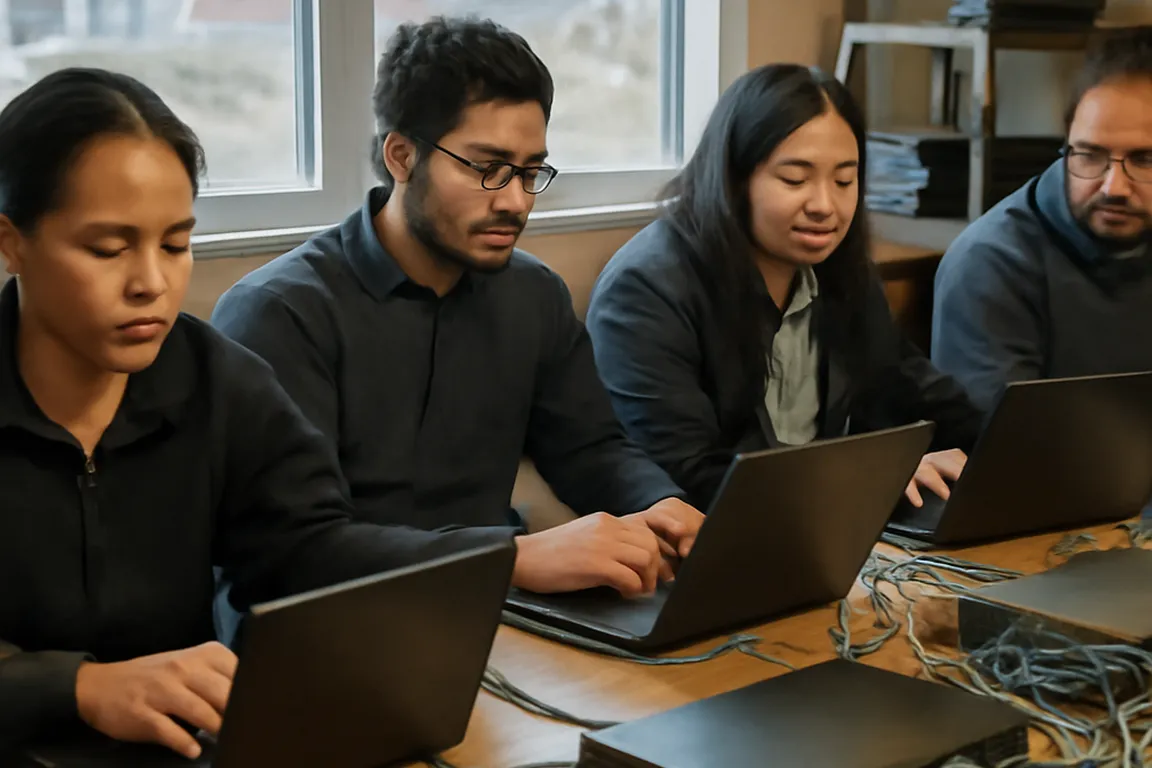
Northern Quebec — Nunavik and Eeyou Istchee — is going through a sustained period of digital modernization, driven by the arrival of low-Earth-orbit satellite, the multiplication of online services and the growing determination of regional organizations to build their own technological sovereignty. This transformation is creating real, persistent demand for IT professionals, often accompanied by attractive compensation.
This guide presents an honest overview of the IT careers available in the region in 2026: available positions, observed salaries, training paths, and what to concretely expect when relocating to Kuujjuaq or a Cree community.
Why Northern Quebec is hiring in IT
The modernization of regional digital infrastructure — schools, health centres, municipal administrations, cooperatives — generates a constant need for skilled technical staff. Several structural factors explain this sustained demand:
- The renewal of network equipment across Nunavik’s 14 villages and Eeyou Istchee’s Cree communities
- The arrival of more complex technologies (LEO satellite, cloud, cybersecurity) requiring expertise local teams don’t always yet possess
- Higher staff turnover than in the south, due to remoteness and often time-limited contracts
- Growing political will to build local digital sovereignty, creating new roles focused on training and skills transfer
Most in-demand roles: network technician, support, cybersecurity
The network technician remains the most sought-after profile in the region. Their role covers installing, maintaining and troubleshooting network equipment — routers, switches, satellite antennas, structured cabling — in demanding climate conditions.
IT support technician positions, handling day-to-day troubleshooting of workstations and business applications, are also in high demand, particularly at school boards and health centres.
More specialized cybersecurity and cloud systems administration roles are growing rapidly, driven by regulatory requirements around protecting sensitive data (medical records, school data) and the gradual migration of several organizations to hybrid infrastructure.
| Role | Typical experience level | Common employers |
|---|---|---|
| Network technician | Entry to mid-level | Municipalities, cooperatives, telecom operators |
| IT support technician | Entry to mid-level | School boards, health centres |
| Systems administrator | Mid to senior level | Kativik Regional Government, Cree organizations |
| Cybersecurity specialist | Mid to senior level | Large regional organizations, IT providers |
Salaries and remoteness bonuses observed in 2026
Base salaries in the Northern IT sector are generally comparable to or slightly higher than in southern Quebec, but it’s the remoteness bonus that makes the biggest difference in total compensation.
Estimated salary ranges for 2026:
- Entry-level network technician: 55,000 to 65,000 $/year (base salary)
- Experienced network technician: 65,000 to 75,000 $/year (base salary)
- Systems administrator: 75,000 to 90,000 $/year (base salary)
- Cybersecurity specialist: 85,000 to 110,000 $/year (base salary)
On top of these amounts, employers generally add a remoteness bonus of 15 to 30% of the base salary, plus in-kind benefits such as subsidized housing and partial coverage of annual flights.
Good to know: total compensation (base salary + remoteness bonus + benefits) for an experienced network technician in Nunavik can thus exceed 90,000 $ equivalent annually — a level rarely reached for a comparable position in southern Quebec without several additional years of seniority.
Technical and soft skills sought by employers
Beyond standard technical skills — networking, operating systems, virtualization, basic information security — Northern employers look for specific human qualities:
- Strong autonomy, since remote assistance isn’t always immediately available
- An ability to improvise solutions with locally available materials
- Genuine cultural openness toward Inuit and Cree communities
- Resilience in the face of geographic and social isolation, especially during the long winter months
- The ability to rigorously document work to ease handoffs to other technicians
Useful training paths and certifications
A DEC in computer science, networking or network administration is the most common baseline for accessing a technician position. For systems administrator or cybersecurity specialist roles, a bachelor’s degree in computer science or software engineering is generally preferred.
Industry-recognized professional certifications often carry as much weight as formal education in the eyes of Northern employers:
- CompTIA certifications (Network+, Security+) for technician roles
- Cisco certifications (CCNA) for network infrastructure-focused roles
- Microsoft certifications (Azure, Microsoft 365) for systems administration positions
- Advanced cybersecurity certifications (CompTIA Security+, specialized cloud certifications) for senior roles
| Training path | Typical duration | Main outcome |
|---|---|---|
| DEC in computer science/networking | 3 years | Network technician, IT support |
| Bachelor’s in computer science/software engineering | 3 to 4 years | Systems administrator, development |
| CompTIA or Cisco certification | A few weeks to a few months | Complements a diploma, faster hiring |
| Ongoing advanced cybersecurity training | Variable, often modular | Cybersecurity specialist, senior roles |
Relocating to Kuujjuaq or a Cree community: what to know
Professional relocation to the Far North requires different preparation than a standard move. Most employers arrange initial transportation and provide an extra baggage allowance for air freight, a real consideration given the high cost of shipping personal belongings.
Housing is generally provided or heavily subsidized by the employer, which greatly simplifies settling in compared to an independent housing search. An adjustment period of several months is normal, both climatically — the Arctic winter runs from November to April — and culturally, particularly for people who have never lived in an Indigenous community context.
For a practical overview of services and accommodation available in Kuujjuaq, our guide to Nunavik’s administrative capital offers a useful starting point for planning a relocation.
Before signing a contract: always ask your prospective employer to detail in writing the exact nature of the housing provided (size, furnished or not, length of availability) and the precise terms of the remoteness bonus — these elements vary enormously between organizations and are rarely standardized across the region.
The role of companies like Soleica in local employment
These career paths echo the experience of other technology professionals in the region, as shown in our interview with a web developer specialized in Indigenous projects, which illustrates how technical expertise and cultural sensitivity combine in this type of career.
Specialized Northern IT providers play a dual role: they fill immediate technical staffing needs while helping build a sustainable local workforce. Our case study on a Hyper-V server deployment in a Northern environment concretely illustrates the type of technical projects these teams handle on a daily basis.
This hybrid model — external expertise combined with progressive skills transfer to local residents — is increasingly favoured by regional organizations, who want to reduce their long-term dependence on technicians from the south.
IT training programs for Inuit and Cree residents
Several structured initiatives aim to train a local technical workforce, jointly led by regional school boards and private partners:
- The Kativik School Board integrates advanced technical modules into certain vocational training pathways
- The Cree School Board develops similar programs for Eeyou Istchee communities
- Partnerships with private companies, including Soleica, offer paid internships and mentored apprentice technician positions
- Targeted postsecondary scholarships encourage Inuit and Cree students to pursue college or university training in information technology
These programs represent a long-term investment for the region: every locally trained technician reduces dependence on costly staff travel from the south and strengthens the resilience of community digital infrastructure. For a full overview of the college and university options available to future technicians in the region, our feature on vocational and postsecondary training in Nunavik and Eeyou Istchee details the available pathways and scholarship terms.
To understand the everyday challenges faced by IT professionals already established in the region, our interview on telework in Nunavik with an Inuit entrepreneur from Salluit usefully rounds out this overview of Northern technology careers.
For professionals considering relocation who will need French-English-Inuktitut professional translation services as part of their work, ProfTeam Translate offers services tailored to the multilingual realities of Northern Quebec.
Frequently asked questions
What are the most in-demand IT jobs in Nunavik and Eeyou Istchee?
Network technician, first- and second-level IT support, and systems administrator roles are the most sought after in the region. Demand for cybersecurity specialists and cloud infrastructure management is also growing, driven by the modernization of systems at municipalities, school boards and regional organizations such as the Kativik Regional Government and Cree entities across the territory.
What salary can be expected for a network technician role in the Far North?
A network technician in Nunavik or Eeyou Istchee can expect a base salary comparable to or slightly higher than in southern Quebec, generally between 55,000 and 75,000 CAD per year depending on experience, plus a remoteness bonus that can represent 15 to 30% of the base salary. For systems administrator or cybersecurity specialist roles, total compensation can exceed 90,000 CAD including bonuses.
Is a specific diploma required to work in IT in a northern community?
A DEC in computer science, networking or network administration is the most common baseline for technician roles. For systems administrator or cybersecurity specialist positions, a bachelor's degree in computer science or software engineering is generally preferred, though field experience and professional certifications (CompTIA, Cisco, Microsoft) often carry as much weight as formal education in the eyes of Northern employers.
What remoteness bonuses and benefits are typically offered?
Remoteness bonuses vary by employer and location, generally ranging from 15 to 30% of base salary for positions based in Nunavik. These are often paired with subsidized or provided housing, partial or full coverage of annual flights home, and sometimes a cost-of-living allowance to offset the high cost of food and consumer goods in these regions.
What does relocating professionally to Nunavik actually look like?
Most employers arrange initial transportation and part of the move, often with an extra baggage allowance for air freight. Housing is generally provided or heavily subsidized, which greatly simplifies settling in. An adjustment period of several months is normal, both climatically and culturally, and employers experienced in Northern recruitment typically plan a structured onboarding program to ease this transition.
Are there IT training programs for local residents?
Yes, several initiatives exist to train a local technical workforce, notably led by the Kativik School Board, the Cree School Board and private partners such as Soleica. These programs aim to reduce dependence on technicians from the south by training Inuit and Cree residents in IT support and network management roles, with direct hiring prospects at local organizations.