
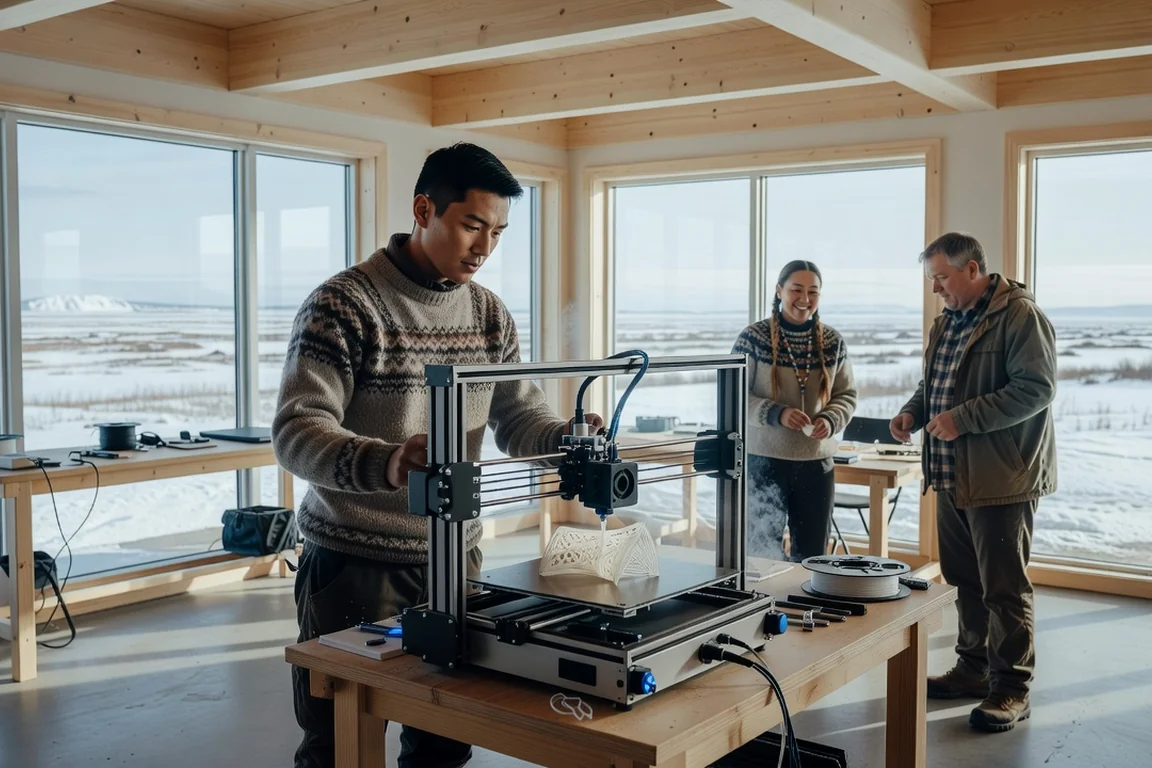
In Iqaluit, capital of Nunavut, the École des Trois-Soleils robotics club runs on three 3D printers: students design vases, sculptures, luggage tags and keychains, then sell them at craft fairs — $900 raised, according to Nunatsiaq News. Thousands of kilometres south, the First Peoples Innovation Centre is rolling out a permanent FabLab model in Indigenous communities in 2025, while Université Laval consolidates several additive manufacturing labs.
3D printing is no longer a maker curiosity in Canada’s North: it is a teaching, repair and prototyping tool whose documented uses keep multiplying. This feature takes stock of what actually exists, what research and fieldwork validate, and what still needs building.
Why 3D printing makes sense in the North
The core argument is logistical, and it fits in one sentence: in a territory where parts and goods arrive by plane or by ship a few months a year, manufacturing locally changes the entire equation of a repair.
Scientific literature formalized this as early as 2023: work documented on arXiv stresses that 3D printing is particularly useful in isolated communities for producing spare parts and needed objects locally, reducing dependence on long, costly transport. The same findings appear in research on isolated laboratories and low-logistical-autonomy settings: when resupply is the binding constraint, fabrication at the point of need becomes critical infrastructure, not a gadget.
Concretely, a northern community can now print locally:
- plastic replacement parts for household or recreational equipment;
- brackets, jigs and mounts for workshops and community kitchens;
- prototypes before ordering a metal version from the south;
- custom teaching materials and classroom objects.
Iqaluit, the school that manufactures
The most vivid and best-documented case remains a school. Nunatsiaq News followed the École des Trois-Soleils robotics club in Iqaluit: three 3D printers in the school’s technology lab, students who design, manufacture and sell their creations — vases, sculptures, luggage tags, keychains — and two craft fairs that brought in $900 for the club.
That detail matters more than it seems: 3D printing there has moved from learning tool to small economic engine and source of school pride. Students touch the whole chain — design, production, sales — in a language and cultural context that is their own. For a territory like Nunavik, whose school digital education challenges we have documented, the model is directly transferable: the hardware costs a few hundred dollars, but it is the support that makes the difference.
Schools and FabLabs: the Quebec model
Quebec has a documented, structured ecosystem of community digital fabrication, catalogued on the fablabs.quebec wiki: 3D printing services, modelling, training and school project support. It includes digital creation labs in public libraries — Amos library’s Médialab is the documented example — a model that works in the south and only awaits an operating budget to move further north.
The most significant 2025 development is institutional: the First Peoples Innovation Centre (CIPP) presented its permanent FabLab model, designed to embed durably in Indigenous communities rather than passing through a few weeks a year. Documented locations: Gatineau, La Tuque, Akwesasne and Fredericton. The bet directly answers the historical weakness of travelling fab labs — the support that ends when the truck leaves.
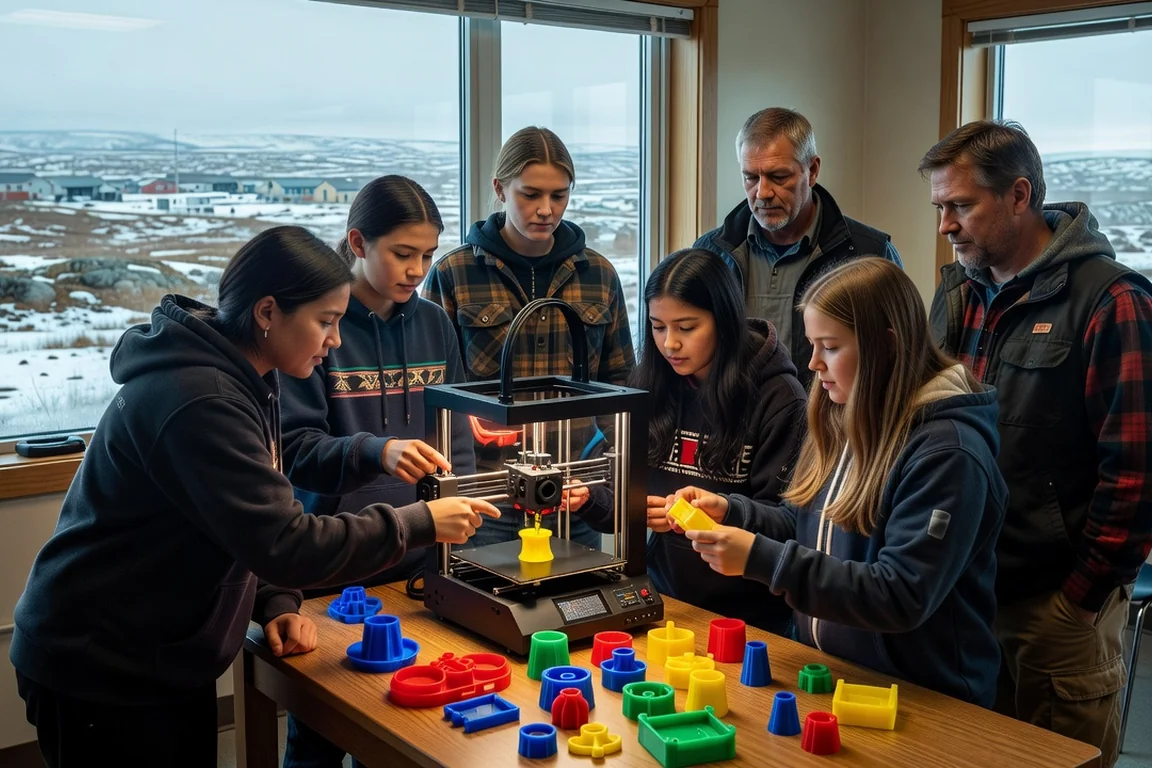
For northern Quebec, the question is therefore no longer whether the model exists, but who funds permanence: a viable community FabLab needs a heated space, a locally paid staff member and a steady filament supply — three modest budget lines compared with what they unlock in repair autonomy and training.
Research and partnerships: Laval, Makivik and the North
On the advanced-capacity side, Université Laval holds a documented role. As of 2025, the university has a 3D printing lab at the CHU de Québec research centre, oriented toward medical devices and bioprinting; its School of Design claims one of Canada’s largest 3D printing labs for prototyping; and the proceedings of the 2025 Sentinelle Nord conference show additive manufacturing at the heart of northern research, including 3D-printable water treatment membranes.
The institutional link with Nunavik is real but still to be consolidated: Makivik saluted Université Laval’s leadership in northern sustainable development research in 2025, while no public program deploying 3D printers across all communities is documented to date. This is precisely the kind of project where university research, Inuit institutions and technical organizations can meet — provided the skills stay in the territory.
Spare parts: what the literature really validates
Let us stay honest about what 3D printing can replace. The 2023 literature clearly validates use for small parts and plastic objects; it does not say a community printer will replace a machine shop.
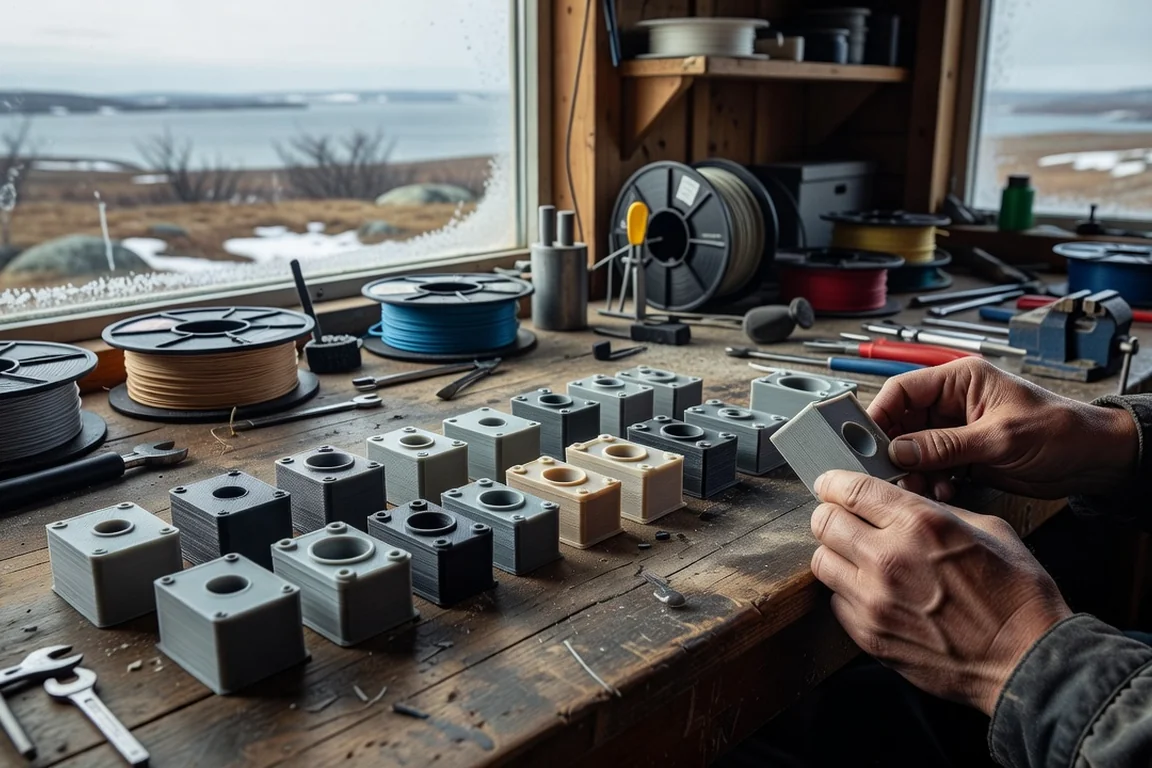
The documented, realistic uses for a northern village or organization:
- Light, non-critical parts: brackets, screw covers, guides, handles, tips;
- Keeping equipment alive while waiting for a part: a printed mount can keep a device running until the factory part arrives by cargo;
- Local prototyping: testing a shape before ordering the metal version from the south avoids months of back-and-forth;
- Cold-weather adaptation: custom mounts and guards for equipment exposed to freezing, where no southern model exists.
Safety parts, vehicle components and anything under heavy mechanical stress, on the other hand, remain the domain of certified parts. The workshop rule is simple: print to bridge and prototype, never to replace a part whose failure could put someone at risk.
The documented initiatives at a glance
| Initiative | What it does | Source / year |
|---|---|---|
| Robotics club, École des Trois-Soleils (Iqaluit) | 3 printers; producing and selling objects; $900 raised | Nunatsiaq News / 2024 |
| First Peoples Innovation Centre (permanent FabLab) | Permanent fab lab model embedded in Indigenous communities | cipp-fpic.com / 2025 |
| 3D printing lab, CHU de Québec (Université Laval) | Medical devices and bioprinting | crchudequebec.ulaval.ca / 2025 |
| School of Design, Université Laval | One of Canada’s largest 3D printing labs | design.ulaval.ca / 2025 |
| Sentinelle Nord (Université Laval) | Additive manufacturing in northern research (water treatment membranes) | RSSN proceedings / 2025 |
| fablabs.quebec ecosystem | Catalogue of community digital fabrication services in Quebec | wiki.fablabs.quebec / 2025 |
| Research on isolated communities | Local spare parts, reduced transport dependence | arXiv 2305.09394 / 2023 |
What does it cost to start a community workshop?
Back to brass tacks, because this is the question school principals, band councils and community organizations actually ask: what does a functional first 3D printing workshop in the North really cost?
Entry-level hardware is no longer the barrier. A reliable entry-level printer runs on the order of a few hundred dollars, and a small school or community workshop configuration — two or three machines, filament spools, basic tooling — comes in at thousands of dollars, not tens of thousands. The organizations documented in the table above mostly start from exactly this kind of modest setup, not industrial machines.
The real budget lines are elsewhere, and they are recurring rather than one-time:
- The staff member: a local salary for someone who can model, configure and repair — the line item that decides whether the project survives its first year, and the hardest one for a small organization to fund;
- Filament and maintenance: modest but regular consumables that must be restocked without waiting for next year’s sealift — one more argument for a technical equipment inventory planned around the northern logistics calendar;
- Space and energy: a heated, secure space with stable power, or winter outages take out both printers and prints in progress;
- Ongoing training: a learning budget, local or remote, so the skill never rests on a single person.
The documented FabLab experience — in Quebec and elsewhere — is unanimous on one point: the projects that last are the ones where someone is paid to make them last. Hardware without a staff member is a donation going unused; a staff member without hardware can always improvise.
Real limits and next steps
Three structural limits frame the enthusiasm. Materials first: the PLA and ABS of community printers do not replace aluminum, steel or even technical nylon; extreme cold, moreover, makes some plastics more brittle. Supply next: the filament itself must be imported — the printer reduces dependence on finished parts, not on raw materials; local plastic-to-filament recycling circuits are not documented to date in northern Quebec. Skills finally: without a locally trained staff member, a printer quickly becomes out-of-service furniture.
The logical path for organizations and communities is the one documented ecosystems already take: anchor additive manufacturing in permanent places — schools, libraries, FabLabs — connected to technical trades training. The profiles able to model and maintain a printer are exactly those described in our feature on IT careers in the North, and the tool slots naturally into the community digital toolkit we catalogued in our guide to northern apps and tools.
As with community artificial intelligence, the technology is not the issue: local governance and the permanence of skills are. A well-supported 3D printer can last a whole winter in a Nunavik village; the same printer delivered without training will last until its first clogged nozzle.
Looking further ahead, the most plausible trajectory is not a heavy fabrication plant but a light mesh: one working printer in every school or community centre, connected to a peer network sharing models, settings and field experience — exactly the role played by documented networks like fablabs.quebec. The real economic vein, meanwhile, lies in extending the life of equipment whose full replacement would otherwise arrive by cargo, with delays of several months: keeping existing equipment running is often the most profitable economy that exists in the North.
Frequently asked questions
Where is 3D printing actually being used in Canada's North today?
The best-documented case is in a school: at Iqaluit's École des Trois-Soleils, the robotics club uses three 3D printers to design and manufacture objects — vases, sculptures, luggage tags, keychains — that it has even sold at craft fairs, raising $900 according to Nunatsiaq News. In Quebec, the First Peoples Innovation Centre deployed its permanent FabLab model in Indigenous communities as early as 2025 (Gatineau, La Tuque, Akwesasne, Fredericton), and Université Laval operates several 3D printing labs, including a bioprinting lab at the CHU de Québec research centre.
Why does 3D printing make sense for isolated communities?
Recent scientific literature (2023) documents a strong logistics argument: producing spare parts and everyday objects locally reduces dependence on long, costly transport — the default reality in remote territories where a parcel can take days or weeks to arrive. In a village reachable by plane and, a few months a year, by ship, fabricating a broken plastic part, a bracket or a prototype locally avoids a costly air shipment and a wait that can sideline essential equipment.
What is the First Peoples Innovation Centre's permanent FabLab model?
The First Peoples Innovation Centre (FPIC/CIPP), based in Quebec, presented its permanent FabLab model in 2025 as a learning and innovation tool embedded durably in Indigenous communities, in contrast to temporary or travelling fab labs. Documented locations include Gatineau, La Tuque, Akwesasne and Fredericton. The model combines digital fabrication equipment (including 3D printing), ongoing support and local anchoring, and it fits within Quebec's fab lab ecosystem catalogued on the fablabs.quebec wiki.
Does Université Laval play a role in northern additive manufacturing?
Yes, at several documented levels as of 2025: the university operates a 3D printing lab at the CHU de Québec research centre, focused on medical devices and bioprinting; its School of Design claims one of Canada's largest 3D printing labs for prototyping; and the proceedings of the 2025 Sentinelle Nord conference show additive manufacturing at work in northern research, including 3D-printable water treatment membranes. Makivik also highlighted Université Laval's leadership in northern sustainable development research in 2025.
What are the real limits of 3D printing in the North?
Three structural limits. First, materials: standard community printers mostly work with PLA and ABS — common plastics unsuited to replacing mechanical parts exposed to heat, extreme cold or heavy stress. Second, energy and supply: the filament itself must be imported, and a winter power outage halts production. Third, skills: modelling, configuring and maintaining a printer requires training that communities must be able to access locally — precisely what supported FabLab models are designed to solve.