
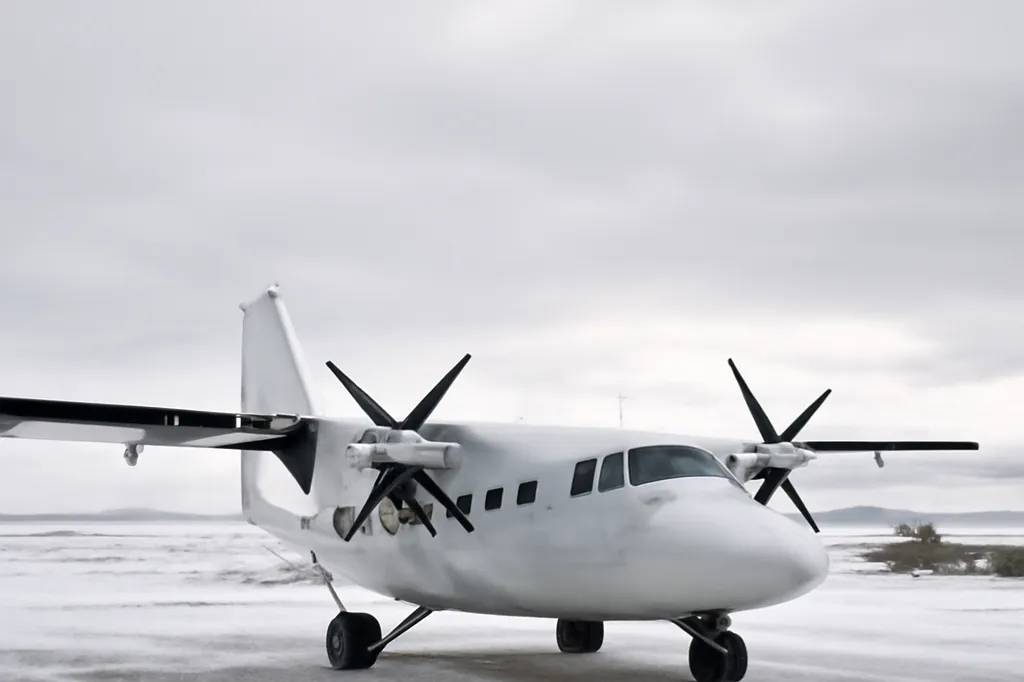
In Nunavik, air travel isn’t just one transport option among others. It’s often the only fast link between the 14 northern villages, hospitals in the south, government services, family, and essential goods. In 2026, Air Inuit occupies a central place in this network, while Canadian North also handles certain routes to Nunavut and other northern territories. This accessibility comes at a price: a Montreal-Kuujjuaq round trip generally runs between $2,000 and $4,000 CAD, before fare-reduction programs.
A territory where air travel structures daily life
Nunavik covers the vast Quebec territory north of the 55th parallel. Its 14 village communities aren’t connected to Quebec’s road network. There is no road linking Kuujjuaq, Puvirnituq, Salluit, Inukjuak or Kangiqsujuaq to Montreal or Quebec City by car.
This reality completely changes the function of air transport. In southern Quebec, flying often relates to business travel, vacations or saving time. In Nunavik, a scheduled flight can determine whether someone makes a medical appointment, a court appearance, a training session, a family visit, or whether perishable goods and urgent equipment arrive at all.
Resupply ships play a major role during the maritime shipping season — a topic we cover in our feature on Nunavik’s housing crisis, where the same maritime schedule governs the delivery of construction materials. But this route remains seasonal. Between shipping periods, and for needs that can’t wait, air transport takes over.
Air travel therefore serves several realities at once:
- resident travel between villages and to southern Quebec;
- medical evacuations and health-related transport;
- supply of perishable goods and urgent medical equipment;
- movement of workers, families, students and visitors;
- government, community and economic services that require a physical presence in the territory.
Talking about air fares in Nunavik is therefore really talking about the concrete cost of accessing services. It isn’t just a tourism or business question.
Air Inuit: a regional airline owned by Nunavik Inuit
Air Inuit stands out in Quebec’s aviation landscape because of its ownership. The airline belongs to Nunavik Inuit through the Makivik Corporation. This detail matters for understanding its role in the region: it isn’t simply a carrier operating a remote market, but a company directly tied to Nunavik’s Inuit institutions.
The Makivik Corporation stems from the framework established by the James Bay and Northern Quebec Agreement. Through it, Nunavik Inuit own Air Inuit, which has long played a structuring role for northern communities.
In 2026, the company offers scheduled, charter, cargo and emergency services. It operates 24 hours a day, 365 days a year. This availability doesn’t mean weather conditions, aircraft capacity or operational constraints disappear: in the Quebec Arctic, delays and schedule changes can have significant consequences. It rather reflects that the network must serve a region where needs don’t only follow standard commercial hours.
Air Inuit connects Nunavik’s 14 village communities. It also operates routes between Nunavik and southern Quebec, notably Montreal, Quebec City and Sept-Îles, as well as certain points in Nunavut.
Its role therefore goes beyond the simple Montreal-Kuujjuaq route, often used as a fare benchmark. The network must serve villages that are far apart from one another, with airport infrastructure suited to demanding northern conditions, and demand that can’t be reduced to the profitability of a single high-traffic route.
Nunavik’s 14 villages and the logic of an air network
Serving the 14 villages is at the heart of the regional service. These communities are spread along Hudson Bay, Hudson Strait and Ungava Bay. They don’t all have the same population, the same travel needs, or the same connections to the south.
In this context, an air route doesn’t function like a simple corridor between a major city and a tourist destination. Flights form an intercommunity network. A resident may need to pass through another point in Nunavik before reaching Kuujjuaq or Montreal. Depending on the destination, schedules and rotations, the journey can take longer than a map would suggest.
This organization has several concrete effects.
First, flight schedules affect access to services. For a medical appointment, a training session or an administrative process in the south, a trip isn’t always limited to a single travel day. It sometimes requires overnight accommodation, meals and enough margin in case a flight changes.
Second, the air network also connects communities to each other. This function is sometimes less visible in flight comparison tools, which emphasize departures from Montreal or Ottawa. Yet for many residents, regional trips are just as important: family visits, work, institutional activities, community gatherings, or access to certain services concentrated in larger villages.
Finally, cargo travels through the same operational environment as passengers. Available capacity, emergency priorities and weather conditions can affect how quickly certain goods are delivered.
Air Inuit and Canadian North: different networks, sometimes complementary
Air Inuit is the regional carrier most directly associated with serving Quebec’s Nunavik. Canadian North also has a place in northern air transport, but its operating territory is broader: the company serves communities in Nunavut, Nunavik and the Northwest Territories, with routes to Ottawa, Montreal, Edmonton and Calgary.
For travellers, this coexistence doesn’t necessarily mean simple, constant competition on every route. In the North, routes are tied to geography, service rights, schedules and each carrier’s own network. Comparison options therefore vary a lot depending on the departure village and final destination.
| Comparison point | Air Inuit | Canadian North |
|---|---|---|
| Main ownership | Regional airline owned by Nunavik Inuit through the Makivik Corporation | Carrier serving several northern Canadian regions |
| Territories served | The 14 Nunavik communities, southern Quebec and certain points in Nunavut | Communities in Nunavut, Nunavik and the Northwest Territories |
| Southern connections | Montreal, Quebec City and Sept-Îles | Ottawa, Montreal, Edmonton and Calgary |
| Services noted in this feature | Scheduled, charter, cargo and emergency flights, year-round | Passenger service across the northern network |
| Role for Nunavik | Backbone of regional connectivity and air supply | An option on certain routes, integrated into a broader northern network |
For a visitor, the first instinct is often to search for the cheapest fare. That’s useful, but not enough. It’s also worth checking total trip duration, layovers, fare restrictions, baggage policy, change options and the margin between connections.
For residents, the choice may be even more constrained by destination, family or medical obligations, and available schedule. Northern air transport doesn’t always work according to expectations built on major routes like Montreal-Toronto or Montreal-Paris.

Expensive tickets: the Montreal-Kuujjuaq example
Ticket price remains one of the most sensitive topics when it comes to accessibility in Nunavik. Flight search tools give variable results depending on dates, availability and fare conditions. For a Montreal-Kuujjuaq round trip on Air Inuit, amounts observed in available sources fall roughly between $2,049 and $3,833 CAD per passenger.
For 2026, it’s reasonable to use an order of magnitude of $2,000 to $4,000 CAD round trip for this route. This isn’t a fixed fare. Booking in advance, a less busy period, or a specific fare class can change the price. Conversely, a trip forced by a family event, a medical need or a work constraint sometimes leaves little room to choose dates.
This range helps measure the gap between the notion of an essential service and the financial reality of a trip. For someone living in Nunavik, reaching Montreal can represent a very significant expense, often on top of accommodation, meals, local transport and sometimes the cost of accompanying a family member.
The high cost doesn’t stem from a single factor. The network has to operate over long distances, serve isolated communities, maintain infrastructure and cope with northern conditions. That doesn’t make the price any easier for households to absorb. The tension remains fully present: an essential service can stay hard to access without public aid or a reduction program.
The KRG’s Air Fare Reduction Program
The Kativik Regional Government (KRG) offers an Air Fare Reduction Program meant to lower part of the cost of eligible trips. This program targets Nunavik residents who have lived there for at least 12 months. It’s also available to certain beneficiaries of the James Bay and Northern Quebec Agreement residing in Quebec.
The aid doesn’t apply to every trip without condition. It covers personal travel, accompanying a patient, or travel related to the death of an immediate family member. The program reimburses or reduces 40% of the eligible ticket cost, up to a maximum of $1,500 per year.
In practice, that cap matters a lot. A 40% reduction can meaningfully ease an expensive ticket, but the annual limit can be reached quickly if someone needs to travel several times or if the base fare is high.
Here are the key parameters listed for this program:
- residency in Nunavik for at least 12 months, or eligibility as certain JBNQA beneficiaries residing in Quebec;
- reduction covering 40% of the eligible fare;
- annual maximum of $1,500;
- eligible personal trips;
- eligible patient-accompaniment trips;
- eligible trips related to the death of an immediate family member.
The program responds to a real need, but it doesn’t remove access inequalities. A person who must travel repeatedly for family, administrative or health reasons can quickly see their expenses exceed the available aid.
Air Inuit’s discounts: regional access and senior fares
Air Inuit also offers fare measures that can change the actual cost of certain trips. They don’t necessarily replace the KRG program and don’t apply identically to every route or traveller category.
Air Inuit’s Regional Air Access Program offers discounts of up to 85% on certain routes. The exact details of how this applies to the Kuujjuaq-Montreal route aren’t publicly available. It’s therefore worth avoiding presenting this percentage as an automatic, universal or guaranteed discount on this route.
Air Inuit also offers a 50% discount on the Flex fare for people 60 and over. Here too, the fare category matters: the reduction applies to the Flex fare, not necessarily to every published fare or price level.
Public subsidies to maintain essential services
The Quebec government pays subsidies to Air Inuit and other carriers to maintain essential air services in remote communities. The exact amount of these subsidies isn’t publicly available in the sources used here.
This public support reflects a hard-to-avoid reality: northern routes can’t be evaluated solely by the standards of major air markets. An isolated community can’t wait for a route to become profitable under the same terms as a connection between two metropolises.
But the presence of subsidies doesn’t mean residents automatically get low-priced tickets. This is one of the most visible contradictions of air transport in Nunavik: a service can be publicly supported because it’s essential, while remaining very costly for the people who depend on it.
Air cargo: a matter of food, health and continuity
Passenger transport is the most visible side of air operations, but cargo is just as critical. Air Inuit handles a significant share of the supply of perishable goods and urgent medical equipment between maritime shipping seasons.
In northern villages, goods don’t all arrive through the same channel. Seasonal maritime transport is essential for bulky cargo and planned supplies. Aircraft serve more urgent needs, more time-sensitive or less suited to waiting: perishable food, urgent medical equipment, parts needed for certain repairs, urgent administrative or professional shipments.
This function also affects the overall cost of living. When goods must be flown in rather than shipped by boat, logistics costs are necessarily heavier. Residents feel this reality in prices, in the availability of certain products, and in the importance of planning orders or trips — a dynamic that directly connects to what we document in our interview on food security and cost of living in Nunavik.
Medical emergencies and unavoidable trips
Nunavik has local and regional health services, but certain specialized care requires travel to southern Quebec. In these situations, air transport becomes a link in the care pathway.
Air Inuit provides emergency services as part of its operations. The ability to fly year-round, 24 hours a day, addresses an obvious need in a region with no road access to major hospital centres. An emergency can’t be postponed until the next shipping season or wait for a road that doesn’t exist.
Patient escorts are also part of this reality. When a child, an elderly person or a vulnerable individual needs care outside their community, having a family member present can be essential. A medical trip often has effects that go beyond the ticket itself: missed work, accommodation costs, temporary family separation. Air transport solves the physical distance, without necessarily erasing the social cost of that distance.

What travellers should plan for in 2026
For a resident, a visitor, a professional or anyone required to travel to Nunavik, booking shouldn’t be limited to finding the lowest price. Availability can be limited, and the consequences of a plan change can be heavier than on an urban route.
A few precautions are particularly useful:
- book early enough once dates are known;
- budget for possible overnight stays in Montreal, Kuujjuaq or another connecting community;
- check fare conditions before choosing a cheaper but inflexible ticket;
- confirm baggage policies, especially for extended stays or work trips;
- check directly with Air Inuit, Canadian North or the KRG for applicable discounts and programs.
Visitors should also understand that their presence fits into a network primarily designed for community needs — the same plane that lets someone discover Nunavik, as outlined in our responsible travel guide to Nunavik, is the same system carrying residents, patients, essential workers and urgent goods.
A vital infrastructure, but not equal access for everyone
Air transport in Nunavik in 2026 is basic infrastructure. Without it, the 14 communities would be even more isolated from specialized services, southern institutions, and from each other. Air Inuit, owned by Nunavik Inuit through the Makivik Corporation, plays a particularly central role in this. Canadian North rounds out the picture with its broader northern connections.
Despite this, ticket price remains a concrete barrier. A Montreal-Kuujjuaq round trip that can range between $2,000 and $4,000 CAD gives a sense of the problem. Even with aid covering 40% of a ticket, up to $1,500 a year, travel can remain difficult for households that must move several times or on short notice.
In Nunavik, air travel sustains the continuity of regional life. But an essential service doesn’t automatically become accessible just because it exists. The whole question of fares, subsidies and aid programs comes down to this: balancing the need to maintain a costly air network with the equally real need to let residents actually use it without every major trip becoming a financial ordeal.
Main sources consulted for this feature: airinuit.com, makivvik.ca, krg.ca (Air Fare Reduction Program), Radio-Canada (Espaces autochtones), Journal de Montréal (2021), Wikipedia (Air Inuit, Canadian North). Figures consulted in August 2026; airfares change based on dates and availability.
Frequently asked questions
How much does a round-trip flight between Montreal and Kuujjuaq cost?
Fares observed in 2026 for a Montreal-Kuujjuaq round trip on Air Inuit generally range between $2,049 and $3,833 CAD per passenger depending on dates and the search tool used, with a realistic order of magnitude of $2,000 to $4,000 CAD. These amounts don't account for available reduction programs, which can significantly lower the final cost for eligible residents.
What is the Kativik Regional Government's Air Fare Reduction Program?
This is a Kativik Regional Government (KRG) program that covers 40% of the eligible fare, up to a maximum of $1,500 per year. It's available to Nunavik residents of at least 12 months and to certain beneficiaries of the James Bay and Northern Quebec Agreement residing in Quebec. Eligible trips include personal travel, accompanying a patient, and travel related to the death of an immediate family member.
Is Air Inuit really owned by Nunavik Inuit?
Yes. Air Inuit is the regional airline owned by Nunavik Inuit through the Makivik Corporation, itself established under the framework of the James Bay and Northern Quebec Agreement. This is not simply a carrier operating a remote market — it is a company directly tied to the region's Inuit institutions.
Is there a senior discount on Air Inuit flights?
Air Inuit offers a 50% discount on the Flex fare for people 60 and over. The airline also runs a Regional Air Access Program with discounts of up to 85% on certain routes, though the exact details of how this applies to the Kuujjuaq-Montreal route aren't publicly available. These discounts don't necessarily combine with the KRG program or with every fare category.
How do perishable goods reach Nunavik outside the shipping season?
Air Inuit handles a significant share of the supply of perishable goods and urgent medical equipment between maritime shipping seasons, which are limited to a few summer months. Air cargo complements seasonal maritime transport for anything urgent, time-sensitive or impossible to plan months in advance.