
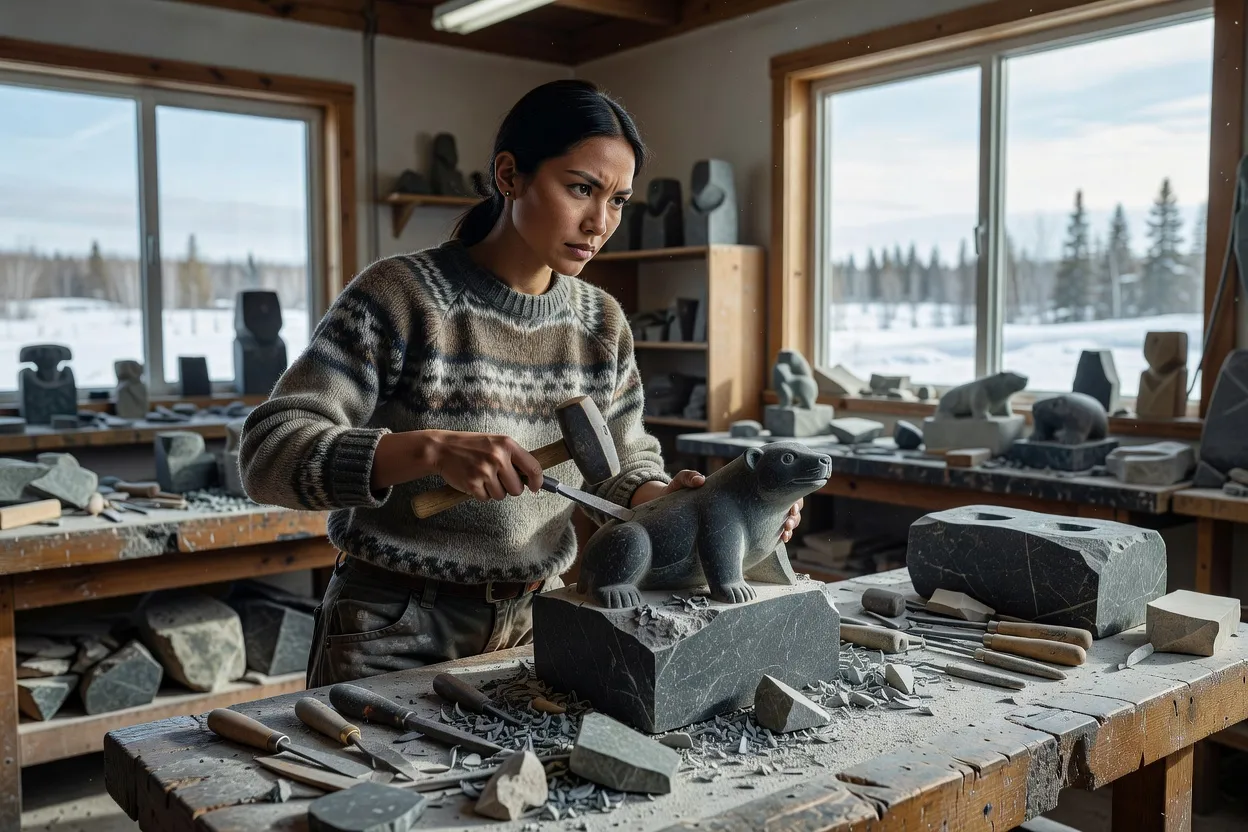
The Inuit and Cree artistic heritage of Northern Quebec brings together living practices tied to the land, to memory and to contemporary economic realities. In Nunavik, soapstone sculpture and printmaking occupy a major place, notably thanks to community cooperatives such as the Puvirnituq Cooperative, historically recognized for its role in the dissemination of Inuit prints. In Eeyou Istchee, Cree arts also express knowledge passed down through families: textile work, beadwork, hide work, narrative motifs and contemporary creations. These works connect generations while contributing to the local economy.
An artistic heritage rooted in the northern land
Inuit art and Cree art cannot be reduced to decorative objects or travel souvenirs. They are cultural languages carrying stories, learned gestures, observations of the environment and family ties. In the communities of Nunavik and Eeyou Istchee, artistic creation is part of a daily relationship with Northern Quebec: the wildlife, the seasons, travel, the materials available and the stories shared.
Inuit sculpture is often associated with soapstone. This relatively soft rock allows the shaping of human, animal or hybrid figures. Bears, birds, marine mammals, hunters, parental figures and scenes of northern life can take form in compact volumes, sometimes polished, sometimes left rougher to preserve the mineral presence of the stone.
On the Cree side, artistic expression unfolds across a wide range of media. Beadwork, sewing, embroidery, the working of furs and hides, along with contemporary visual practices, all contribute to cultural continuity. The motifs can evoke plant life, family journeys, relationships with animals, water, the boreal forest and the seasonal cycles.
This territorial dimension is essential: the works do not tell of an abstract North. They can convey a precise experience of Cree or Inuit life on the land, without every meaning necessarily being accessible to an outside eye.
| Artistic technique | Materials | Cultural significance |
|---|---|---|
| Soapstone sculpture | Soapstone, carving and polishing tools | Depiction of wildlife, human relationships and the strength of the land |
| Printmaking and prints | Stone, stencils, paper, ink, cutting tools | Dissemination of visual stories, community memory and graphic experimentation |
| Cree beadwork | Beads, thread, textile, leather or hide | Transmission of motifs, identity affirmation and care given to objects |
| Sewing and hide work | Hides, furs, textiles, thread, decorative trims | Practical and aesthetic knowledge tied to northern life and family bonds |
| Contemporary art | Mixed media, photography, drawing, installation, digital | Dialogue between cultural heritage, current realities and international circulation |
Soapstone sculpture: a signature practice of Inuit art
Soapstone has become one of the materials most associated with Inuit art in the international imagination. Its grain, density and colour variations offer great creative freedom. The stone can range from deep grey to green, brown or black, depending on its origin. Each block also imposes its own constraints: a crack, a vein or a natural shape can guide the carver’s hand.
Soapstone sculpture requires time, observation and a gradually developed mastery of tools. The work often begins with the search for an overall silhouette, then continues with the definition of volumes, details and textures. The finish can profoundly change how a piece is read: a glossy polish brings out the material, while a matte or striated surface can accentuate the movement of feathers, fur or a face.
It would nonetheless be reductive to consider all Inuit sculptures as identical. Approaches vary by community, generation, individual path and aesthetic choice. Some pieces favour stylization, others movement, humour, family intimacy or the power of an animal. Contemporary Inuit art further widens this field by bringing long-standing know-how into dialogue with present-day themes.
For collectors and visitors, there is also an ethical dimension. A work should be purchased with clear information about its provenance, its creator when that information is available, and its distribution chain. Favouring responsible galleries, cooperatives, art centres and transparent sellers helps to recognize the real value of the artistic work.
Among the useful benchmarks for appreciating an Inuit sculpture, one can note:
- the quality of the stonework, without confusing mechanical perfection with expressive strength;
- the coherence between form, subject and the natural character of the material;
- documented provenance and respect for the artist’s rights;
- an understanding that a work is not only an object, but also the product of cultural knowledge and paid labour.
Inuit printmaking and the legacy of the Puvirnituq Cooperative
Inuit printmaking holds a decisive place in the recognition of northern art in Quebec, in Canada and internationally. It has allowed original images to be disseminated in multiple copies, while still leaving great room for the singularity of drawing, composition and interpretation by the printmakers and printers involved.
In Nunavik, the Puvirnituq Cooperative is an important historical reference. It is recognized for its participation in the development and dissemination of Inuit printmaking, as well as for its role in the community organization of artistic production. Cooperatives have offered concrete structures to support creation, prepare the works, encourage their circulation and create markets beyond the northern communities.
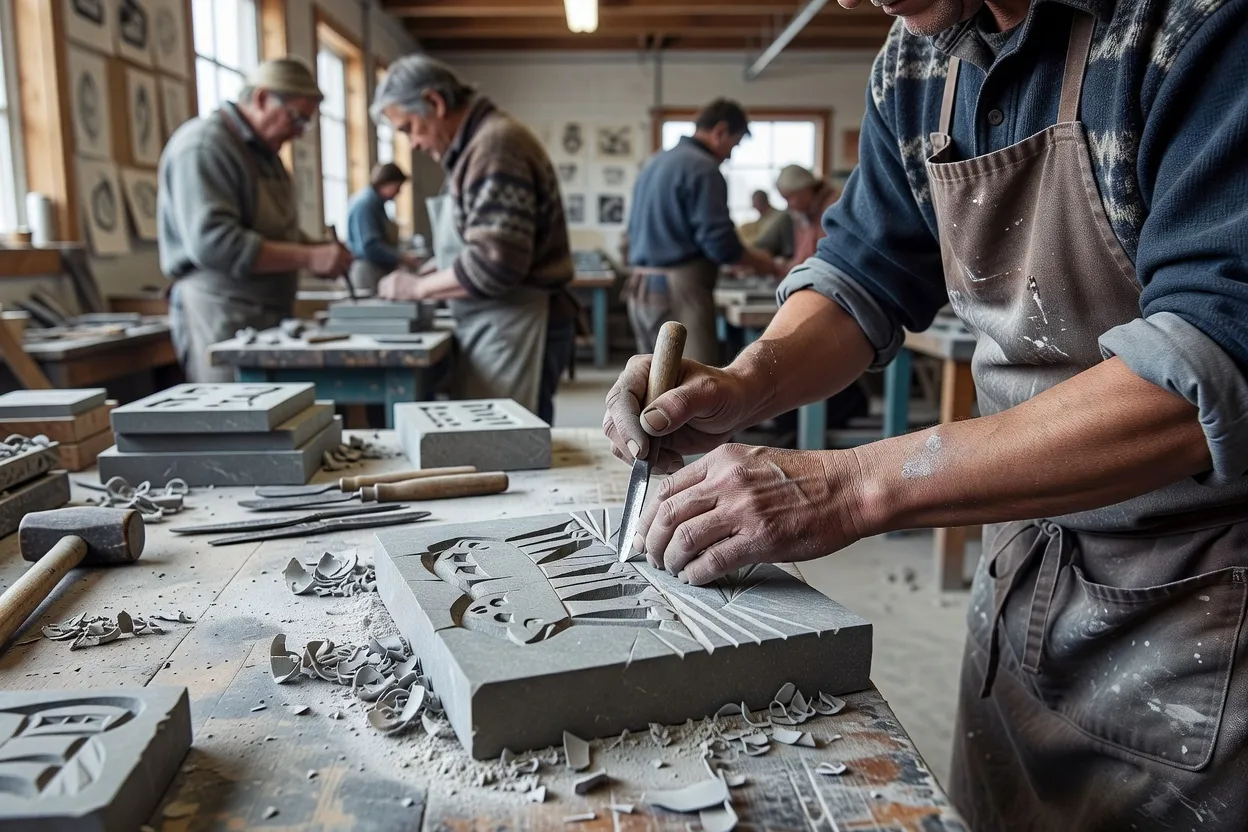
Prints can depict hunting scenes, animals, human figures, orally transmitted stories or more open compositions. Their strength often comes from the economy of line, the density of flat colour areas, and the ability to suggest movement or atmosphere with few elements. An image of a bird, a caribou or a family can thus become a space for storytelling, rather than a simple illustration.
Printmaking is also a collective practice with several stages. The initial drawing, the transfer onto the matrix, the cutting, the inking and the printing can mobilize distinct skills. This organization takes nothing away from the image’s author: it is a reminder that graphic arts often rest on a chain of know-how, particularly in cooperative contexts.
Today, prints from Nunavik continue to interest Inuit art enthusiasts, cultural institutions and researchers. Their value does not rest solely on their rarity or resale potential. It also lies in their documentary, aesthetic and historical importance, as well as their capacity to make voices from Northern Quebec visible.
Cree arts in Eeyou Istchee: textile, beadwork and contemporary creation
Eeyou Istchee refers to the traditional Cree territory located in Northern Quebec. Cree artistic practices there are deeply tied to family knowledge, to activities on the land and to forms of transmission that pass through doing. Sewing, beading, preparing a hide, assembling a garment or decorating an object is not purely technical: these gestures can carry memory, attention to detail and a relationship to the person who will receive or use the object.
Beadwork is particularly important in many Indigenous traditions. It can adorn clothing, accessories, utilitarian pieces or works made for exhibition. The motifs should not be interpreted hastily by outside observers: some stem from a family aesthetic, others from floral inspiration, personal invention or a dialogue with contemporary forms.
Present-day Cree creators do not only work within the continuity of practices recognized as “traditional.” They also use drawing, painting, photography, film, digital arts, fashion and installation. This diversity reflects a dynamic culture, not one frozen in the past. Contemporary Cree art can address themes such as language, youth, the land, environmental change, colonial history, healing and identity affirmation.
To understand these works, two pitfalls must be avoided: confining them to folklore, or demanding that they conform to an outside image of authenticity. A contemporary Cree creation can use modern materials, take a stance on a current issue, or fit within the codes of international art, while remaining deeply rooted in a cultural and territorial experience.
Art cooperatives: creation, autonomy and local benefits
Art cooperatives have played a major role in several Inuit communities. They have made it possible to structure the marketing of locally produced works and to create more favourable conditions for compensating artisans. In regions where access to southern markets can be complex and costly, these organizations have served as essential links between creators, buyers, galleries and institutions.
The cooperative model is not limited to selling sculptures or prints. It can include the supply of materials, technical support, inventory management, promotion and the transmission of information about the works. Its importance is both economic and cultural: it helps maintain spaces where creation can be recognized as a professional activity.
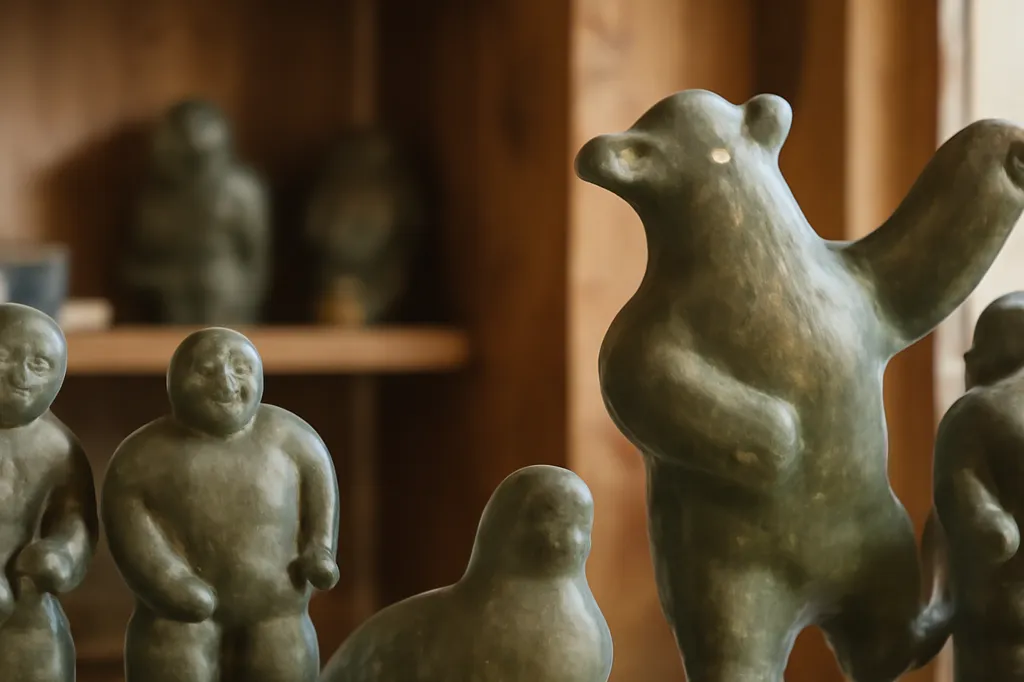
For many artisans and artists, income from art is not incidental. It can supplement other sources of income, support a household, finance the purchase of tools or materials, and allow more time to be devoted to production. The reality remains variable from one person to another: transportation costs, the seasonality of demand, access to materials and the gaps between local sale prices and resale prices all directly influence creators’ economic situations.
A responsible approach to the Indigenous art market involves, in particular:
- recognizing fair compensation for artists and artisans;
- verifying the provenance of works and avoiding imitations or falsely attributed objects;
- respecting any restrictions related to materials derived from wildlife;
- favouring channels that maintain a clear link between the buyer, the community and the creator;
- not conflating community production, tourist art and authenticated Indigenous creation.
Intergenerational transmission and international recognition
The transmission of artistic techniques often begins within the family and the community. It happens through observation, listening, repetition and the sharing of tools or materials. A younger person may learn by watching a relative work the stone, draw, bead or sew. This learning does not always follow the model of a formal course: it is woven into daily life, into conversations and into the time devoted to a task.
This transmission is particularly valuable because it connects technical skills to broader knowledge. Knowing how to choose a material, recognize an animal form, tell a story or understand the use of a garment can all be part of the same learning process. Elders, parents, experienced artists and those who teach in community workshops all play a role in this continuity, an issue of preservation that also connects to digital archiving of Northern Quebec’s cultural heritage.
International recognition of Inuit art is now well established. Public collections, museums, specialized galleries and exhibitions devote sustained attention to sculptures, prints, drawings and contemporary practices from the Arctic. This visibility has helped make Nunavik known as an important territory of Inuit creation.
It comes with a responsibility, however. Presenting Inuit or Cree art internationally requires contextualizing the works, correctly naming the communities and territories, avoiding generalizations and respecting artists’ rights. Visibility must not translate into the appropriation of motifs, commercial copying or the erasure of the people who create.
In 2026, the artistic heritage of Nunavik and Eeyou Istchee therefore remains both legacy and movement. It is passed down, transformed, sold, exhibited and reinvented. Its vitality depends as much on cultural recognition as on economic conditions that allow artisans and artists to continue their work with dignity.
Frequently asked questions
What is the difference between Inuit art from Nunavik and Cree art from Eeyou Istchee?
They share a strong grounding in Northern Quebec and in territorial knowledge, but they belong to distinct cultures, languages, histories and artistic traditions. Inuit art is notably recognized for soapstone sculpture and printmaking, while Cree arts include, among other things, beadwork, textile work, hide work and many contemporary practices.
Why is soapstone so widely used in Inuit sculpture?
Soapstone is relatively soft and can be carved and then polished with precision. Its colours and veining also give artworks a particular presence. Its use is part of sculpting traditions developed and renewed by Inuit artists across generations.
What role did the Puvirnituq Cooperative play?
The Puvirnituq Cooperative played an important historical role in the development and dissemination of Inuit art, particularly in printmaking. It also represents the importance of cooperative structures in supporting the production, circulation and marketing of works created in Nunavik.
How can someone buy an Inuit or Cree artwork responsibly?
It is best to turn to a cooperative, a recognized gallery, an art centre, a cultural event, or a seller able to document the artwork's provenance. Ask for information about the creator, the community, the materials and the terms of sale, without demanding disclosures the artist does not wish to share.
Is contemporary Indigenous art different from traditional art?
The distinction is sometimes useful, but it can also be too simplistic. Many artists combine inherited techniques, current materials and contemporary concerns. A work can be fully contemporary while still carrying forward knowledge, motifs, stories or relationships to the land passed down over a long time.