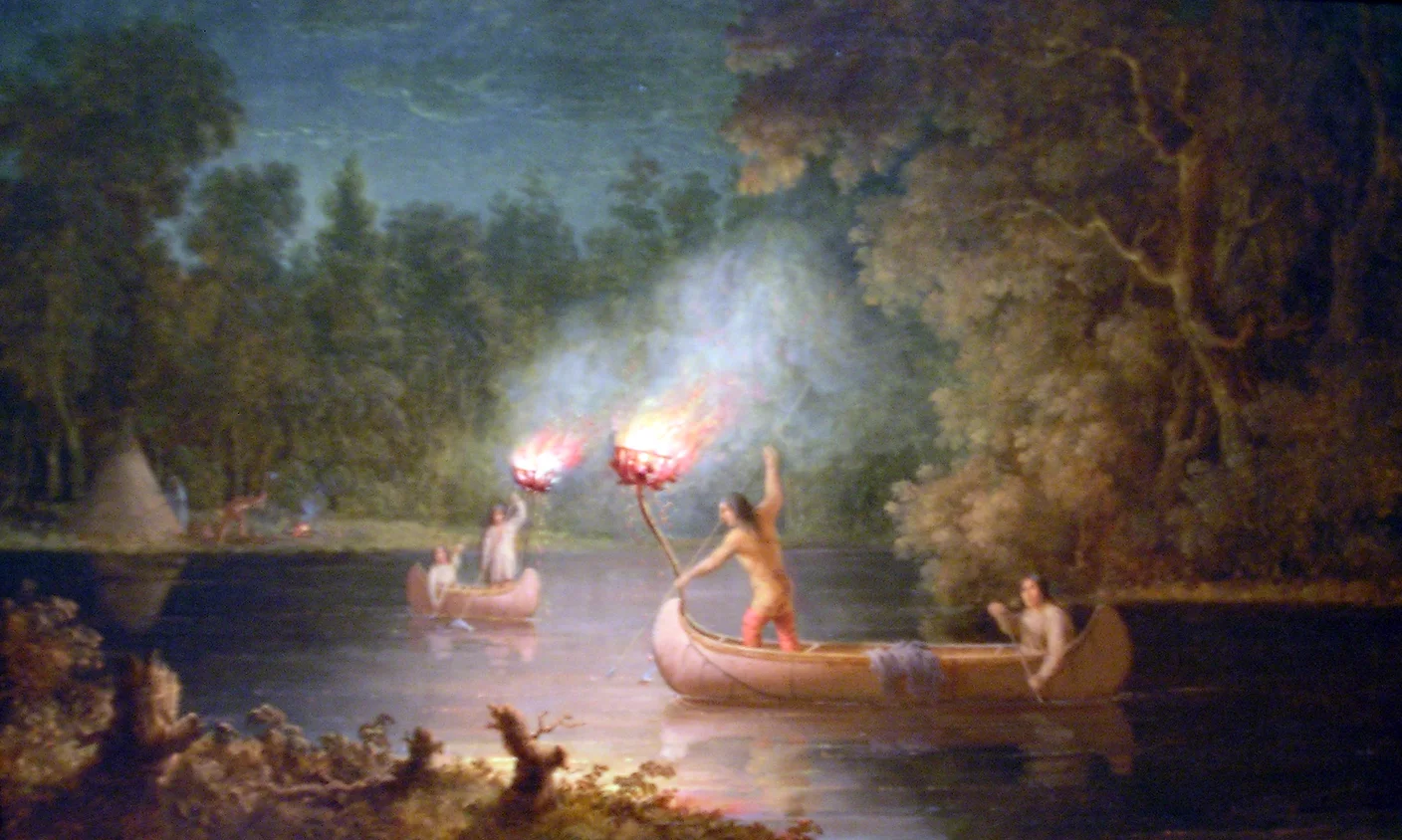
Waswanipi, ᐙᔅᐙᓂᐲ (Wâswânipî), is a Cree village located in Quebec, at the confluence of the Chibougamau and Waswanipi rivers. Its name evokes “light on the water”: it refers to nighttime torch fishing, a practice in which resin or tar torches attracted fish, particularly sturgeon. Now accessible by Route 113, Waswanipi remains connected to its rivers, its lakes and a long history of presence on the land.
The meaning of the name Waswanipi
The name Waswanipi is written ᐙᔅᐙᓂᐲ in syllabic writing and is pronounced Wâswânipî. It is formed from wâswân, which refers to nighttime torch fishing, and the suffix -pî, which means “lake.”
The translation “light on the water” recalls a careful way of fishing on the lakes and rivers of the land. At night, resin or tar torches could be used to attract fish, particularly sturgeon. The name thus brings together a fishing practice, light and water, three elements associated with the place.
- ᐙᔅᐙᓂᐲ: syllabic form of the name.
- Wâswân: nighttime torch fishing.
- -pî: lake.
- Translation: “light on the water.”
This name preserves the memory of a tangible relationship with the waters of the land. It also recalls the ingenuity of fishing practices adapted to life on rivers and lakes.
The land before the village
The Waswanipi land is shaped by waterways, including the Waswanipi River and the Chibougamau River. The village is located at their confluence, in an environment where lakes and rivers support fishing, wildlife observation and travel across the traditional territory.
At the end of the XVIIIth century, the North West Company established the first permanent post in the region. As early as 1775, a post operated year-round near Lake Cheashquacheston, now called lac au Goéland. This post was located about ten kilometres west of Waswanipi Island.
The post was later moved to Waswanipi Island, known as the Old Post. The Hudson’s Bay Company also operated a post on Lake Waswanipi during the XIXth and XXth centuries. This history of the fur trade is among the historical landmarks of the territory.
Waswanipi Island was never a reserve in the conventional legal sense. It nevertheless remains associated with an important period of gathering and community life around the lake and the trading post.
The creation of the village
The present-day village is part of a history of gradual gathering during the 1970s. The closure of the Hudson’s Bay Company post, in June 1965, marked the end of a commercial presence on Lake Waswanipi.
In the years that followed, hydroelectric projects and the threat of flooding accelerated the relocation of families. The collective decision to establish a new village made it possible to continue community life in a new location, upstream on the Waswanipi River.
The new village was built in 1978, about forty-seven kilometres upstream on the Waswanipi River. This settlement represents continuity: the connection with the waters, the land and the community continued despite the relocation from the former site.
- The Hudson’s Bay Company post closed in June 1965.
- The gathering took place gradually during the 1970s.
- Hydroelectric projects and the threat of flooding accelerated the relocation.
- The new village was built in 1978 on the Waswanipi River.
The village timeline
The history of Waswanipi links the former posts established near the lakes to the creation of the present-day village. The following timeline presents the main available landmarks.
| Year or period | Event |
|---|---|
| 1775 | A post operates year-round near Lake Cheashquacheston, now lac au Goéland, about ten kilometres west of Waswanipi Island. |
| End of the XVIIIth century | The North West Company establishes the first permanent post, later moved to Waswanipi Island, called the Old Post. |
| XIXth and XXth centuries | The Hudson’s Bay Company operates a post on Lake Waswanipi. |
| June 1965 | Closure of the Hudson’s Bay Company post on Lake Waswanipi. |
| November 11, 1975 | The James Bay and Northern Quebec Agreement provides Waswanipi with a stabilized status. |
| 1970s | Gradual gathering of families; hydroelectric projects and the threat of flooding accelerate the relocation. |
| 1978 | Construction of the new village, about forty-seven kilometres upstream on the Waswanipi River. |
| 2025 | Commemoration of the fiftieth anniversary of the James Bay and Northern Quebec Agreement in Cree communities, with a community celebration entitled “Light on the Water” in Waswanipi. |
This sequence of events highlights the community’s ability to maintain its connections with the land while choosing a new place to live. The history of the present-day village is therefore inseparable from that of Waswanipi Island, the lake, the trading posts and the rivers.
The village today
Waswanipi is now accessible by Route 113. Located at the confluence of the Chibougamau and Waswanipi rivers, the village has a population of 459 according to the 2021 census subdivision population.
The municipality is the Cree Village Municipality of Waswanipi. Its address is 1 Chief Louis R. Gull Street, C. P. 30, Waswanipi (Québec) J0Y 3C0. The chief is Irene Neeposh.
The community has Wesleyville School, under the CSB, as well as the Waswanipi Miyupimaatisiiun Community Centre, connected to the CBHSSJB. These services are part of the village’s daily life.
The rivers and lakes remain at the heart of the Waswanipi experience. Fishing, wildlife observation, the traditional territory and the history of the trading post are among the elements associated with visiting and discovering the place.
A community connected to light on the water
The name Waswanipi powerfully sums up a relationship between the community, fishing and the waters of the land. From the former post on Waswanipi Island to the village built in 1978, local history reflects collective choices and a continuity of community life rooted in rivers and lakes.
The “Light on the Water” celebration, held in Waswanipi in 2025 in the context of the fiftieth anniversary of the James Bay and Northern Quebec Agreement, echoes this enduring image. Light on the water remains an expression that connects the village’s name, its land and its history.
Notable Facts and People
Waswanipi is written ᐙᔅᐙᓂᐲ (Wâswânipî): wâswân refers to torch-lit night fishing and -pî to the lake. The name — “light over the water” — evokes the traditional technique of using resin torches to attract fish, especially sturgeon. A permanent post is attested as early as 1775 near what is now Lake au Goéland; the post then moved to Waswanipi Island, operated in the 19th and 20th centuries by the Hudson’s Bay Company until it closed in June 1965.
After the post closed and as the Cree way of life transformed, families were gathered into a permanent community: the present village was built in 1978, about 47 kilometres upstream from the old site. In 2025, for the 50th anniversary of the James Bay Agreement, the community notably celebrated the “Light on the Water” event.
Local Services and Institutions
Nation office and municipality. The community is governed by the Cree Nation of Waswanipi The current chief is Irene Neeposh. The Cree Village Municipality of Waswanipi has its office at 1 Chief Louis R. Gull Street, P.O. Box 30, Waswanipi QC J0Y 3C0; tel.: 819-753-2587.
School. Elementary and secondary education is provided by the Cree School Board: Wesleyville School.
Health. Health services are operated by the Cree Board of Health and Social Services of James Bay (CBHSSJB): Waswanipi Miyupimaatisiiun Community Centre.
Access and Transportation
Waswanipi is accessible by Route 113, which links the community to the Chibougamau-Chapais region and southern Quebec. This road positioning is relatively rare among Eeyou Istchee villages.
Tourism and Attractions
The village and its territory offer several attractions:
- fishing in the surrounding rivers and lakes
- wildlife viewing on the Cree territory
- the history of the Waswanipi Island trading post (Old Post)
- community celebrations, including “Light on the Water” (2025)
To go further
- Eeyou Istchee and James Bay: landmarks for visiting Cree territory
- Community tourism in Eeyou Istchee: Cree villages and etiquette
- All Cree villages of Eeyou Istchee
Frequently asked questions
What does Waswanipi mean?
Waswanipi (ᐙᔅᐙᓂᐲ, Wâswânipî) means “light over the water”: wâswân refers to torch-lit night fishing and -pî to the lake.
Where was the old Waswanipi village?
On Waswanipi Island (Old Post), on Lake Waswanipi, where the Hudson’s Bay Company operated a post until June 1965. The present village was built in 1978, about 47 kilometres upstream.
What is the population of Waswanipi?
The 2021 census counted 459 residents in the Waswanipi census subdivision.
How do you get to Waswanipi?
By Route 113, which links the community to Chibougamau-Chapais and southern Quebec.
What local services does Waswanipi have?
Wesleyville School (Cree School Board) and the Waswanipi Miyupimaatisiiun Community Centre (CBHSSJB).