

Nunavik, a territory of 500,000 km² covering the northern third of Quebec, comprises 14 coastal villages accessible only by air or, during the short navigation season, by boat. For the approximately 14,000 residents — predominantly Inuit — internet access is not an optional service. It is critical infrastructure, on a par with drinking water or electricity.
In 2026, the situation has improved considerably compared to five years ago. The arrival of low-Earth orbit (LEO) satellite has transformed speeds and latency. But challenges persist: high costs, infrastructure fragility in the Arctic climate, and dependence on operators headquartered far from the region. This feature reviews every active provider in 2026 and analyses their coverage village by village.
The digital divide in Arctic Quebec
Before examining individual providers, it is important to understand the structural constraints that make internet in Nunavik fundamentally different from what it is in Montreal or Quebec City.
Permafrost prevents cable burial over long distances. The absence of roads between villages makes any terrestrial inter-village deployment impossible. The navigation season is short — three to four months — which limits installation windows for heavy equipment. And the extremely low population density (an average of one resident per 35 km²) makes any commercial investment difficult to justify without public support.
These constraints explain why Nunavik has historically relied on high-altitude geostationary satellite (GEO), with its well-known drawbacks: high latency (an average of 600 ms), bandwidth shared across dozens of villages, and prohibitive costs. The arrival of LEO constellations like Starlink or Telesat Lightspeed represents a genuine technological break, but it does not solve every problem.
Tamaani Internet — Makivik’s community operator
Tamaani Internet is the community operator created by the Makivik Corporation, the organisation representing the Inuit of Nunavik. It has historically been the region’s primary internet access provider.
Its model relies on a dual network: GEO satellite links for the backbone (Hughes Network Systems, Telesat) and a community Wi-Fi network on a local intranet in each village. This architecture makes connectivity available to all residents, including low-income households, at below-market rates.
In 2026, Tamaani has begun a shift toward LEO satellite for its backbone links, reducing latency and increasing available bandwidth. Residential offers range from 10 to 50 Mbps depending on the village, with monthly plans between $60 and $120. Public institutions (schools, health centres, administrations) benefit from guaranteed bandwidth negotiated directly with Makivik.
Tamaani’s main limitation remains the inequality of service between villages: Kuujjuaq, Inukjuak and Puvirnituq have more modern infrastructure than Ivujivik or Akulivik, where bandwidth remains more constrained.
Important: choosing a provider in Nunavik depends first and foremost on use case. For a household with everyday needs (browsing, messaging, social media), Tamaani is often sufficient and less expensive. For professional or institutional uses that demand more bandwidth (telemedicine, video conferencing, intensive remote work), a Tamaani + Starlink combination offers the most robust setup. Tip: before subscribing to a Starlink plan, check with the municipality or local cooperative whether an equipment subsidy program (terminal ~$650) is available — several villages have benefited from these through the federal and provincial programs discussed later in this feature.
Managing this type of hybrid infrastructure — satellite backbone, community Wi-Fi, DHCP and DNS routing — typically relies on Linux-based equipment. For technical teams in Nunavik communities who are new to open source server environments, this Linux glossary for beginners covers the 50 essential terms needed to navigate Linux infrastructure.
Xplorenet / Xplore — long-range fixed wireless
Xplorenet, rebranded as Xplore since 2023, operates in several Nunavik communities via long-range fixed wireless technologies (WiMAX, fixed LTE) and satellite services. Its positioning is that of a national rural operator trying to differentiate on price against pure-play satellite providers.
In practice, Xplore service quality in Nunavik is variable. In mid-sized villages — Puvirnituq (1,900 residents), Salluit (1,700 residents) — connectivity is stable and speeds reach 25 to 50 Mbps in off-peak hours. In smaller villages, the situation is more constrained. Xplore faced criticism in 2022-2023 in some rural Canadian areas for speeds falling short of advertised rates, before revising its offers in 2024.
Xplore’s fixed wireless network requires clear line of sight between the base antenna (installed on a building or tower) and the client equipment. In villages built on hillsides along the shore, this condition is not always met, which can exclude certain areas.
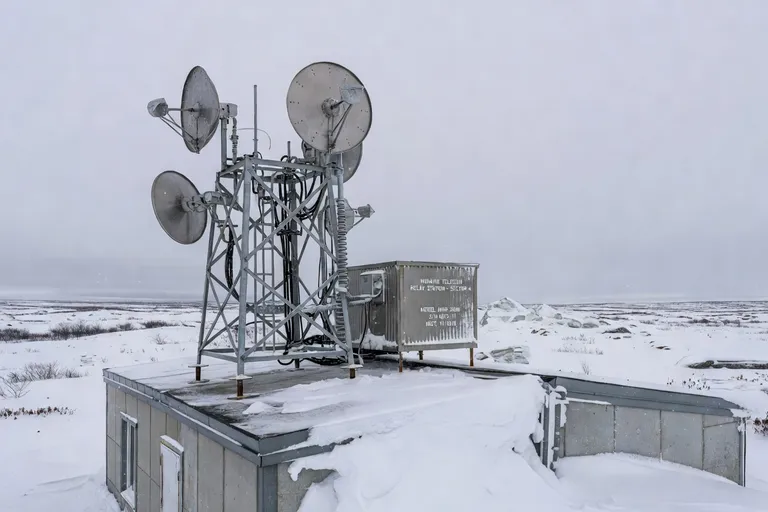
Starlink (SpaceX) — low-orbit satellite arrives in Nunavik
Starlink has been available across Nunavik since mid-2023. Its deployment has represented a paradigm shift: for the first time, speeds above 100 Mbps with latency below 60 ms are accessible in villages like Ivujivik (Quebec’s northernmost village, at 62°N), where no provider previously offered true broadband.
In 2026, real-world performance measured in the field ranges between 50 and 180 Mbps download and 5 to 25 Mbps upload. Latency is generally between 25 and 55 ms, making quality video conferencing, real-time telemedicine and online gaming possible — uses that were nearly impossible with GEO satellite. To understand how this bandwidth translates concretely inside village health centres, see our feature on e-health and telemedicine in Nunavik and Eeyou Istchee.
Costs remain high. In 2026, the hardware terminal costs approximately $650 (sometimes subsidised by regional programs), and the residential subscription is between $140 and $170 per month. For a low-income Inuit household, this is a significant investment. Municipal and provincial subsidy programs exist for institutions, but not systematically for individuals.
Starlink’s main technical drawback remains its sensitivity to extreme weather: heavy snowstorms, frost on the terminal, and to a lesser extent aurora borealis can momentarily degrade the service.
Common mistake: underestimating Starlink’s total cost of ownership. The advertised subscription price ($140-170/month) does not include the terminal (~$650), which may not be refundable on early cancellation depending on the terms in effect at purchase. For a lower-income household, this upfront cost can weigh more heavily than the monthly subscription itself — which is why it’s worth checking available subsidies before committing. Key takeaway: Starlink is a genuine game-changer for speed and latency, but it remains a complement — not a universal replacement — to Tamaani’s offering, particularly for households that don’t need intensive daily bandwidth.
Télébec (TELUS) — telephony and internet in accessible areas
Télébec, a TELUS subsidiary, is historically the telephone operator of northern Quebec. Its presence in Nunavik focuses on wired telephony and, in certain villages, limited DSL services.
In 2026, Télébec’s internet offering in Nunavik is modest: DSL speeds of 5 to 10 Mbps in villages where the copper infrastructure is in good condition, and a presence primarily for institutional dedicated lines, emergency telephone services and business services. For individuals, Télébec is generally not the primary internet access solution, but remains an important player for voice telephony and dedicated lines for public services.
Bell and other national operators
Bell Canada has a limited presence in Nunavik. Its 4G/LTE mobile services only cover the immediate vicinity of certain airports. There is no extended mobile coverage in the villages themselves. Occasional partnerships with Tamaani or other regional operators allow some professional users to access roaming services, but this is not a residential connectivity solution.
Videotron, Rogers and other major national operators are absent from Nunavik on the residential side. Their investments focus on areas with high commercial returns.
Tarqavik Communications — Indigenous digital sovereignty
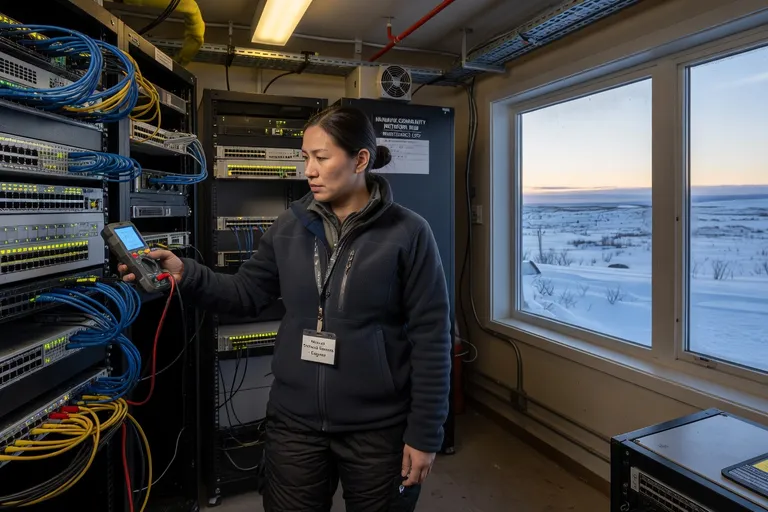
Tarqavik Communications is the organisation whose mission is to develop a telecommunications infrastructure truly controlled by Nunavik’s Inuit communities. Its work is part of a long-term vision of digital sovereignty: not depending indefinitely on external operators whose commercial decisions and investment priorities are not aligned with local needs.
Tarqavik works in collaboration with Tamaani, the Kativik Regional Administration (KRG) and the Makivik Corporation to identify infrastructure opportunities — undersea fibre links, regional internet exchange points, community data centres — that would reduce transit costs and improve network resilience.
In 2026, Tarqavik is not yet an operator per se, but a strategic body that directs public investment and advocates with provincial and federal governments for equitable treatment of Far North communities.
Government programs 2024-2026
Several public programs have contributed to improving connectivity in Nunavik between 2024 and 2026.
At the federal level, the CRTC’s Universal Broadband Fund and the Connect to Innovate program (Innovation, Science and Economic Development Canada) have funded community network expansion projects, LEO equipment installation in public institutions, and digital skills training programs in the villages.
At the provincial level, the Québec Connecté program has targeted specific investments for underserved northern regions. In 2025, the Quebec government announced additional investment to accelerate broadband deployment in the villages of Ivujivik, Akulivik and Quaqtaq — the three communities still most poorly served.
These programs are essential but sometimes suffer from long implementation delays and complex eligibility criteria, particularly for small villages whose local administration has few resources to prepare funding applications.
Village-by-village comparison (2026)
The following table summarises the approximate connectivity situation in Nunavik’s main villages in 2026. Speeds are estimates based on publicly available information and field reports — they can vary by neighbourhood and weather conditions.
For companies and organisations deploying digital services in the region, an analysis of Nunavik’s digital infrastructure and an interview with a northern digital specialist provide deeper context.
| Village | Population | Tamaani | Starlink | Xplore | Télébec | Estimated speed (2026) |
|---|---|---|---|---|---|---|
| Kuujjuaq | ~3,000 | Yes | Yes | Yes | Yes | 50-200 Mbps |
| Puvirnituq | ~2,000 | Yes | Yes | Yes | Partial | 50-150 Mbps |
| Inukjuak | ~1,800 | Yes | Yes | Partial | No | 30-120 Mbps |
| Salluit | ~1,700 | Yes | Yes | Yes | No | 40-150 Mbps |
| Kangiqsujuaq | ~900 | Yes | Yes | No | No | 25-100 Mbps |
| Kangiqsualujjuaq | ~800 | Yes | Yes | No | No | 20-80 Mbps |
| Kuujjuaraapik | ~800 | Yes | Yes | Partial | Yes | 30-120 Mbps |
| Umiujaq | ~500 | Yes | Yes | No | No | 15-60 Mbps |
| Akulivik | ~600 | Yes | Recent | No | No | 15-50 Mbps |
| Quaqtaq | ~400 | Yes | Recent | No | No | 10-40 Mbps |
| Ivujivik | ~350 | Yes | Yes | No | No | 15-60 Mbps |
| Tasiujaq | ~300 | Yes | Recent | No | No | 10-40 Mbps |
| Kangirsuk | ~550 | Yes | Yes | No | No | 20-70 Mbps |
| Aupaluk | ~220 | Yes | Recent | No | No | 10-30 Mbps |
Soleica regularly works in several of these villages on the deployment of local IT infrastructure (Hyper-V servers, secure local networks) to complement provider internet connections.
2026-2030 outlook — undersea fibre, permafrost and sovereignty
The next decade will likely see three major developments in Nunavik connectivity.
The first is the potential deployment of an undersea fibre optic link connecting the Hudson Bay coastal villages. Several feasibility studies have been conducted by Makivik, Tarqavik and the federal government. The project is technically feasible, but its cost (estimated at several hundred million dollars) and the challenges posed by coastal permafrost and seasonal ice make it complex to finance and maintain.
The second development involves the rise of new LEO constellations competing with Starlink: Telesat Lightspeed (Canadian), Amazon Kuiper, and others. Competition should lower prices and improve resilience, particularly by avoiding dependence on a single foreign provider.
The third challenge is institutional: how can Inuit communities exercise real control over their digital infrastructure? This is where actors like Tarqavik and Tamaani play an irreplaceable role, and long-term support from federal and provincial governments is essential.
For travellers and professionals looking to understand Canada’s remote northern regions, a guide to travel in Canada’s remote northern regions provides valuable geographical and practical context.
About Soleica — Soleica has supported Inuit and First Nations communities of Nunavik and Eeyou Istchee in their IT infrastructure and connectivity projects for over 15 years. Our team carries out field missions several times a year in northern Quebec villages. Learn more about our services.
Frequently asked questions
Which is the best internet provider in Nunavik in 2026?
There is no universal answer — it depends on the village and the use case. Tamaani Internet (Makivik) offers the widest coverage with community-adapted plans. Starlink (SpaceX) provides the highest speeds (50 to 200 Mbps) where available, but at a higher monthly cost for households. Xplorenet covers several villages with fixed wireless connectivity. For professional or institutional use, a Tamaani + Starlink combination is often the most robust solution.
Is Tamaani Internet available in all Nunavik villages?
Tamaani Internet, the community operator of the Makivik Corporation, has a presence in the vast majority of Nunavik's 14 coastal villages. Its network primarily relies on geostationary satellite links (Hughes, Telesat) and community Wi-Fi access points. Service quality varies between villages: Kuujjuaq, Puvirnituq and Inukjuak have more modern infrastructure than smaller villages like Ivujivik or Akulivik.
Does Starlink work in the Far North of Quebec?
Yes. Starlink (SpaceX) has been available across Nunavik since 2023. The LEO (Low Earth Orbit) constellation delivers speeds between 50 and 200 Mbps with latency reduced to 30-50 ms, compared to 600 ms for classic geostationary satellite. The main drawbacks are the equipment cost (terminal ~$650), the monthly subscription (approximately $140-170/month in 2026), and sensitivity to extreme weather conditions.
How much does internet cost in Nunavik compared to southern Quebec?
The gap is considerable. A standard residential subscription in Nunavik costs between $80 and $200/month for speeds of 10 to 50 Mbps, compared to $60-80/month for 1 Gbps in urban Quebec. The real cost also includes satellite equipment, installation fees and service outages during storms. Public institutions (schools, health centres) sometimes benefit from provincial or federal subsidies.
Does Xplorenet cover isolated Nunavik villages?
Xplorenet (now Xplore) operates in several Nunavik communities via long-range fixed wireless and satellite links. Its coverage is uneven: stronger in mid-sized villages like Puvirnituq or Salluit than in smaller ones. In 2024-2025, Xplore reorganised its rural offerings with a greater focus on LEO satellite through partnerships. For a village-specific diagnosis, contacting Tamaani or the Kativik Regional Administration directly is recommended.