
Editorial character. This interview synthesises documented digital development challenges in Nunavik communities.
In recent years, internet connectivity in Nunavik has crossed a threshold. Low-orbit satellite technologies, government investments and community organisation initiatives have transformed what it means to be “connected” in a remote Arctic village. But challenges remain: costs, infrastructure fragility, digital sovereignty. Nadia Okalik, who has spent eight years at the intersection of northern Indigenous communities and digital systems, spoke to us candidly.

Northern digital development adviser
Originally from Kuujjuaq, Nadia has spent 8 years supporting Indigenous and government organisations in digital transformation projects in the Far North. Formerly a project manager at the Kativik Regional Administration.
What concretely changes when a village gets broadband
Claire Vasseur: You've been working on these issues for eight years. What really changes, concretely, when a village like Ivujivik or Akulivik goes from a slow GEO satellite connection to Starlink or a fast LEO connection?
Nadia: The first thing that changes is telemedicine. And for families in these villages, it's a revolution. Before, a specialist consultation often meant a flight to Kuujjuaq or directly to Montreal — with everything that entails: finding childcare, being away for several days, travel costs. Today, many consultations happen by video from the village itself. It's not perfect — some specialties still require travel — but the number of medical trips has dropped significantly in villages with good broadband.The second thing is education. Young people who want to take post-secondary courses from their village — online from UQAM, UQAT or a CEGEP — can now do so without having to leave. This is fundamental for keeping young people in the North. And for children, access to quality educational resources in Inuktitut and French is a language and cultural preservation tool we didn’t have ten years ago.
The third thing — less visible but economically very important — is the ability to start a business or work remotely from the village. I’ve met people doing graphic design, translation, customer service from Kuujjuaq or Inukjuak for clients in the south. This creates income without forcing people to leave their community.
Tamaani and Tarqavik — Indigenous digital sovereignty
Claire Vasseur: What is the fundamental difference between a community operator like Tamaani or Tarqavik and a commercial operator like Bell or Xplore?
Nadia: The difference is structural. A commercial operator makes investment decisions based on return on investment. If a village of 250 people doesn't generate enough revenue to cover infrastructure costs, the operator doesn't deploy — or deploys a minimal service. That's rational from an economic standpoint, but it leaves the smallest and most isolated communities in a digital desert.Tamaani Internet, created by the Makivik Corporation, has a different mandate: ensure universal connectivity for all Inuit communities in Nunavik, regardless of size or commercial viability. It’s a public interest operator, not a profit-seeking one. This changes everything in investment decisions.
Tarqavik goes even further in the digital sovereignty vision. The idea is not just to have connected services, but to control the infrastructure. For decisions about the network, data and pricing to be made in Kuujjuaq and not in Toronto or Seattle. It’s a political challenge as much as a technical one.
Starlink — revolution or dependency?
Claire Vasseur: Starlink has been presented as revolutionary for isolated regions. Are the promises being kept in Nunavik?
Nadia: Technically, yes. The speeds are real, the latency is transformed. Going from 600 milliseconds to 40 milliseconds is the difference between a connection that makes any video conferencing nearly impossible and one that works normally. For institutions — health centres, schools, administrations — Starlink has been an immediate gain.But there are important nuances. First, the cost. 140-170 dollars per month plus a 650-dollar terminal is out of reach for many low-income households in Nunavik. Without a residential subsidy program, Starlink remains a solution for institutions and people with stable incomes.
Then there’s the question of dependence on a foreign provider. SpaceX is an American company whose commercial decisions, prices and even service availability are outside the control of communities. The digital sovereignty question arises: do we want our access to the internet — an essential service — to depend on the decisions of a California entrepreneur?
I’m not saying Starlink is bad — on the contrary, it’s a remarkable tool. But it must fit into a broader infrastructure strategy with alternatives, and above all with a strengthening of Indigenous community operators.
Common mistake: underestimating the real cost of a reliable connection in Nunavik. Between the Starlink subscription (140-170 $/month), the terminal (650 $) and the electricity costs of keeping equipment heated through the winter, the monthly bill far exceeds what a remote worker in southern Quebec would pay for an equivalent service — with no guarantee of employer reimbursement.
Xplorenet — what happened
Claire Vasseur: Xplorenet had a difficult start in some rural Canadian regions. What happened, and where does things stand in Nunavik?
Nadia: Xplorenet suffered, like other rural operators, from a gap between commercial promises and the real capacity of the network. In some areas, subscribers paid for advertised speeds of 25 Mbps and received 3 to 5 Mbps in practice — especially at peak hours when the shared network was saturated. This is problematic, particularly for essential services.In Nunavik, Xplore is present in some villages but its deployment is uneven. Long-range fixed wireless technology requires clear line-of-sight conditions that are not always met in villages built on slopes along rocky shores. And competition from Starlink has changed user expectations: when you know you could have 100 Mbps with Starlink, paying for an unstable 10 Mbps service becomes increasingly unacceptable.
For 2026, Xplore has revised its rural Canadian positioning toward LEO service partnerships rather than its own fixed network. We’ll see if this changes the picture in Nunavik.
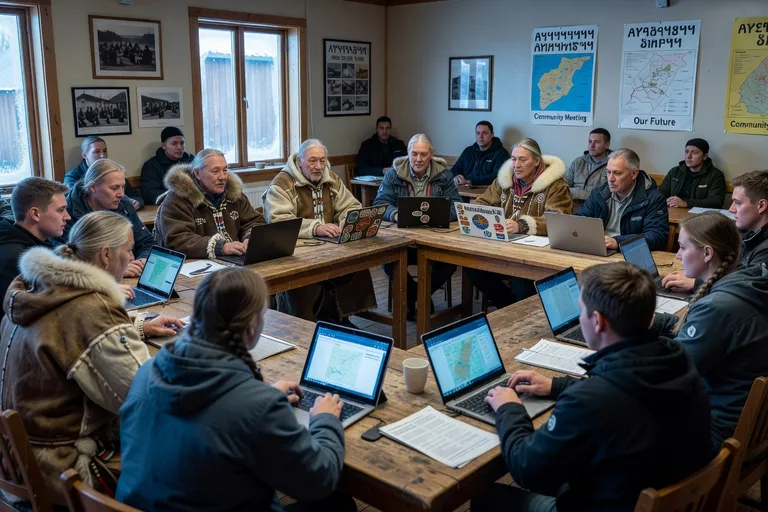
Public services and connectivity
Claire Vasseur: How are health, education and administration services concretely using connectivity in villages in 2026?
Nadia: In healthcare, the most visible change is telemedicine. But beyond video consultations, the entire care chain is transformed: test results arriving in real time from the Kuujjuaq laboratory, radiology images sent to Montreal specialists for immediate reading, medical records shared between village nurses and Kuujjuaq physicians. This reduces errors and accelerates care.In education, the situation is still developing. The tools are there — the connections exist — but educational resources in Inuktitut and Cree are desperately lacking. This is long-term work being done by organisations like the Kativik School Board: developing culturally relevant digital content in Indigenous languages.
In administration, the challenge is access to government services. Online forms, permit applications, program registrations — all of this requires a working connection. When it goes down during a storm, these processes become impossible. For people less comfortable with digital tools, human support remains irreplaceable.
Remote work from Nunavik — reality or utopia?
Claire Vasseur: Is working remotely from Nunavik truly possible today for a professional who wants to stay in their village?
Nadia: Possible, yes. Systematically accessible and economically viable, not yet.Possible: in well-served villages like Kuujjuaq, Puvirnituq or Inukjuak, speeds allow quality remote work. Video conferencing, access to SaaS tools, file sharing — it works. I’ve met graphic designers, accountants and web developers working from these villages.
Not yet systematic: outages are more frequent than in the south. A snowstorm can cut service for two or three days. High connection costs are not always reimbursed by employers who don’t understand northern realities. And for employees who need to be permanently connected — call centres, technical support — connection reliability issues are deal-breakers.
The potential is enormous. Nunavik has a young, dynamic population that is very culturally connected to digital tools. If the infrastructure consolidates and costs drop, in five years remote work from the North will no longer be a curiosity but an economic reality.
Key takeaway: remote work already works in well-served villages (Kuujjuaq, Puvirnituq, Inukjuak), provided three concrete prerequisites are met — a stable LEO connection backing up the main link, a budget that can absorb subscription costs higher than in the south with no guaranteed employer reimbursement, and organisational tolerance for occasional weather-related outages. Tip: before committing to a fully remote position from Nunavik, test your connection over several weeks during peak hours (6pm-10pm) — that’s when shared capacity saturates the most, and this real-world test reveals whether the advertised speed actually holds up under a daily professional video conference load.
Government funding — administrative maze
Claire Vasseur: Governments regularly announce northern connectivity investments. Does this actually materialise on the ground?
Nadia: The announced amounts are real. The CRTC Universal Broadband Fund, Connect to Innovate, Québec Connecté — there is public money committed. But between a program announcement and an antenna being installed in a village, two to four years can pass. That's too long.The main obstacle isn’t political — it’s administrative. Preparing a federal funding application requires project management, accounting and public procurement expertise. A 300-person village with two or three administrators doesn’t have these capacities internally. Either it goes through external consultants who take a portion of the funds, or it gives up.
What’s needed is active support for small communities in accessing funding. Not just open application windows, but people who go to the villages and help prepare applications. This is what Tarqavik does at its scale, but it’s insufficient without a clearly assigned mandate and resources from the provincial government.
Digital sovereignty — next steps
Claire Vasseur: What are the next concrete steps to advance toward digital sovereignty for Nunavik's Inuit communities?
Nadia: Three of them, in my view.The first is physical infrastructure. Continue LEO satellite deployment in villages that are still excluded. And in the longer term, seriously examine the feasibility of a coastal undersea fibre link — it’s expensive, but it’s the only way to have sovereign, lasting infrastructure.
The second is training. Training network technicians, systems administrators, developers from within the communities themselves. Today, much of the technical expertise operating in Nunavik comes from the south. Tarqavik and the KRG are working on training programs, but it takes time and requires resources. Our guide to IT careers in Northern Quebec maps out exactly these jobs and training paths for the local technical workforce.
The third is data governance. Inuit communities generate increasing quantities of data — health, education, local governance, cultural heritage. This data must remain under Indigenous control. Initiatives like the First Nations Principles of OCAP (Ownership, Control, Access and Possession) are models to adapt to the Nunavik Inuit context.

Quick questions — true or false on common misconceptions
Claire Vasseur: To close, a few misconceptions about internet in Nunavik. True or false?
Nadia:“Satellite internet is always slow and expensive” — False for LEO, true for GEO. Starlink delivers 50 to 200 Mbps and under 50 ms latency. That’s genuine broadband. The problem remains cost, not speed.
“Northern internet doesn’t work in storms” — True and false. GEO satellite is little affected by weather at the connection level (issues are mostly with local system design). LEO can be degraded by very heavy snow on the antenna, but this is usually fixed with a de-icer or simply clearing the dish.
“All of Nunavik is now covered” — False. There are still significant inequalities between large villages (Kuujjuaq, Puvirnituq, Inukjuak) and smaller ones (Aupaluk, Tasiujaq). Universal access is a goal, not a reality.
“Inuit people don’t want technology” — Completely false and a stereotype that needs dismantling. Inuit communities are among the most active social media users in Canada, use smartphones extensively and are deeply engaged in discussions about digital transition. What they want is technology that respects their sovereignty and culture — not just any technology at any price.
“It’s not worth investing in northern networks” — Depends how you calculate it. On pure short-term commercial criteria, perhaps. But if you factor in savings on medical transfers, youth retention in communities, and local economic development — the public return on investment is very positive.
Editorial note: Nadia Okalik is an editorial character representative of the northern digital development professionals working in Nunavik communities. This interview synthesises documented digital connectivity challenges for Indigenous communities of northern Quebec.
For more on concrete IT deployments in Nunavik, see our case study on deploying a Hyper-V server with satellite fibre and our services for northern organisations.
For practical information on Canada’s remote northern regions, voyage-canada.com offers resources on geography, transport and the specificities of northern territories.
Frequently asked questions
What is Starlink's concrete impact on daily life in Nunavik villages?
The most immediate impact is on telemedicine. Before Starlink, a specialist consultation from a village like Ivujivik often required an air transfer to Kuujjuaq or Montreal — with everything that entails: finding childcare, being away for several days, travel costs. Today, many consultations happen by video from within the village. This is a concrete change in life for families who no longer need to leave their community for medical appointments. For entrepreneurs, the ability to work in real time with partners in Montreal or Ottawa has opened new economic opportunities.
How does Tamaani Internet position itself against Starlink?
Tamaani and Starlink are not really competitors — they are complementary. Tamaani is the community operator ensuring universal coverage, including for low-income households. Starlink is technically superior but more expensive and primarily accessible to institutions and households with stable income. The ideal is a hybrid model: Tamaani as accessible baseline infrastructure for everyone, Starlink as the premium layer for intensive uses. This is what several villages are progressively implementing.
Which public services in Nunavik directly depend on connectivity?
Practically all modern services are affected. In healthcare: telemedicine, remote specialist consultations, test result transmission, teleradiology. In education: online courses, digital teaching resources, connections with universities for post-secondary courses. In administration: government forms, online payments, cooperative management. In public safety: regionalised emergency reporting systems. Without reliable connectivity, all of this collapses.
How do federal and provincial governments fund northern connectivity?
There are several funding channels. Federally: the CRTC Universal Broadband Fund, Connect to Innovate (ISED), and specific northern infrastructure funds. Provincially: Québec Connecté and specific envelopes in the Ministry of Municipal Affairs and Housing budget for northern municipalities. The challenge is not a lack of programs — it is administrative complexity. Preparing a funding application for a 300-person village with a three-person administration is extremely difficult.
Can you really work remotely from a Nunavik village in 2026?
Yes, in well-served villages. In Kuujjuaq, Puvirnituq, Inukjuak and several other mid-sized communities, available speeds allow quality remote work: stable video conferencing, access to SaaS tools, large file sharing. Important nuances: connections remain more vulnerable to outages than in the south (weather, equipment), and high costs weigh on the budgets of remote workers who do not receive employer reimbursement. The potential is real but the support framework still needs to improve.