
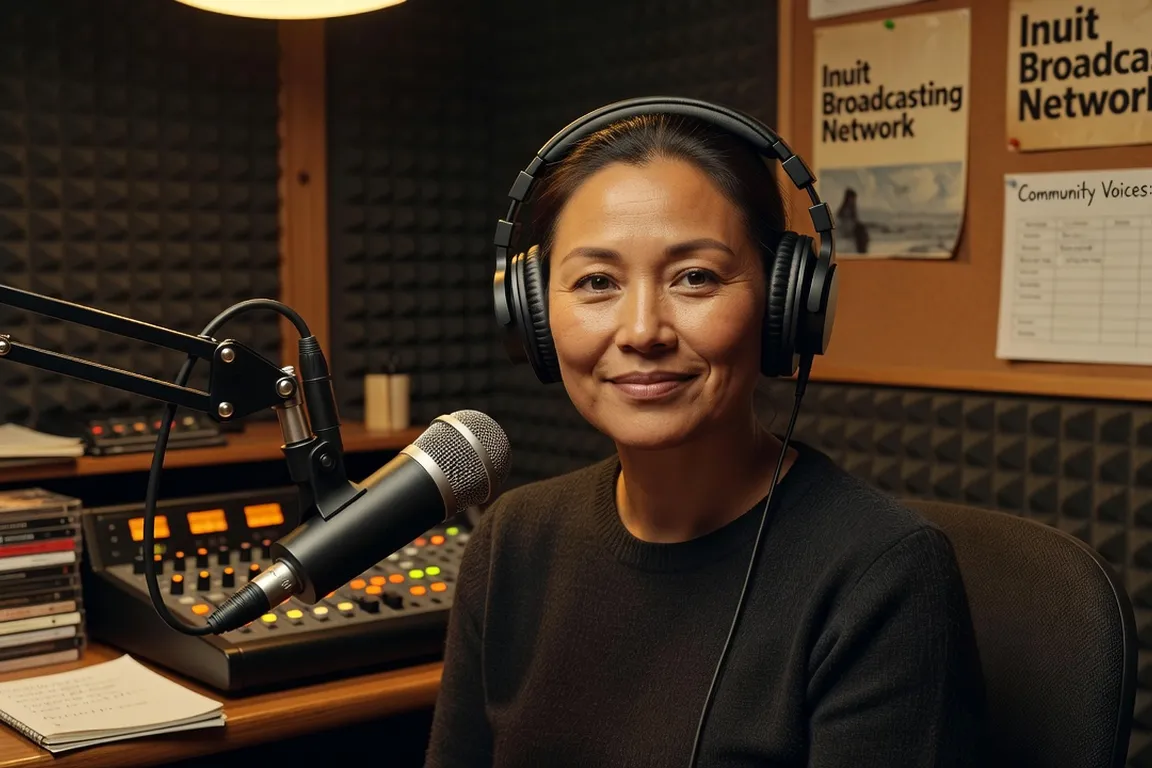
Meeting at the Puvirnituq FM studio
Upon arriving at the Puvirnituq FM studio, a small, unassuming building in the heart of the village, the comforting smell of freshly brewed coffee fills the air. Inuktitut signs adorn the walls, reminding us of the importance of local language and culture. The radio console, with its buttons and blinking lights, sits at the centre of the room, symbolizing the vital link between the community and the outside world.
Lisa Annahatak-Tukkiapik, the program director for several years, greets me with a warm smile. She has dedicated 14 years to the development of community radio, having started after studying broadcasting techniques at Cégep Marie-Victorin. Lisa speaks Inuktitut fluently, her mother tongue, as well as English and French, demonstrating her commitment to bringing this multicultural radio station to life.
1. How was Puvirnituq FM born?
Journalist: Could you tell us how Puvirnituq FM came to be?
To place Puvirnituq in the regional context, read our Kuujjuaq capital of Nunavik guide.
Lisa Annahatak-Tukkiapik: Puvirnituq FM was born in the 1980s, a time when movements for Indigenous rights and the recognition of their cultures were gaining momentum in Canada. It was a period when communities sought to reaffirm their identity and autonomy, and the media played a crucial role in this. The radio was founded by a group of passionate local residents who firmly believed that we needed our own voices to tell our stories. At the time, the only broadcasts we received were from the Hudson’s Bay Company, which mainly aired content in English. The creation of Puvirnituq FM allowed us not only to broadcast in our language but also to share news and events that directly concern us. This is how we began to shape our own media space, in connection with the broader Indigenous media movement across the country.
2. The pivotal role of community radio in Nunavik
Journalist: Why does radio remain central in Nunavik, even in the era of the smartphone?
Lisa Annahatak-Tukkiapik: Radio plays a crucial role here, far beyond just broadcasting music or news. In a region where distances are vast and weather conditions can be extreme, radio is often the most reliable way to stay informed. We broadcast essential community announcements: lost items, personal messages, death notices, and even urgent weather alerts. It is our daily link with the community. Smartphones and social networks have certainly gained popularity, but they do not replace the proximity and immediacy of radio. People here still turn to their radio for reliable local news and relevant information, which is not always available on the Internet. Additionally, radio is accessible to everyone, even those without a stable Internet connection.
3. Programming: Between Inuktitut, English, and French
Journalist: How is the linguistic content distributed at Puvirnituq FM?
Lisa Annahatak-Tukkiapik: Our programming is a reflection of our community, which is multilingual. About 60% of our broadcasts are in Inuktitut, as it is the language most of our listeners speak at home. English accounts for about 30% of our schedule, given that it is widely understood, especially among the younger ones. The remaining 10% is in French, mainly for news bulletins. We chose this mix to reach as many people as possible. One of the challenges is the issue of written Inuktitut, with our young people sometimes finding it easier with the Roman alphabet than with syllabics. We must continually adapt our materials so that our content is accessible to everyone.
4. The connectivity challenge: satellite, fibre, streaming
Journalist: How do you handle connectivity challenges here in Nunavik?
To understand the technical constraints of this broadcasting, see our Nunavik digital infrastructure 2026 report.
Lisa Annahatak-Tukkiapik: Connectivity remains a major challenge in our region, especially in winter when weather conditions complicate everything. Thanks to a partnership with Tamaani, we have been able to set up online streaming, allowing us to reach an audience beyond Puvirnituq. However, latency and bandwidth can sometimes be an issue. Since 2018, we have seen a significant improvement in our network, and we continue to work to make our service as stable as possible. By 2026, we hope the situation will improve further with advances in satellite and fibre optic connectivity.
5. Streaming “snow festival radio live”: An audience beyond the village
Journalist: Has the “snow festival radio live” helped expand your audience?
This local broadcasting dynamic is also at the heart of the Puvirnituq Snow Festival, a biennial event that amplifies the station’s visibility.
Her vision echoes that of an Inuit entrepreneur in Nunavik we interviewed on remote work in Salluit.
Lisa Annahatak-Tukkiapik: Absolutely. The live streaming of our special snow festival broadcast has allowed us to reach an audience far beyond the borders of our village. We have regular listeners among Inuit living in Ottawa and Montreal, as well as English speakers from Atlantic Canada. Researchers and journalists from the south are also interested. The festival has really highlighted our ability to offer unique and authentic content. We have received feedback from people who would never have heard of Puvirnituq without this initiative. In terms of numbers, our streaming audience doubled during these special events, which is very promising for the future.
6. The voices that make the station: Hosts, Elders, youth
Journalist: Who are the voices behind Puvirnituq FM?
Lisa Annahatak-Tukkiapik: Our hosts are the heart of the station. We have personalities like Elijah Ittukallak, who hosts a very popular morning show, and Sarah Kaviok, who runs a show on local traditions. Elders play an essential role; they share their knowledge and stories through dedicated programs. It’s a way to preserve and transmit our culture. We also have young hosts in training, who bring fresh ideas and new perspectives. The station operates thanks to a mix of employees, contractors, and volunteers, each contributing in their own way to our mission.
7. Funding and economic viability
Journalist: How is Puvirnituq FM funded?
The federal program supporting these stations is the Indigenous Languages Initiative — Canadian Heritage.
Lisa Annahatak-Tukkiapik: Our funding comes from several sources. We have sponsors like Air Inuit and the FCNQ cooperative federation, who believe in our mission. We also benefit from federal grants, notably through the Indigenous Languages Initiative of Canadian Heritage. Local advertising also plays a role, albeit modest. It is a constant challenge to maintain our economic viability, especially compared to larger stations like CBC radio in Nunavik. But we have learned to do a lot with little, thanks to rigorous management and strong community involvement.
8. The preservation of Inuktitut through the airwaves
Journalist: What role does radio play in the preservation of Inuktitut?
Lisa Annahatak-Tukkiapik: We are committed to preserving and promoting Inuktitut, which is at the heart of our identity. We broadcast programs exclusively in this language, which has an important educational role, especially for young people who might be more exposed to English. We work in partnership with the Avataq Cultural Institute for transcription and documentation initiatives. The Tarramiut dialect we use is unique to our region, and we want it to continue to thrive across generations. The challenge is to keep young people interested and engaged, but we are seeing progress thanks to our efforts.
These transcription and documentation efforts connect to a broader initiative: digital archiving of Inuit and Cree cultural heritage now makes it possible to preserve these Inuktitut radio recordings for future generations, beyond the live broadcast itself.
9. Collaboration with other northern radios
Journalist: How do you collaborate with other northern radios?
For local and Indigenous cultural news, see the Peuple Actu blog, which regularly covers community media.
Lisa Annahatak-Tukkiapik: We have close relationships with radios like CBC North Quebec and Wachiya Radio from Eeyou Istchee. We regularly exchange content and participate in annual conferences that bring together Indigenous radios. These events are opportunities to share ideas and resources. We have also led joint projects, which strengthen our network and our ability to serve our listeners with diverse and enriching perspectives.
10. The future of community radio in the digital age
Journalist: What future do you see for Puvirnituq FM in the digital age?
Lisa Annahatak-Tukkiapik: The future is promising but filled with challenges. We are exploring podcast and webcast options to reach a younger, more connected audience. A mobile app is also in development for 2026-2030, which will make accessing our content easier. However, we must ensure we do not become just a digital information relay. Our strength is our editorial autonomy, and we want to preserve it. Recruiting young talent and integrating new technologies are priorities, but without losing sight of our community mission.
Quick questions — myths about Inuit radio
-
“Inuit radio only broadcasts in Inuktitut.”
- That is not true. While Inuktitut is predominant, we also broadcast in English and French to reflect the linguistic diversity of our region.
-
“Young people prefer TikTok over the airwaves.”
- This is partly true. Young people use social networks a lot, but they also listen to the radio, especially for local events and shows that concern them directly.
-
“Puvirnituq FM is funded by the Quebec government.”
- Not exactly. Our funding mainly comes from federal grants via Canadian Heritage, combined with sponsorships and local advertising.
-
“Everyone at the station is a volunteer.”
- That is false. We have a mix of employees, contractors, and volunteers working together to run the station.
-
“Streaming has reduced local AM/FM radio audiences.”
- No, streaming complements our AM/FM broadcasts. It allows us to reach a wider audience without harming our local following.
-
“You can listen to Puvirnituq FM from Montreal without any problem.”
- Yes, thanks to our web streaming service, with low latency, you can listen to us from anywhere, including Montreal.
3 things to remember
- A crucial social role: Puvirnituq FM is much more than just a radio; it is an essential community pillar for local information and social cohesion.
- Linguistic and cultural diversity: The station reflects the linguistic diversity of Nunavik with broadcasts in Inuktitut, English, and French.
- Innovation and tradition: While adapting to technological advances like streaming, Puvirnituq FM remains true to its mission of promoting and preserving Inuit culture and language.