
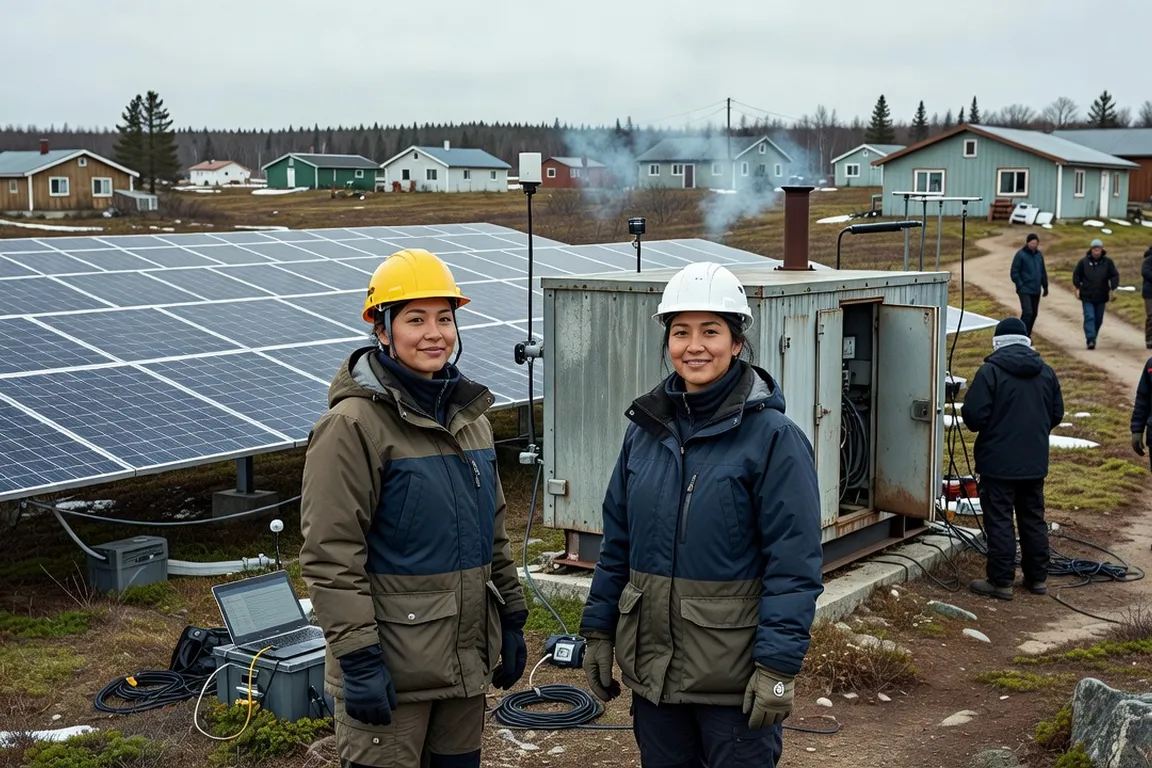
Camille Fortin receives us one July morning in the Montreal offices of the engineering firm where she coordinates Northern renewable energy projects. On her computer, an annotated single-line diagram shows the microgrid of a 900-resident village she helped design. She has just returned from a three-week field mission where her team oversaw the installation of the final row of solar panels for a project launched two years earlier. To understand the broader energy and community context of the territory, our profile of Niskamoon Corporation and its mission in Eeyou Istchee offers complementary context on the organizations funding this type of project.
For over an hour, Camille details the technical, logistical and human dimensions behind the hybrid solar-diesel microgrids gradually transforming energy supply in Nunavik’s isolated villages.
Portrait of Camille Fortin, northern energy engineer
Claire Vasseur:Camille, how did you come to specialize in Northern microgrids?
Camille Fortin:I studied electrical engineering at Université Laval, with a specialization in renewable energy. My first contract out of school involved a small-scale solar project on the Lower North Shore, and I was immediately fascinated by the complexity of isolated networks — what's called "off-grid systems" in English. Unlike a connected grid where you simply add a power source, an isolated grid must constantly maintain the balance between production and consumption, with no external safety net.
A colleague then steered me toward a Nunavik project in 2018, and I never left this sector since. It's now been eight years that I've worked exclusively on Northern microgrids, between Nunavik and James Bay.
Claire Vasseur:What sets Northern energy engineering apart from equivalent work in southern Quebec?
Camille Fortin:The margin for error is much smaller. In the south, if a component fails, you call a supplier and have a replacement part in 24 to 48 hours. In Nunavik, the same failure can leave you without a solution for weeks if you haven't anticipated a stock of critical parts on site.
You also have to accept designing simpler and more robust systems than you would elsewhere, even though it seems counterintuitive for an engineer trained to optimize performance. Reliability always trumps sophistication.
Why diesel remains dominant in isolated villages
Claire Vasseur:Why do Nunavik's 14 villages still depend so heavily on diesel in 2026?
Camille Fortin:Because none of these villages are connected to Quebec's main hydroelectric grid. Each community operates as a completely isolated electrical network, what's called an autonomous grid. Historically, the simplest solution to deploy and maintain with locally available skills has always been the municipal diesel plant.
Building a hydroelectric transmission line across hundreds of kilometres of permafrost would cost astronomical sums, not to mention the maintenance challenges in such a hostile environment. Diesel has therefore persisted, despite a real cost far higher than the price posted at the pump once you include maritime transport and storage.
Key takeaway: the real cost of diesel in Nunavik includes summer maritime transport, storage in climate-adapted tanks and losses from generator start-stop cycles — a cost often two to three times higher than the litre price posted in southern Quebec.
Claire Vasseur:Is there a documented environmental cost to this dependence?
Camille Fortin:Yes, and it's significant at the scale of each village. A medium-sized municipal diesel plant can consume several million litres of fuel per year, with corresponding greenhouse gas emissions, not to mention spill risks during transport and storage. That's a strong argument in favour of the transition, beyond the purely economic aspect.
The principle of the hybrid solar-diesel microgrid
Claire Vasseur:Concretely, how does a hybrid solar-diesel microgrid work?
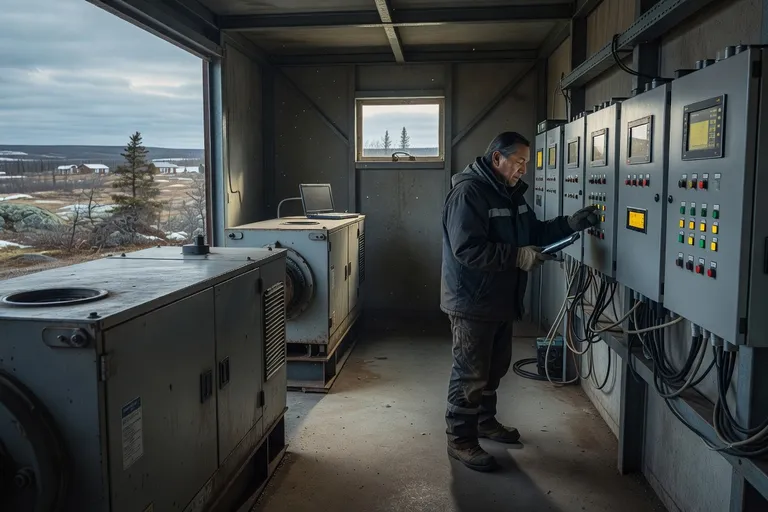
Camille Fortin:We combine three main elements: photovoltaic panels, a battery storage system, and the existing diesel plant, which remains in place as a backup source. An intelligent management system, called a microgrid controller, arbitrates in real time between these three sources based on solar availability and village demand.
When sunlight is available, the system prioritizes solar and charges the batteries with the surplus. When demand exceeds what solar and batteries can supply, or at night, diesel automatically takes over. The goal is never to fully replace diesel — that's technically unrealistic with current technology in an Arctic climate — but to reduce its consumption as much as possible.
Here’s a table summarizing the typical components of a hybrid microgrid that Camille and her team deploy in Nunavik:
| Component | Role | Northern-specific feature |
|---|---|---|
| Photovoltaic panels | Solar power generation | Reinforced mounting against wind, orientation optimized for Arctic summer |
| Lithium-iron-phosphate batteries | Intermediate storage | Heated room required, cannot charge below 0°C |
| Existing diesel generator | Backup and supplemental source | Reduced cycles to extend lifespan |
| Microgrid controller | Automatic source arbitration | Software redundancy to avoid service outages |
| Remote monitoring system | Performance tracking and alerts | Satellite or fibre link for telemetry |
Real gains observed during the Arctic summer
Claire Vasseur:What concrete gains do you observe during the summer months?
Camille Fortin:It's really spectacular. With nearly continuous sunlight between June and August, some villages where we've installed microgrids reach solar coverage of 30 to 50% of total electricity consumption during that period. There are days in June when the diesel plant idles for several consecutive hours.
On an annual basis, the average reduction in diesel consumption ranges from 15 to 25%, which remains very significant for a municipal budget, even though winter brings dependence on diesel back to nearly 95%.
Here’s a seasonal comparison of typical solar coverage observed across Camille’s projects:
| Season | Average solar coverage | Diesel’s role |
|---|---|---|
| Summer (June-August) | 30 to 50% of consumption | Supplemental, often idling several hours per day |
| Shoulder season (April-May, September-October) | 10 to 20% of consumption | Main source, solar as a top-up |
| Winter (November-March) | Less than 5% of consumption | Near-exclusive source |
The main benefits measured across Camille’s projects include:
- A 15 to 25% reduction in annual diesel consumption in equipped villages
- A decrease in generator start-stop cycles, which extends their useful lifespan
- A measurable reduction in greenhouse gas emissions from local electricity production
- Increased resilience in the event of a temporary fuel supply disruption
Battery storage constraints in extreme climates
Claire Vasseur:Is battery storage truly viable in conditions dropping to -40°C?
Camille Fortin:Yes, but only if strict rules are followed. The lithium-iron-phosphate batteries we use tolerate cold discharge well, but charging below 0°C can permanently damage the cells. The absolute rule is that batteries must always be installed in a heated, well-insulated room, never exposed directly to outdoor cold.
This represents significant civil engineering costs — a dedicated heated building or extension must be planned — but it's the only way to guarantee a normal lifespan, generally eight to ten years for this type of battery in well-managed Northern use.
Claire Vasseur:Are older lead-acid batteries completely abandoned?
Camille Fortin:They're being gradually replaced, but you still find them in older installations. Lead loses significant capacity in the cold, sometimes up to 40% at -30°C, and its lifespan is shorter than lithium in this context. The higher upfront cost of lithium is generally justified over the project's total lifespan.
Logistics: transporting solar panels to Nunavik
Claire Vasseur:How does transporting solar equipment to a Nunavik village actually work?
Camille Fortin:Everything must be ordered and shipped for the summer maritime rotation, generally between July and September depending on the village. That means finalizing orders for panels, inverters and mounting structures as early as the previous winter, often in January or February, to guarantee availability and manufacturing lead times.
If a part is missing or an ordering error is discovered on site, it generally can't be corrected before the next rotation, meaning a wait until the following year. This constraint shapes the entire project schedule, far more than the purely technical aspects.
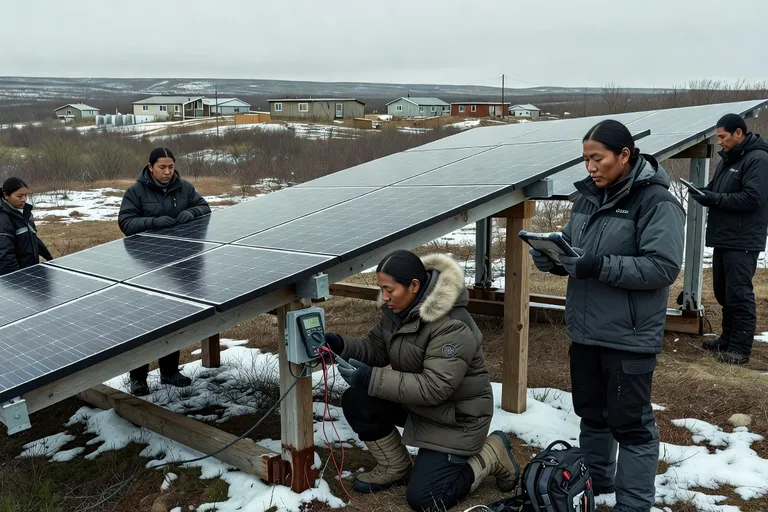
Claire Vasseur:Does permafrost complicate the installation of panel mounting structures?
Camille Fortin:A great deal. You can't simply pour a standard concrete foundation, because summer thawing of the permafrost's active layer would cause the structure to shift over the years. We generally use screw piles or adjustable footings that can be recalibrated if the ground shifts slightly. This requires specific geotechnical expertise and increases installation time compared to a project in a temperate climate.
Financing and the role of community organizations
Claire Vasseur:How are these projects financed?
Camille Fortin:Financing is generally mixed. Hydro-Québec, which directly operates several Northern diesel plants, leads certain pilot projects for solar integration as part of its energy transition strategy. The Quebec government contributes through programs targeted at autonomous grids.
Société Makivik and the Kativik Regional Government also play a financing and governance role, particularly for projects where part of the production can directly benefit households, not just municipal infrastructure. It's often a combination of these sources that closes a project's budget.
Environmental impact and reducing diesel dependency
Claire Vasseur:How do you measure the real environmental impact of these projects?
Camille Fortin:We calculate the reduction in litres of diesel consumed per year, which we then convert into equivalent tonnes of greenhouse gas emissions avoided. For an average village with a well-sized microgrid, we're talking about tens of thousands of litres of diesel saved annually, a significant impact at the territorial scale.
There's also a less visible but equally important benefit: reduced risk of fuel spills related to transport and storage, a major environmental and health concern for these coastal communities.
What municipalities should know before starting
Claire Vasseur:What advice would you give a municipality considering a microgrid project?
Camille Fortin:First, plan for a minimum two-to-three-year timeline between the initial idea and commissioning, due to financing and maritime logistics constraints. Second, it's essential to involve local diesel plant operators from the start — they're the ones who will operate and maintain the hybrid system daily, and their buy-in determines the project's success.
Finally, never underestimate the training budget. A microgrid poorly understood by the local team often ends up running in diesel-only mode permanently, because no one knows how to diagnose an issue on the solar side.
Common mistake to avoid: underbudgeting ongoing training for the local team. Camille observes that the best-maintained microgrids are consistently those where at least two local operators have received full training, with a knowledge refresh plan every two to three years.
Here’s a checklist summarizing the key steps before launching a hybrid microgrid project:
- Confirm combined financing (Hydro-Québec, provincial government, regional organizations)
- Plan equipment orders at least a year before the target maritime rotation
- Provide a dedicated heated room for battery storage
- Involve local diesel plant operators from the design phase
- Budget for an ongoing training program for the local technical team
- Stock critical spare parts on site to limit intervention delays
Next steps for the 2026-2035 decade
Claire Vasseur:How do you see these projects evolving by 2035?
Camille Fortin:I think we'll see a multiplication of hybrid projects, with an ever-growing solar share as panel costs continue to fall and accumulated experience reduces engineering risks. Wind power could also enter the picture in particularly windy villages, complementing solar to better cover winter needs.
There's also real potential in smart grids that let households actively participate in demand management, for example by shifting certain energy-intensive uses to peak solar production hours. This is a decade that will gradually, but durably, transform Nunavik's energy mix.
To understand how these energy infrastructures connect with the digital connectivity of the same villages, our report on internet in Nunavik’s most isolated villages and our case study on a Northern server deployment offer complementary insight into the logistical challenges shared by these two sectors.
For a comparative overview of energy costs versus the rest of Quebec, also see our analysis of internet costs in Nunavik in 2026, which illustrates similar cost dynamics tied to remoteness.
To find additional community resources and services in the region, the CGLQ directory of community services in Quebec lists organizations active in several sectors, including energy and the environment.
Frequently asked questions
What exactly is a hybrid solar-diesel microgrid?
A hybrid solar-diesel microgrid is an autonomous electrical network that combines photovoltaic panels, battery storage and one or more diesel generators, all managed by an intelligent control system. The goal is to reduce diesel consumption by using available solar energy while keeping diesel as a safety net. Unlike simply adding solar panels, the microgrid actively manages energy flows to maximize solar use and minimize diesel generator start-stop cycles, which extends generator lifespan.
Why does Nunavik still depend so heavily on diesel in 2026?
Nunavik is not connected to Quebec's main hydroelectric grid. Each village operates as an isolated electrical network, historically powered by municipal diesel plants. This dependence stems from real geographic constraints: no roads connecting villages, distance from existing hydroelectric transmission lines, and the prohibitive cost of building such lines across hundreds of kilometres of permafrost. Diesel remains the simplest solution to deploy and maintain with locally available technical skills, even though its real cost, including transport, is much higher than the posted price per litre.
What share of consumption can a solar microgrid cover in summer?
In the projects I've worked on, the solar share can reach 30 to 50% of total electricity consumption during June to August, thanks to nearly continuous sunlight during the Arctic summer. This proportion drops sharply in winter, sometimes below 5%, due to low sunlight and snow covering the panels. On an annual basis, a well-sized microgrid generally allows a 15 to 25% reduction in diesel consumption, which remains significant at village scale.
What are the biggest logistical challenges for installing solar panels in remote regions?
Transport is the main challenge. Panels, inverters and mounting structures must be shipped during the summer maritime rotation, which requires ordering equipment several months in advance. We also have to deal with permafrost to anchor structures, with reduced crews on site, and with an outdoor construction window limited to a few months per year. An unexpected issue — a missing part, an ordering error — can delay a project by a full year, until the next rotation.
Is battery storage viable at -40°C?
Lithium-iron-phosphate (LFP) batteries, which we favour for these projects, tolerate charging poorly below 0°C but handle cold discharge well. The standard solution is to install batteries in a heated, insulated room, never outdoors. This adds civil engineering costs, but it's the only way to guarantee normal battery lifespan. Older lead-acid batteries lose significant capacity in the cold and are gradually being replaced by lithium in new projects.
What role do Hydro-Québec and governments play in these projects?
Hydro-Québec directly operates the diesel plants in several Northern villages and leads certain pilot projects for solar integration. The Quebec government, through programs like its Energy Policy and targeted envelopes for autonomous grids, finances part of the renewable energy investments. Société Makivik and the Kativik Regional Government also participate in financing and governance of certain community projects, especially when surplus production can directly benefit households.