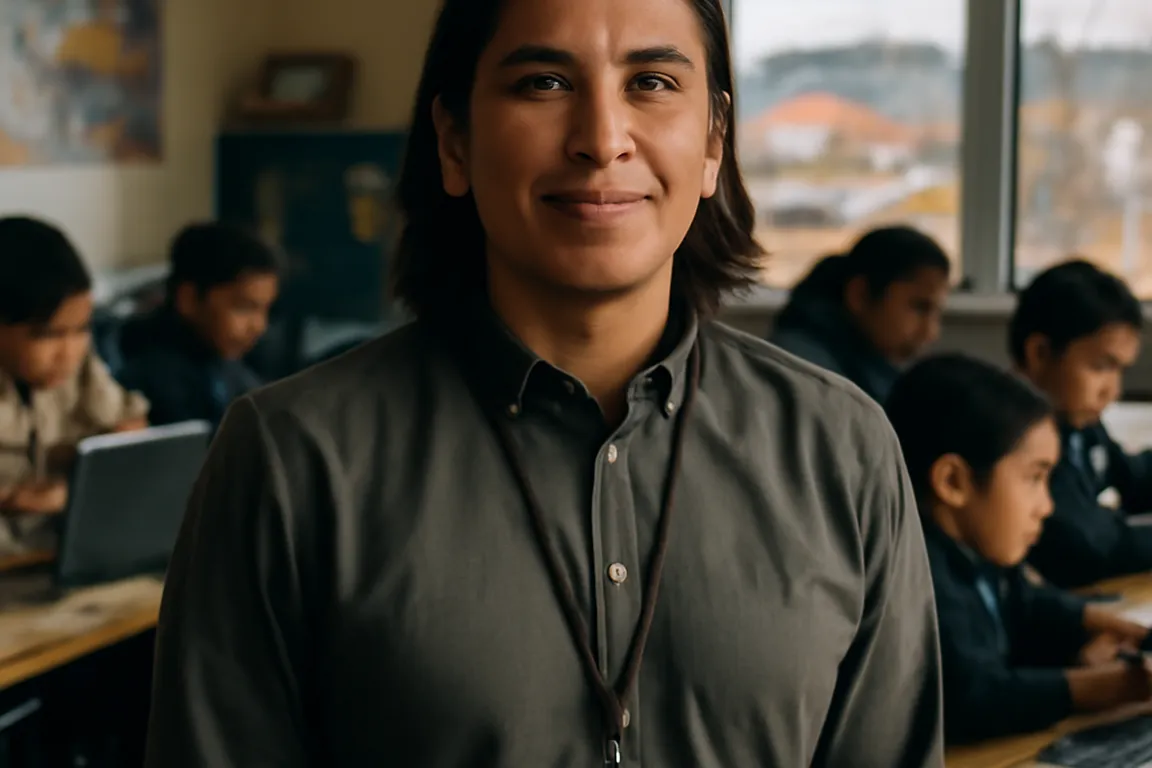
David Kanatawakhon Cloutier welcomes us by videoconference from the Kativik School Board offices in Kuujjuaq. On the wall behind him, student drawings from robotics projects sit alongside a poster of the Inuktitut syllabic keyboard. He has just finished a tour of three schools where his team trained teachers on a new multimedia creation tool in the local language. To situate the broader cultural context of his work, our lexicon of 30 essential Nunavik and Eeyou Istchee terms offers useful reference points, as does our feature on Goose Break goose hunting traditions, which illustrates the intergenerational cultural transmission discussed later in this interview.
For over an hour, David shares his field perspective on youth digital literacy in Nunavik, covering logistical constraints, cultural preservation, and the initiatives that are bearing fruit.
Portrait of David Kanatawakhon Cloutier and his background
Antoine Monnier:David, what's your background and how did you come to this position?
David Kanatawakhon Cloutier:I grew up between Montreal and a Northern community, with a teacher mother who instilled in me an early interest in education. I studied educational technology at Université de Montréal, then taught for four years in a secondary school before joining the Kativik School Board six years ago as youth technology program coordinator.
My role involves designing, deploying and evaluating digital literacy initiatives across all fourteen schools in the Kativik network, working closely with local administrations and teachers.
Antoine Monnier:What surprised you most when you took this position?
David Kanatawakhon Cloutier:The gap between provincial curriculum expectations and the reality on the ground. I was asked to implement standards designed for well-equipped urban schools, while some of our schools were still running ten-year-old computers with limited internet access. I had to relearn how to design realistic solutions rather than mechanically applying policies from the south.
The state of computer equipment in Nunavik schools in 2026
Antoine Monnier:Where does computer equipment stand in schools today?
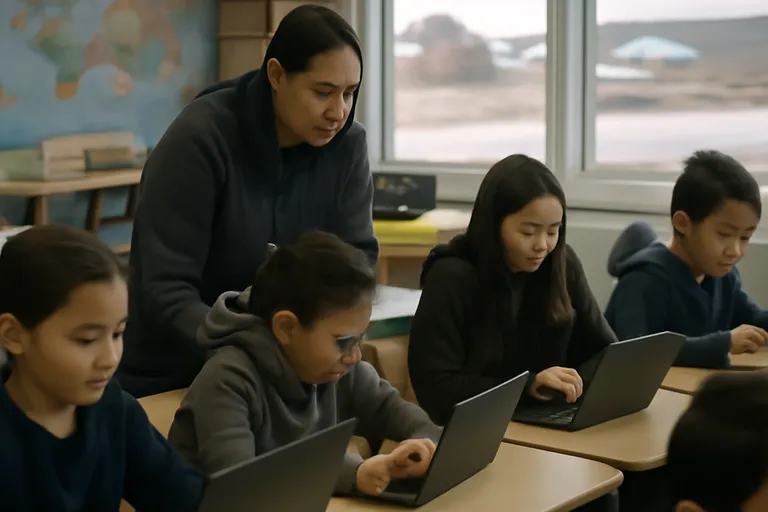
David Kanatawakhon Cloutier:It varies a lot depending on village size. Kuujjuaq schools have computer labs with fifteen to twenty functional workstations, renewed on a five-to-seven-year cycle. In smaller villages, it's more about shared laptop carts split among several classrooms, which limits regular individual access.
Connectivity has improved markedly with the arrival of low-Earth-orbit satellite in recent years, but it remains a limiting factor for certain bandwidth-heavy uses, like streaming high-definition educational video for an entire class simultaneously.
Here’s a comparative overview of typical equipment by village size:
| Village size | Typical equipment | Renewal cycle | Connectivity |
|---|---|---|---|
| Large village (Kuujjuaq) | 15-20 fixed workstation lab | 5-7 years | LEO satellite + partial fibre |
| Medium village | Shared laptop carts | 6-8 years | LEO satellite |
| Small isolated village | Limited units, often shared | Variable, donation-dependent | Geostationary or LEO satellite |
Reconciling digital learning with preserving the Inuktitut language
Antoine Monnier:How do you reconcile teaching digital skills with preserving the Inuktitut language?
David Kanatawakhon Cloutier:It's the most delicate balance in my work. Our approach is to use digital tools as a means of valuing the language rather than eroding it. We develop Inuktitut syllabic vocabulary apps, multimedia projects where students document traditional knowledge in their own language, and structured digital correspondence with community elders.
The Canadian syllabic keyboard is built into every workstation used in class, and we train teachers to move naturally between both worlds, rather than presenting digital tools as an exclusively French or English space.
Key point: in schools where Inuktitut syllabics are fully integrated into everyday digital tools, teachers report stronger student engagement with both learning tracks — technology and language — rather than competition between the two.
Digital literacy programs currently in place
Antoine Monnier:What concrete programs currently exist for young people?
David Kanatawakhon Cloutier:Several programs coexist. The Kativik School Board integrates digital literacy modules into the regular curriculum starting in elementary school — safe internet use, basic online research, introduction to visual programming. Organizations like Pinnguaq offer summer technology camps focused on robotics and video game creation.
There are also one-off initiatives led by technology companies or foundations that come run workshops directly in the communities, generally lasting a few days to a few weeks per year.
Here’s an overview of the main programs by target age group:
| Program | Age group | Geographic reach |
|---|---|---|
| Kativik School Board curriculum modules | Elementary to secondary | All 14 schools in the Kativik network |
| Pinnguaq summer camps (robotics, programming) | Ages 8 to 16 | Participating villages, annual rotation |
| One-off coding/multimedia workshops | Secondary | Depending on external partner availability |
| Digital documentation projects with elders | All ages (intergenerational) | Volunteer communities |
The main active programs in 2026 include:
- Digital literacy modules integrated into the Kativik School Board’s regular curriculum
- Pinnguaq summer technology camps focused on robotics and creative programming
- One-off coding and multimedia creation workshops led by external partners
- Digital documentation projects for traditional knowledge, in collaboration with elders
The role of elders and families in accepting digital tools
Antoine Monnier:How do elders and families perceive the growing presence of digital tools at school?
David Kanatawakhon Cloutier:The concerns are real and legitimate. Several elders worry about screen time and the potential loss of traditional knowledge transmission in favour of passive digital activities. The programs that work best are those that explicitly involve elders from the design stage, for example by inviting them to document their knowledge with young people using digital tools.
This approach turns technology into an intergenerational bridge rather than a source of rupture, and it's probably the most important success factor I've observed.
This digital literacy acquired at school also benefits families beyond the classroom: it later eases digital access challenges for government services in Nunavik, especially when young people help their parents or grandparents with online administrative procedures.
Youth programming training initiatives
Antoine Monnier:Do Nunavik youth have access to more advanced training, in programming or cybersecurity for example?
David Kanatawakhon Cloutier:Access exists but remains uneven across villages. Summer camps and one-off workshops generally cover programming basics, often through visual platforms like Scratch for younger students. Cybersecurity is a more recent topic, addressed for now mostly as online safety awareness — recognizing phishing, protecting personal information — rather than as an advanced technical discipline.
Developing more structured pathways in advanced programming and cybersecurity remains a work in progress for coming years, and it's one of my current priorities.
Logistical challenges: delivery, repair, equipment maintenance
Antoine Monnier:What are the main logistical obstacles you face day to day?
David Kanatawakhon Cloutier:Transport and repair are my two biggest headaches. Heavy equipment must be ordered for the summer maritime rotation, requiring very rigorous annual budget planning — if we miss the ordering window, we wait until the following year.
When a computer breaks down, repair often requires sending the defective part to southern Quebec and back, a process that can take several weeks. Some schools have developed local first-level troubleshooting skills to limit this dependence, but complex repairs still depend on the south.
The role of Soleica and local IT partners
Antoine Monnier:How do you work with IT partners like Soleica to support these initiatives?
David Kanatawakhon Cloutier:Partners like Soleica play a valuable role on the infrastructure side — local server maintenance, connectivity, technical support for school network equipment. This lets our pedagogical team focus on educational content rather than solving technical problems we're not equipped to handle alone.
Our collaboration with this type of IT partner echoes the challenges faced by other Indigenous organizations regarding the [development of websites for First Nations non-profits](/en/blog/developpeur-web-projets-autochtones-quebec-interview-specialiste-2026/), where digital sovereignty and local ownership of tools are also central priorities.
Observed results and student feedback
Antoine Monnier:What concrete results do you see after several years of these programs?
David Kanatawakhon Cloutier:We see young people presenting multimedia projects in Inuktitut with obvious pride, students pursuing [post-secondary vocational and technical studies](/en/blog/vocational-postsecondary-training-nunavik-eeyou-istchee-2026/), and teachers who feel more confident integrating digital tools into their daily practice. These aren't overnight, dramatic transformations, but steady, measurable progress year over year.
The most touching feedback often comes from parents telling me their child showed a grandparent how to use a tablet to view family photos — these small moments show that digital tools are finding their natural place in community life.
Outlook for the next school decade
Antoine Monnier:What are your priorities for the coming years?
David Kanatawakhon Cloutier:Three main priorities. First, structure more advanced pathways in programming and cybersecurity for students who show strong interest. Second, strengthen local technical troubleshooting skills to reduce our dependence on repairs sent south. Finally, continue developing bilingual Inuktitut-French educational content that fully uses digital tools' potential for cultural transmission.
I'm convinced that in ten years, Nunavik will be able to locally train a significant share of its own technicians and developers, reducing our current dependence on resources from the south.
Misconception to correct: no, digital tools do not replace oral transmission of traditional knowledge. In David’s projects, they act instead as an archiving and sharing medium that complements — without ever replacing — the direct relationship between an elder and a young person.
The main priorities identified for the coming years are:
- Structure advanced pathways in programming and cybersecurity for interested students
- Strengthen local first-level technical troubleshooting skills
- Develop more bilingual Inuktitut-French educational content
- Locally train a technical workforce to reduce dependence on southern Quebec
To explore the connectivity issues underpinning these educational initiatives, our interview on telework in Nunavik with an Inuit entrepreneur from Salluit illustrates how digital access is also transforming the economic life of communities.
For accommodation services adapted to the realities of remote regions of Quebec, Soleica Chalets offers lodging solutions designed for these territories.
Frequently asked questions
What is the current state of computer equipment in Nunavik schools?
Equipment varies significantly from village to village. Schools in larger communities like Kuujjuaq generally have computer labs with fifteen to twenty functional workstations, renewed every five to seven years. In smaller villages, equipment can be more limited, sometimes with only a few shared laptop carts split among several classrooms. Internet connectivity, while improved since the arrival of low-Earth-orbit satellite, remains a limiting factor for certain bandwidth-heavy uses like educational video streaming.
How can digital learning be reconciled with preserving the Inuktitut language?
This is one of the most delicate balances to maintain. Our approach is to use digital tools as a means of valuing the language rather than eroding it: Inuktitut syllabic vocabulary apps, multimedia projects where students document traditional knowledge in their local language, structured digital correspondence with elders. The Canadian syllabic keyboard is built into the systems used in class, and teachers are trained to move naturally between both worlds rather than treating them as opposed.
What digital literacy programs currently exist for young people?
Several programs coexist. The Kativik School Board integrates digital literacy modules into the regular curriculum starting in elementary school. Organizations like Pinnguaq offer summer technology camps focused on robotics and creative programming. There are also one-off initiatives led by technology companies or foundations that come run coding or video game design workshops directly in the communities.
What role do parents and elders play in accepting digital tools?
Their role is decisive. In several communities, elders have raised legitimate concerns about screen time and the potential loss of traditional knowledge transmission in favour of passive digital activities. The programs that work best are those that explicitly involve elders from the design phase, for example by inviting them to document their knowledge alongside young people using digital tools. This turns technology into an intergenerational bridge rather than a source of rupture.
Do Nunavik youth have access to programming or cybersecurity training?
Access exists but remains uneven across villages. Summer camps and one-off workshops generally cover programming basics, often through visual platforms like Scratch for younger students. Cybersecurity is a more recent topic, addressed for now mainly through online safety awareness — recognizing phishing, protecting personal information — rather than as an advanced technical discipline. Developing more structured pathways in advanced programming and cybersecurity remains a work in progress for coming years.
What logistical obstacles slow the deployment of computer equipment in classrooms?
Transport and repair are my two biggest headaches. Heavy equipment must be ordered for the summer maritime rotation, requiring very rigorous annual budget planning — if you miss the ordering window, you wait until the following year. When a computer breaks down, repair often requires sending the defective part to southern Quebec and back, a process that can take several weeks. Some schools have developed local first-level troubleshooting skills to limit this dependence, but complex repairs still depend on the south.