Eeyou Istchee and James Bay in 2026: interview with a Cree tourism guide on the Indigenous territories of northern Quebec
Published · 14 min· by Claire Vasseur
In short : Samuel Petawabano has been guiding groups on the territory of Eeyou Istchee for 12 years. Trained in Indigenous ecotourism, he works with several Cree organisations to develop responsible tourism that generates revenue for communities. He speaks to us about the territory, welcoming visitors and common misconceptions.
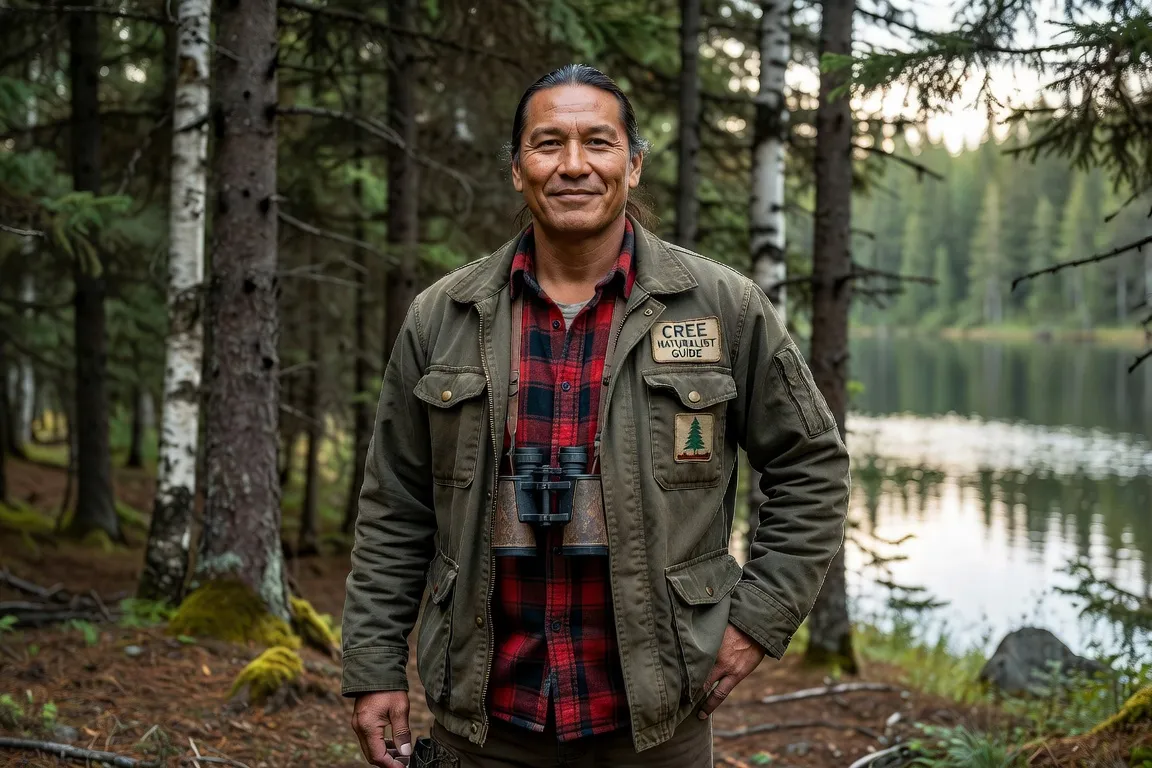
Samuel PetawabanoNaturalist and cultural tourism guide, Cree Nation of Mistissini
Samuel Petawabano has been guiding groups on the territory of Eeyou Istchee for 12 years. Trained in Indigenous ecotourism, he works with several Cree organisations to develop responsible tourism that generates income for communities.
Editorial character representative of Indigenous tourism guides from Eeyou Istchee. This synthesis draws on documented practices of Cree cultural tourism.
Eeyou Istchee remains one of Quebec’s least-known tourist territories — and yet one of its richest: in history, biodiversity and living culture. For many Quebecers and international visitors, James Bay evokes mainly the great hydroelectric dams. But behind these industrial constructions lies a deeply inhabited territory, governed by the Cree Nation for millennia. Samuel Petawabano has been guiding travellers on this territory for twelve years.
Samuel Petawabano
Naturalist and cultural tourism guide, Cree Nation of Mistissini
Samuel has been guiding groups on Eeyou Istchee for 12 years. Trained in Indigenous ecotourism, he develops responsible tourism experiences with several Cree organisations.
Eeyou Istchee — a misunderstood territory
Claire Vasseur: Many people confuse Eeyou Istchee, James Bay and Nunavik. Can you help us untangle this?
Samuel: It's a very common confusion, and it often tells me the person hasn't really encountered this territory yet.
Eeyou Istchee is the Cree name for our territory. “Eeyou” means “the people” in Cree, and “Istchee” means “the land.” So Eeyou Istchee literally means “the land of the people.” It’s the traditional territory of the Cree of Quebec — the Eeyouch — covering about 400,000 km² around the James Bay basin.
James Bay is a body of water, the southern extension of Hudson Bay. It borders our territory to the west. When people talk about the “James Bay region,” they sometimes use that term for the whole geographic region, including non-Cree lands. We prefer Eeyou Istchee, which names our territory in our own language.
Nunavik is yet another thing: it’s the territory of the Inuit of Quebec, north of Eeyou Istchee. The two territories meet at Whapmagoostui-Kuujjuaraapik, a mixed Cree-Inuit village on the Hudson Bay coast. Cree and Inuit are two distinct peoples, with different languages, cultures and histories — but also long histories of coexistence.
How to visit respectfully
Claire Vasseur: How can a visitor access Eeyou Istchee respectfully? What is expected?
Samuel: The first thing is to arrive with humility. Eeyou Istchee is not a natural park. It's an inhabited territory, governed by nine Cree nations each with their own government, customary laws and family trapping territories. When you enter this territory, you are a guest — not a consumer.
Concretely, that means: go through a recognised local guide or organisation. Don’t just arrive alone by car and “wander around.” Ask before photographing people or sensitive places. Respect zones where hunting and fishing are active. And listen more than you speak, especially in the first days.
The good news is that the Cree are generally very welcoming toward curious, well-intentioned visitors. What creates tension is disrespect — not sincere questions.
The highlights of the year
Claire Vasseur: What are the best times to visit Eeyou Istchee — and what do you do there by season?
Samuel: Spring, with the Goose Break, is an extraordinary time if you have the chance to be invited. It's when families leave the villages to join their hunting territories. The atmosphere is one of returning to the source — literally.
Summer is the most accessible season for visitors: the roads are open, the boreal forest is lush, the lakes and rivers are navigable by canoe. It’s the ideal season for hiking, canoe trips, fishing in trout lakes and wildlife observation. The clarity of the water and the serenity of the boreal forest in July-August are incomparable.
Autumn is the season of colours — deciduous trees turn red and gold, and moose are in rut, making wildlife sightings particularly intense. It’s also moose hunting season, which has major cultural significance for the Cree.
Winter — snowmobiling, ice fishing, northern lights, snowshoe outings in snowy forest — is possible but requires serious physical preparation. Temperatures can drop to -40°C. It’s not for everyone, but those who’ve experienced it always describe it as a transformative experience.
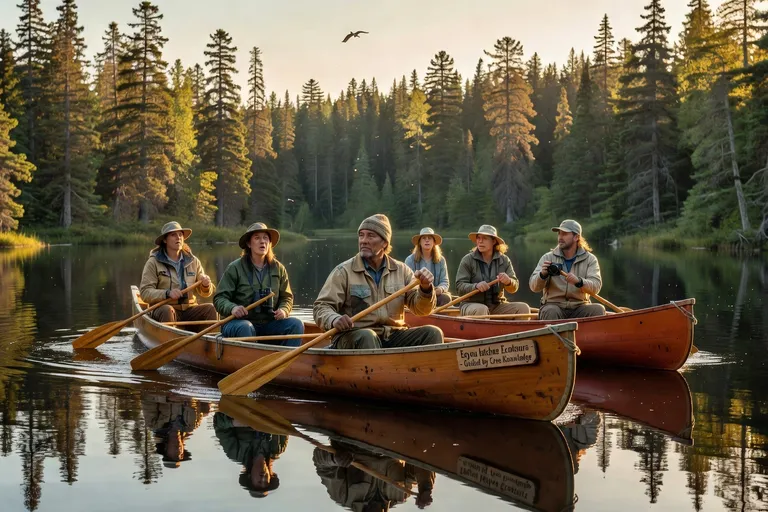
Group of visitors and Cree guide paddling canoes on a boreal forest lake in Eeyou Istchee.
Nature and ecology of James Bay
Claire Vasseur: What can a visitor learn about the nature and ecology of James Bay that they can't learn anywhere else?
Samuel: The first thing is scale. We're talking about one of the last large, relatively intact watersheds in North America. The Eastmain River, the Rupert River, the Broadback River — these waterways drain millions of km² of boreal forest and flow into James Bay. Observing the power of these rivers, their rapids, their coastal wetlands, is to understand why James Bay is one of the most important zones for migratory birds across the entire northern hemisphere.
What visitors often discover with surprise is the richness of the fishing. The lakes and rivers of Eeyou Istchee harbour populations of brook trout, smallmouth bass, pike, walleye, sturgeon — species that have often disappeared from southern Quebec lakes due to pollution or overfishing. Here, Indigenous land management maintains exceptionally healthy aquatic ecosystems.
And then there’s the terrestrial wildlife. Moose, black bear, lynx, beaver, wolf, caribou in the more northern zones. A naturalist could spend a lifetime on this territory without exhausting it.
The James Bay Road — how to prepare
Claire Vasseur: The James Bay Road is often cited as one of Quebec's great road itineraries. How do you prepare for it?
Samuel: The James Bay Road is about 620 km from Matagami to Radisson. You drive through boreal forest encountering almost nothing — a few rest stops, a tourist information post at the entrance, and the majesty of forest stretching to the horizon in every direction.
The practical requirements: a reliable vehicle with a spare tire and complete first-aid kit. Water and food for at least 24-48 hours. A communication plan — cell coverage disappears quickly past Matagami. A confirmed reservation in Radisson before leaving, as accommodation options at road’s end are limited.
The mandatory stop: km 257, the Rupert River. This is a spiritually important place for the Cree — the Rupert River was partly diverted for the hydroelectric works, which was an immense cultural and ecological shock. Take the time to stop there, observe the river, reflect on what a river means to a people who have depended on it for millennia.
Tip: on the James Bay Road, never leave without a confirmed reservation in Radisson, at least 24-48 hours of self-sufficiency in water and food, and a backup communication plan — cell coverage disappears quickly past Matagami and the 620 km road offers very little infrastructure.
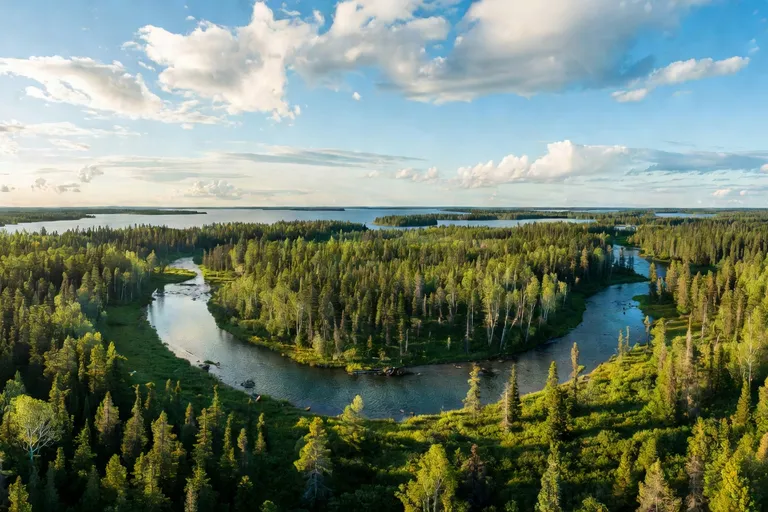
Landscape of Eeyou Istchee territory — boreal forest, river and northern summer sky.
From Radisson, you can continue to Chisasibi by car (about 90 km on paved road). Chisasibi is the most populous and accessible Cree community. It’s an excellent starting point for James Bay excursions with local guides.
Hydroelectricity, territorial rights and mining
Claire Vasseur: The major current issues — hydroelectricity, territorial rights, mining projects — how can visitors inform themselves honestly?
Samuel: I appreciate this question, because it shows the visitor isn't only coming for the scenery — they're also interested in the political and social reality of the territory.
On hydroelectricity: the James Bay dams transformed thousands of km² of territory. The Rupert River, partially diverted for the Eastmain-1-A Project in 2009, is a painful example. The Cree Nation negotiated compensation and rights under the Paix des Braves (2002), but the impacts on ecosystems and certain cultural practices are real. This is not a simple story of “development versus environment” — it’s a complex story of compromise, shared governance and long-term impacts on a living territory.
On mining: Quebec’s Plan Nord opened significant mineral exploration and extraction projects in Eeyou Istchee. Cree Nations have consultation and consent mechanisms, but pressure on the territory is strong. Consult the Grand Council of the Crees directly for their current position on ongoing projects.
The best source of honest information? Cree guides themselves. Not Hydro-Quebec press releases or mining companies. Ask your guide what they think, how their village experiences these changes. You’ll learn more in an hour of frank conversation than in ten newspaper articles.
Authentic experiences — what standard tours don’t offer
Claire Vasseur: What experiences do you offer that aren't found in standard tourism circuits?
Samuel: Several things.
A three-to-five-day canoe descent of a wild boreal river, without a motor and without encountering anyone. Just the forest, the rapids, the sound of geese in the morning, trout in the evening. There are routes on Eastmain or Broadback tributaries that rival the best wild rivers in the world — and very few tourists know about them.
Evenings around the fire with a Cree elder. Listening to someone who has hunted on this territory for sixty years talk about rivers, forests and the changes they’ve witnessed. This isn’t a show — it’s a dialogue between generations that you have the chance to join.
Sturgeon fishing in the Rupert. Sturgeon is a sacred fish for many Cree nations — centuries old, it migrates from the river mouth up to the interior lakes. Watching it leap from the water during a guided fishing trip is to understand why an entire people organised their lives around a territory for centuries.
And for those who wish: spending a night in a traditional Cree tent on a family trapping territory, away from any network. It’s the most disorienting and restorative experience I can offer.
Visitor mistakes — Cree cultural protocols
Claire Vasseur: What are the main mistakes visitors make when they don't know Cree cultural protocols?
Samuel: Photographing without asking. It's the most common mistake and the one that creates the most discomfort. In Cree communities, photographing someone — especially an elder or a child — without their explicit permission is considered disrespectful. And photographing ceremonies, hunting activities or sacred sites without authorisation can be deeply offensive. Always ask. The answer is often yes — but you have to ask.
Arriving with pre-packaged tourist expectations. “I want to see tipis, traditional dances, costumes.” The Cree don’t live in a museum of their own culture. They live in modern houses, watch Netflix, use smartphones — while maintaining deep cultural practices. Real Cree culture is not in folklore, it’s in everyday gestures, in the way people speak about the river, in the sharing of food.
Underestimating the territory. Visitors go wandering in the forest without a map, compass or knowledge of the boreal forest. It’s dangerous. This forest is vast and uniform to an untrained eye. Stay with your guide.
And finally: comparing. “It’s less impressive than the Grand Canyon.” “Safaris in Kenya are better organised.” Eeyou Istchee is not in competition with other destinations. It’s a unique territory, with its own terms of reference. If you come looking for exotic scenery to consume, you’ll miss the essence.
Important: Cree cultural etiquette comes down to a few simple but non-negotiable rules — always ask permission before photographing a person, a ceremony or a sensitive site; go through a recognised local guide or organisation rather than exploring alone; and arrive without pre-packaged folkloric expectations, since real Cree culture lives in everyday life, not in a stage set.
Quick questions — 5 misconceptions about Eeyou Istchee
Claire Vasseur: Five misconceptions. True or false?
Samuel:
“The Cree are the same as the Inuit” — False. They are two distinct peoples, with completely different languages, cultures, territories and histories. There may be historical relations of neighbourship, but we are not the same nation.
“Eeyou Istchee is only accessible by plane” — False. The James Bay Road allows reaching Chisasibi and Radisson by car from southern Quebec in a day’s drive from Montreal (about 1,000 km). The road is passable year-round, but requires winter tires between October and April.
“The dams destroyed everything” — Exaggerated. The impacts are real and documented, and the Cree experienced them as a shock. But the territory of Eeyou Istchee remains immense and largely intact. A large portion of its rivers, lakes and forests are in remarkably good ecological health. The resilience of ecosystems and Indigenous land management have played an essential role.
“The Cree don’t want tourists” — False. Cree communities are actively developing responsible tourism that generates revenue and shares their culture. What they don’t want is tourism that disrespects them or treats them as scenery.
“There’s nothing to do in winter” — Radically false. Snowmobiling, ice fishing, northern lights, snowshoe outings in snow-covered forest, guided hunts — winter is an extraordinary season on this territory. It simply requires equipment and serious preparation.
Editorial note: Samuel Petawabano is an editorial character representative of the Indigenous tourism guides of Eeyou Istchee. This synthesis draws on documented practices of Cree cultural tourism as described by the Cree Nations of Quebec and Indigenous ecotourism organisations.
Eeyou Istchee at a glance — seasons and activities
Season
What you experience
Preparation level
Spring
Goose Break (goose hunting, if invited)
Depends on community access
Summer
Canoeing, hiking, trout fishing, open roads
Accessible, easiest season
Autumn
Fall colours, moose rut, moose hunting
Moderate
Winter
Snowmobiling, ice fishing, northern lights
High — down to -40°C
Always go through a recognised local guide or Cree organisation
Ask permission before photographing a person, a ceremony or a sensitive site
Plan 24-48 hours of self-sufficiency in water/food on the James Bay Road (no cell coverage past Matagami)
Book accommodation in Radisson before departure — options are limited at road’s end
Eeyou Istchee is the traditional territory of the Cree people of Quebec (Eeyouch), covering approximately 400,000 km² in north-central Quebec, around the James Bay basin and the Eastmain River. It comprises nine Cree communities: Chisasibi, Wemindji, Eastmain, Waskaganish, Nemaska, Mistissini, Waswanipi, Ouje-Bougoumou and Whapmagoostui (a mixed Cree-Inuit village). The territory is governed by the James Bay and Northern Quebec Agreement (JBNQA, 1975) and the Cree Nation Governance Agreement (Paix des Braves, 2002).
What is the difference between Eeyou Istchee and James Bay?
James Bay is a body of water — the southern extension of Hudson Bay. Eeyou Istchee is the Cree name for the territory surrounding this bay and extending far inland. 'James Bay' also designates the administrative geographic region of Quebec that includes the non-Indigenous lands around the bay. When we say Eeyou Istchee, we specifically mean the Cree territory, its governance and its culture.
How do you access Eeyou Istchee in 2026?
Several options exist depending on the community. The James Bay Road (Route 167 then the James Bay Road) allows reaching certain communities by car from Chibougamau or Val-d'Or. Regional air links serve all communities from Montreal, Val-d'Or or Chibougamau. For some coastal villages (Chisasibi, Wemindji, Whapmagoostui), air access is often more practical. Canoe trips and boreal forest trails are accessible from road-accessible starting points. Road access makes Eeyou Istchee much more accessible than Nunavik.
Can you visit Eeyou Istchee without an Indigenous guide?
Technically yes, for public areas (roads, open community spaces). But for a genuine cultural experience, to access traditional territories or participate in cultural activities, an Indigenous guide is essential. Not only for safety (the boreal forest is vast and uninitiated visitors can get lost), but because without a local guide, you don't understand what you're seeing. Eeyou Istchee is not a theme park — it's an inhabited territory with its own rules, protocols and stories.
What is the James Bay Road?
The James Bay Road is approximately 620 km from Matagami to Radisson and the Robert-Bourassa hydroelectric facility (LG-2). You drive through boreal forest encountering very little — a few rest stops, a tourist information post at the entrance, and the majesty of a forest stretching to the horizon in all directions. Radisson, at the road's end, is the northernmost point in Quebec accessible by car. From Radisson, secondary roads or flights reach Chisasibi and other coastal Cree villages.